You’re scrolling through a text thread, an Instagram comment, or a Discord chat, and there it is again: “yk.” No caps, no punctuation, just sitting there at the end of a sentence like it’s supposed to mean something obvious. If you’ve ever paused mid-scroll wondering what it actually means, you’re far from alone — this tiny abbreviation shows up constantly in modern digital communication, and it trips up plenty of people who didn’t grow up texting in shorthand.
Here’s the short version: YK stands for “you know.” It’s one of the most common pieces of internet slang in texting today, used to signal shared understanding, soften a statement, or invite quiet agreement from whoever’s reading. But the full story behind YK — where it came from, how its meaning shifts depending on tone and punctuation, and how it’s used differently across WhatsApp, Instagram, TikTok, Snapchat, and dating apps — is more interesting than a one-line definition.
This guide breaks down everything you need to know about YK meaning: its origin, its real-world usage, the platforms where it shows up most, how to reply to it, the mistakes people make when interpreting it, and how it compares to similar chat abbreviations like IK, FR, and TBH. By the end, you’ll never have to second-guess a “yk” again.
Key Takeaways
- YK = “you know.” That’s the meaning in roughly 95%+ of real-world texting and social media use.
- Tone and placement matter more than the letters themselves — mid-sentence YK softens, end-of-sentence YK invites agreement.
- It shows up across WhatsApp, Instagram, TikTok, Snapchat, gaming chats, and dating apps, with slightly different flavors on each.
- YKK is an unrelated company (zippers), not slang — don’t confuse the two.
- Outside of casual texting, YK doesn’t have a standardized meaning, so don’t assume a niche industry definition without context.
- Avoid it in professional emails, client messages, and formal writing.
Quick Answer: What Does YK Mean?
YK means “you know.” It’s an online slang term used in text messages, direct messages (DMs), and social media comments to express that the speaker assumes the listener already understands or relates to what’s being said. It functions less like a standalone word and more like a conversation filler — similar to how people naturally say “you know” while talking out loud.
In rare, context-specific cases, “YK” can also mean “you’re kidding,” but this usage is far less common and almost always requires extra context clues to make sense.
YK Meaning & Definition
The Core Meaning — “You Know”
At its core, YK is shorthand for the phrase “you know,” a verbal habit that’s existed in spoken English for generations. People have always tacked “you know” onto sentences when they want to check that the listener is following along, or when they’re expressing something that feels too obvious to spell out fully. Texting just compressed it into two letters.
Think about how often people say things like “it was just a weird day, you know?” out loud. That phrase doesn’t carry one specific piece of information — it’s doing social work. It’s building rapport, inviting agreement, and softening the statement so it doesn’t feel like a flat declaration. YK does the exact same job in digital communication, just faster to type.
A few real examples make this click instantly:
- “It’s freezing out there today, yk? ❄️”
- “This show is actually so good, yk 🎬”
- “Didn’t sleep at all last night, yk how it is 😴”
In every one of these, swapping in the full phrase “you know” wouldn’t change the meaning at all — it would just take longer to type and feel slightly more formal.
How Tone and Punctuation Change the Meaning
Here’s where most explanations of YK fall short: the letters themselves don’t carry much weight on their own. What changes the meaning is where YK sits in the sentence and what punctuation follows it.
YK as a Statement vs. YK as a Question
- “That feeling when your alarm doesn’t go off, yk.” — Here, YK functions as a statement. The speaker isn’t really asking anything; they’re assuming you already relate.
- “You’re coming tonight, yk?” — With a question mark, YK becomes a soft check-in. It’s gentler than asking “are you coming?” directly, because it implies the answer should already be obvious.
Mid-Sentence YK vs. End-of-Sentence YK
When YK appears in the middle of a sentence, it usually softens whatever comes next: “I just, yk, needed a break.” It acts like a verbal pause, giving the sentence a more natural, spoken rhythm.
When YK appears at the end, it often functions as an invitation for acknowledgment or quiet agreement: “Mondays just hit different, yk.” No reply is strictly required — a simple “fr” or an emoji is often enough.
Where YK Came From
The Roots of “You Know” in Spoken English
“You know” has been a fixture of casual spoken English for a very long time, used as what linguists call a discourse marker — a phrase that doesn’t add new information but instead manages the flow of conversation. It signals familiarity, checks comprehension, and softens tone. Long before texting existed, people were already saying “you know” constantly without thinking about it.
From SMS Character Limits to Modern Shorthand
The shift from spoken filler to typed abbreviation tracks closely with the rise of SMS texting in the late 1990s and early 2000s. Early mobile phones had strict character limits per message, and typing on a numeric keypad (remember pressing “9” three times to get a “y”?) was slow and tedious. That environment pushed an entire generation toward shorthand: LOL, BRB, FYI, and YK all emerged from the same practical need — say more with fewer keystrokes.
Unlike acronyms that stand for a fixed, formal phrase (like FYI for “for your information”), YK survived because it mirrors something people already say constantly out loud. That’s a key reason it never went out of style the way some early-2000s slang did — it wasn’t inventing a new way to talk, it was just abbreviating an existing one.
How YK Spread Through Social Platforms
As messaging moved from SMS to apps like AIM, MySpace, and eventually Twitter, character limits kept shaping how people typed. Twitter’s original 140-character cap, in particular, rewarded brevity, and abbreviations like YK fit naturally into that culture. By the 2010s, YK had moved well beyond texting and into comment sections, captions, and group chats across nearly every major platform.
How YK Is Used in Real Conversations
Casual Texting Between Friends
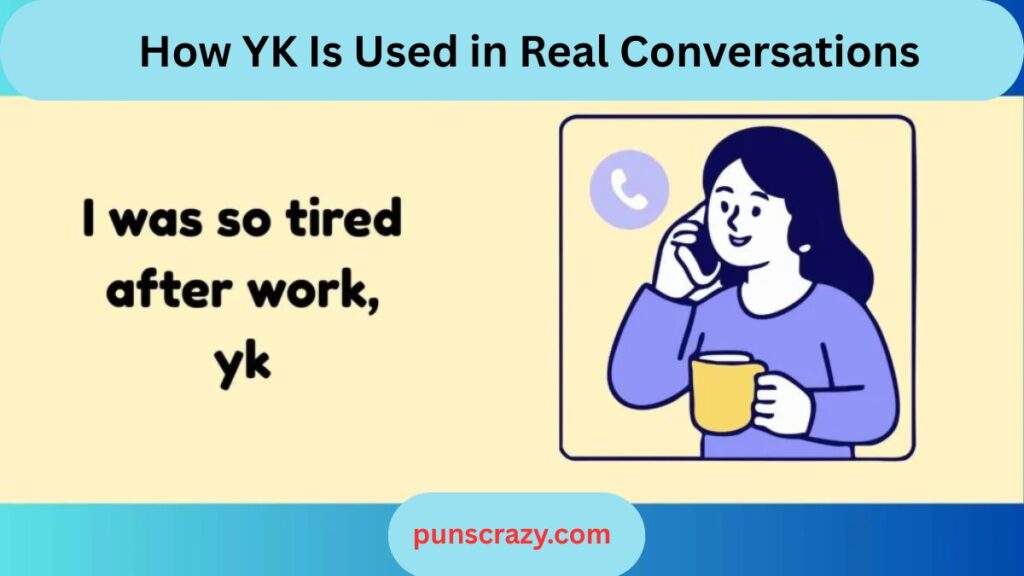
Among friends, YK is almost entirely about shared understanding. It pops up in everyday exchanges about mood, plans, or small frustrations:
- “Didn’t sleep well, yk how it is.”
- “We should just stay in tonight, yk?”
Social Media Captions & Comments
On platforms built around short bursts of text, YK helps a caption or comment feel more like a thought you’d actually say out loud rather than a polished statement. It’s common to see it paired with relatable, slightly self-deprecating captions: “That post-vacation Monday feeling, yk 😩.”
Gaming and Group Chats
In gaming chats — whether on Discord, Twitch, or in-game messaging — YK shows up as a quick way to confirm a shared plan without breaking focus: “YK the plan, let’s go,” or “yk what to do here.” Speed matters in live gameplay, and YK fits that pace perfectly.
Workplace and Semi-Formal Chats (and Why to Avoid It There)
YK occasionally creeps into informal internal team chats, especially among younger coworkers who default to texting habits. But it’s worth being deliberate here: YK is not appropriate for professional emails, client communication, or report submission. A message like “the report is due tomorrow, yk?” can come across as unclear or unprofessional in a workplace setting, where directness and clarity matter more than casual tone. Save it for internal messages between coworkers you already text casually — and even then, use it sparingly.
YK Across Platforms
While the core meaning of YK stays consistent, how it’s used shifts slightly depending on the platform.
| Platform | Common Usage | Typical Placement |
| Casual back-and-forth chats with friends and family | Mid-sentence, blending into longer messages | |
| Captions and comments meant to feel relatable | End of sentence, often paired with emojis | |
| TikTok | Comments agreeing with a video’s vibe or message | End of sentence, frequently emotional |
| Snapchat | Quick, low-effort replies in fast exchanges | Standalone or end of sentence |
| X (Twitter) & Discord | Short posts, gaming coordination, group chat banter | Anywhere, depending on context |
Across all of these, the underlying meaning — “you know” — doesn’t change. What shifts is the tone and purpose: TikTok and Instagram lean emotional and relatable, while Discord and gaming chats lean functional and fast.
YK on Dating Apps
What It Signals in a Dating Conversation
On apps like Tinder, Bumble, or Hinge, YK helps keep early conversations feeling light and low-pressure. It softens statements that might otherwise sound too forward or too serious, which matters in a context where tone is everything and there’s no body language to fall back on.
Example Openers and Replies
- “I’m bad at small talk, yk?” — disarms the conversation and invites a relaxed reply.
- “That moment when the photos don’t match the vibe, yk 😅” — humorous and relatable without being pointed.
When It Can Backfire
Overusing YK on a dating app can come across as vague or low-effort, especially in early conversations where the other person doesn’t yet share enough context to actually “know” what you mean. A message like “yk how it is” without any setup can leave a match confused rather than charmed. The fix is simple: use YK to add tone to a specific thought, not as a substitute for actually saying something.
Does YK Ever Mean Anything Else?
“You’re Kidding” — Rare, Context-Dependent Use
Occasionally, YK is used as shorthand for “you’re kidding,” typically in response to surprising news: “Wait, YK?!” This usage is far less common than “you know” and almost always needs surrounding context (like an exclamation point or a reaction to unexpected news) to read correctly. When in doubt, “you know” is the safer interpretation.
YK vs. YKK — Why People Confuse Them
This is a genuinely useful distinction that gets skipped in most explanations: YKK is a real, well-known entity — the Japanese company famous for manufacturing the zippers found on jeans, jackets, and bags worldwide. It has nothing to do with texting slang. The confusion usually happens because both are short, all-caps strings of letters that people encounter without context. If you see “YKK” stamped on a zipper pull, that’s the company, not the slang.
Outside Texting Slang: Why YK Has No Standardized Meaning in Other Fields
It’s tempting to claim YK has secret meanings in fields like aviation, medicine, or engineering, but that’s not accurate, and it’s worth being honest about it rather than guessing. Outside of casual digital communication, “YK” does not have a standardized, widely recognized definition. Any field-specific use would be a localized shorthand within a single organization or document, not a general industry term — so it’s not something a general reader needs to memorize. If you encounter “YK” outside of a chat or comment section, the safest approach is to ask for clarification rather than assume it follows the texting definition.
Common Mistakes & Misconceptions
Assuming YK Always Means “You’re Kidding”
Because “you’re kidding” is a real (if rare) alternate meaning, some readers default to that interpretation first — which usually leads to a confused reply. Unless the message includes clear surprise or disbelief, “you know” is almost always the correct read.
Confusing YK with YKW, YKWIM, or IKYK
These look similar but mean different things:
- YKW = “you know what” (often the start of a bigger statement)
- YKWIM = “you know what I mean” (a stronger emphasis on shared understanding)
- IKYK = “if you know, you know” (implies an inside joke or niche reference)
Mixing these up is one of the most common sources of confusion in fast-moving chats.
Using YK in Formal Writing or Professional Emails
This bears repeating: YK does not belong in formal communication. It reads as too casual for business communication, academic writing, or client-facing messages, where clarity and professionalism matter more than tone-softening.
YK vs. Similar Slang Terms
| Abbreviation | Expanded Form | Primary Function |
| YK | You Know | Signals shared understanding or softens a statement |
| IK | I Know | Shows agreement or awareness |
| FR | For Real | Emphasizes sincerity or agreement |
| TBH | To Be Honest | Introduces a genuine, often blunt opinion |
| IMO | In My Opinion | Clarifies a personal viewpoint |
| FYI | For Your Information | Shares a fact, often neutrally |
| YOLO | You Only Live Once | Justifies a spontaneous or risky decision |
What makes YK different from most of these is that it rarely carries new information on its own. While TBH introduces an opinion and FYI shares a fact, YK mostly does relationship work — it builds rapport and assumes connection rather than delivering content. That’s why it so often appears as a tag at the end of a sentence rather than as the main point of a message.
How to Respond to YK
Casual, Low-Effort Replies
Most of the time, YK doesn’t require a thoughtful response — it’s an invitation for acknowledgment, not a question demanding analysis. Simple, natural replies work fine:
- “Absolutely, yk 😎”
- “Lol same fr”
- “True, can’t argue with that 😅”
- A relevant emoji on its own
Matching the Tone
If the message carries humor, match it with humor. If it’s emotionally vulnerable (“rough week, yk”), a warmer reply like “yeah, I get it” fits better than a joke.
When a Real Reply Is Expected vs. When It’s Just Filler
If YK follows a direct question (“You’re free Saturday, yk?”), a real answer is expected. If it’s tagged onto a relatable observation, a quick reaction is usually enough — overthinking the reply can actually feel more awkward than just keeping the exchange casual.
Is YK Still Trending in 2026?
Slang trends move fast, and plenty of abbreviations that felt essential a few years ago (remember when everyone used “totes” or “on fleek”?) have quietly faded out. YK has avoided that fate for one specific reason: it isn’t really “slang” in the trend sense — it’s a contraction of something people already say constantly in spoken English.
Why Simple Fillers Like YK Outlast Trendier Slang
Trend-driven slang terms tend to burn out because they’re tied to a specific meme, show, or cultural moment. YK isn’t tied to anything — it’s just a faster way to type a phrase people have used in conversation for decades. That makes it far more durable than terms that depend on staying culturally “fresh.”
Generational Use — Gen Z, Millennials, and Beyond
While Gen Z gets most of the credit for popularizing fast-paced texting shorthand, YK isn’t exclusive to younger users. Millennials who grew up texting through the SMS era are just as likely to use it, and because the underlying phrase (“you know”) is universal in English, it doesn’t carry the same generational stigma that more niche slang does.
Frequently Asked Questions
What does YK mean in texting?
YK means “you know.” It’s used to signal shared understanding, soften a statement, or invite quiet agreement from the person you’re texting.
Is YK only used by younger people?
No. While it’s especially common among Gen Z texters, millennials and other age groups use it too, since it’s simply a shorthand for a phrase (“you know”) that’s existed in spoken English for generations.
Can YK be rude or dismissive?
It can come across that way if the tone is abrupt or if it’s used to brush off a real question — for example, “do it now, yk?” can feel pushy without softer phrasing around it. Context and surrounding words matter more than the abbreviation itself.
Is YK appropriate for work chats?
Generally, no. It’s fine in casual, informal exchanges with coworkers you already text outside of official channels, but it should be avoided in professional emails, client communication, and formal business communication.
What’s the difference between YK and YKWIM?
YK simply means “you know,” while YKWIM means “you know what I mean” — a stronger, more specific emphasis that the listener should understand a particular point, not just relate generally.
Does YK mean “you’re kidding”?
Rarely, and only with clear contextual clues like surprise or disbelief (e.g., “Wait, YK?!”). In the vast majority of cases, especially when YK appears mid-sentence or at the end of a casual statement, it means “you know.”
Conclusion
YK might be one of the smallest pieces of slang in your group chat, but it does real conversational work: it builds familiarity, softens statements, and mimics the natural rhythm of spoken English in a format built for speed. Whether you’re seeing it on Instagram, TikTok, Snapchat, in a gaming lobby, or on a dating app, the meaning behind those two letters stays remarkably consistent — “you know.” Now that you know exactly how it works, where it came from, and how to use (or respond to) it naturally, you’ll never have to pause mid-scroll wondering what someone meant by it again.
You may also like:
BTA Meaning: What Does BTA Stand For?
Snow Bunny Meaning: What It Really Means Online & Beyond 2026
KMS Meaning in Text: The Real 2026 Guide to This Viral Slang Everyone Keeps Misreading

Will Jack is the creative mind behind Punscrazy, a humor-focused platform dedicated to clever wordplay and lighthearted entertainment. With a passion for puns and witty expressions, he curates and creates engaging content that brings smiles to readers around the world. His work blends creativity with simplicity, making humor accessible for everyday moments, social media captions, and casual fun.