You’re mid-conversation. Someone drops “SNM” and vanishes. Now you’re staring at three letters like they owe you an explanation. SNM Meaning in Text
Don’t worry — you’re not alone. SNM meaning in text has confused millions of people across every platform, every age group, every timezone. It looks simple. It isn’t always. And in 2026, it’s showing up everywhere — from Snapchat streaks to Discord servers to, somehow, Slack workspaces.
This guide breaks it all down. Every meaning. Every platform. And every context. By the end, you’ll know exactly what someone means when they send it — and exactly how to respond.
What Does SNM Mean in Text?
At its core, SNM is a texting shorthand — a chat acronym built for speed. It’s part of that long tradition of internet slang born from the need to say a lot with very little. Think “lol,” “brb,” “ngl” — same energy, different era.
The dominant snm definition is “Say No More.” It functions like a verbal nod — the kind you give someone when they’ve explained enough and you’ve already got the picture. No further elaboration required. Message received, understood, and acknowledged.
But here’s where it gets interesting: SNM isn’t a one-trick phrase. Its meaning shifts depending on who’s sending it, what platform they’re on, and what the conversation looks like. That’s what makes it both useful and genuinely confusing to anyone who hasn’t seen it before.
The phrase “say no more” itself has roots in British comedy — famously used in Monty Python’s Flying Circus as a winking signal of “I understand the unsaid thing.” Over time, it migrated into everyday speech, then into digital slang terms, eventually shrinking down to three letters sometime in the early 2010s. By 2026, it’s a fixture of viral chat slang across every major platform.
Every Real Meaning of SNM in Text — Ranked by How Often You’ll See It
“Say No More” — The One That Dominates
This is the snm text slang meaning you’ll encounter roughly 80% of the time. When someone sends you “SNM” after you’ve explained a situation, made a request, or set up a plan — they’re telling you they’re already on board. No more persuasion needed. No more context required.
It communicates full understanding slang in the most efficient way possible. Three letters, zero ambiguity — at least when the context is right.
Real conversation example:
“Hey can you hold my spot in line? I’ll be back in five.” “SNM.”
That’s it. Done. The conversation is over in the best possible way. The sender didn’t need to write “Of course, no worries, I’ll be right here, take your time” — because “SNM” said all of that in three characters.
This version thrives in casual texting between friends, in group chats, and anywhere the relationship is comfortable enough that short replies aren’t read as rude.
“So Not Me” — The Self-Aware, Humorous Version
This one’s personality-driven. When someone shares a meme, a vibe, a lifestyle choice, or a mood — and it’s wildly off-brand for the person reading it — “SNM” becomes “So Not Me.”
It’s the text equivalent of physically recoiling from something that doesn’t match your aesthetic. Used heavily on TikTok comment sections and Instagram DM threads, this version leans into the online vibe culture where identity expression happens fast and in shorthand.
Real conversation example:
“I woke up at 4:30am to journal and meditate before sunrise 🌅” “SNM 😂 I can’t even wake up for work”
The emoji does a lot of heavy lifting here. “SNM” with a crying-laughing face signals self-deprecating humor. Without it, the same reply could read as dismissive or cold — which is a key thing to understand about snm chat meaning across different emotional registers.
“Shoot ‘N’ Move” — The Gaming Community’s Version
This one the competitors missed. In gaming slang, particularly in first-person shooter communities on Discord and in-game voice chat, “SNM” sometimes means “Shoot ‘N’ Move” — a tactical shorthand for a basic FPS combat principle: fire and immediately reposition so you don’t get pinned down.
Real conversation example:
“Why do you keep dying in the same spot?” “I know, I know — SNM from now on.”
This usage stays firmly inside gaming communities and online communities built around multiplayer titles. It almost never bleeds into casual everyday texting. But if you’re active in those spaces, you’ll see it.
“So Not Much” — The Fading, Fringe Meaning
Occasionally, in very specific online subcultures, “SNM” gets used as “So Not Much” — typically as a response to “what’s up?” or “how’s it going?” It’s rare, it’s fading, and it’s mostly a regional internet quirk. Don’t bank on it. If someone sends you “SNM” as a greeting reply, they almost certainly mean “So Not Me” or they’re using a different interpretation entirely.
How SNM Shows Up in Real Conversations — Platform by Platform
The snm meaning in text shifts depending on where the text lives. Same three letters, very different energy.
iMessage and SMS — The Home Turf
In a direct one-on-one text thread, “SNM” reads as warm and efficient. It’s a quick reply that closes a loop without being dismissive. Between close friends, it signals trust — the kind where you don’t need to over-explain.
In group chats, it functions more like a public acknowledgment. One person asks, someone else answers with “SNM,” and the whole group gets it.
Instagram DMs and Comments — Where Tone Gets Slippery
In Instagram DMs, SNM works similarly to texting — it’s private, contextual, and relationship-driven. But in comments? That’s where it gets interesting.
“SNM” dropped on a public Instagram post can read as dismissive to people outside the original conversation. Someone who doesn’t know the context sees three letters and assumes shade. The platform slang dynamic on Instagram is inherently more performative — because strangers are watching.
Snapchat — Built for Speed
Snapchat’s ephemeral format is practically designed for SNM. The platform rewards fast, punchy communication. A 10-second snap, a quick “SNM” reply, and the conversation moves on. There’s no permanence, no overthinking. Snapchat replies in the SNM style fit the medium perfectly.
Discord and Gaming Servers — Functional and Fast
In multiplayer talk and forum abbreviations, SNM strips away all emotional nuance. It’s purely functional: “understood, let’s execute.” The gaming context rewards economy of language because people are, often literally, in the middle of something else.
Dating Apps — When SNM Gets Flirty
This is where snm meaning in text picks up a whole different charge. On dating apps like Hinge, Tinder, or Bumble, “SNM” can read as confident and attractive. It signals that the sender is decisive — someone who doesn’t over-explain or seek validation.
Real conversation example:
“I’ll plan the whole date, just tell me what you’re allergic to.” “SNM 😏”
That one reply communicates calm confidence. It’s flirty texting without being try-hard. The emoji does most of the emotional work — without it, the same “SNM” might land flat or dismissive. On dating slang-heavy platforms, tone awareness is everything.
Work Slack / Microsoft Teams — Tread Carefully
In professional chat and work messaging environments, SNM is a risk. Most workplaces don’t run on internet slang, and what reads as breezy and efficient among friends can read as unprofessional or even rude in a work thread.
The exception? High-energy startup cultures where the line between office slang and casual texting is intentionally blurred. Even then — read the room before you drop three-letter acronyms on your manager.
What to use instead in professional contexts:
- “Understood — I’ll handle it.”
- “Got it, I’m on it.”
- “No need to elaborate further, I’ve got this.”
Is SNM Rude, Flirty, or Just Misunderstood?
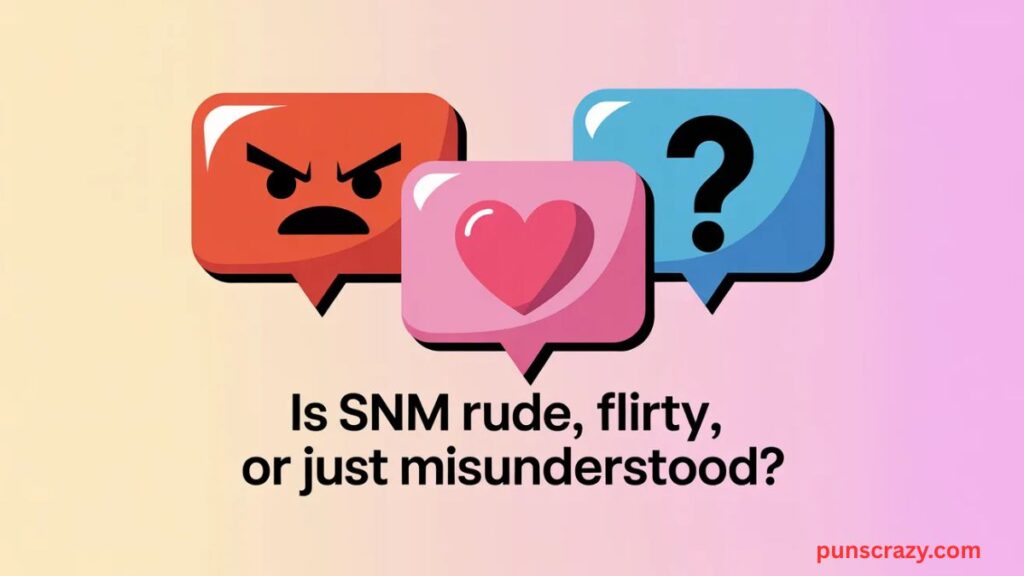
Here’s the honest answer: it depends entirely on context. SNM is one of those chat acronyms that carries almost no fixed emotional tone on its own. The tone is injected by the surrounding conversation, the relationship, and — crucially — whatever emoji or punctuation follows it.
When It Reads as Warm and Affirming
- Between close friends confirming plans
- As a reply to someone who’s over-explaining something simple
- Paired with an affirming emoji like 🙏 or 👌
- When the conversation has been friendly up to that point
When It Can Feel Cold or Dismissive
- Sent alone, with no emoji, to someone mid-emotional story
- As a reply to a long, heartfelt message — it can feel like a brush-off
- In contexts where the other person expected acknowledgment or engagement
The Flirty SNM
Used right, SNM in romantic chat contexts signals someone who’s calm, capable, and in control. It’s a flex disguised as a response. The key is pairing it with the right emoji and ensuring the conversation tone has already established some warmth.
Age Group Perception Table
Different generations genuinely decode this differently:
| Age Group | Likely Read on SNM |
| Gen Z (13–27) | Immediately understood as “Say No More” |
| Younger Millennials (28–35) | Familiar; probably uses it themselves |
| Older Millennials (36–43) | Mostly familiar; might Google it once |
| Gen X (44–59) | Often confused; may read as dismissive |
| Boomers (60+) | Typically unfamiliar; risks seeming rude |
This table matters. It’s why cross-cultural communication and generational gaps are listed as genuine risks with slang. The word that feels breezy and friendly to you can feel cold and alienating to someone outside your linguistic reference frame.
How to Respond When Someone Sends You SNM
First, figure out which SNM they sent. Was it “Say No More” — affirming and definitive? Or “So Not Me” — humorous and self-aware? The context usually makes it obvious within two seconds of re-reading the message.
Affirming Replies (When They Mean “Say No More”)
These match the energy without over-explaining:
- “Bet.”
- “Say less.” (the natural linguistic twin of SNM)
- “Already on it.”
- “You already know 🤝”
- “FR, we got this.”
Funny / Playful Replies
When the relationship allows for humor:
- “SNM yourself 😂”
- “Wait — actually say MORE, I’m lost 😭”
- “You SNM’d me into agreeing to this, didn’t you.“
Clarifying Replies (When You’re Not Sure Which SNM It Is)
Don’t guess wrong. Ask naturally:
- “Haha wait — is that a yes or are you roasting me?”
- “You good or nah?”
- “I’m gonna need you to SNM… explain that SNM 😭”
Professional Context — If It Slips Into Work Chat
Redirect smoothly without calling attention to the slang:
- “Ha — got it! I’ll send details over by end of day.”
- “Understood — I’ll take it from here.”
Common Misunderstandings About SNM
Slang confusion around SNM is real and widespread. Here are the four biggest mistakes people make.
Mistake: Thinking It Means Something Negative
SNM has no inherently negative meaning. In its dominant form (“Say No More”), it’s affirming. The confusion usually comes from its terseness — short replies can feel cold even when they’re not. Tone misinterpretation here is about brevity, not hostility.
Mistake: Confusing SNM with SMH
This happens constantly. “SMH” means “Shaking My Head” — it’s disapproving, frustrated, or exasperated. SNM is the opposite energy entirely. One is “I understand and agree,” the other is “I can’t believe this.” Misread abbreviations between these two can completely flip the meaning of a conversation.
Mistake: Overthinking the Tone
Sometimes “SNM” is just… “SNM.” Not a power move, not a brush-off, not loaded with subtext. Chat mistakes often happen when people project emotional depth onto what is literally a three-letter acknowledgment.
Mistake: Assuming Only Gen Z Uses It
SNM Gen Z slang is a common search phrase — but Millennials use it just as heavily. And increasingly, older users who’ve absorbed it through social media exposure use it too. Slang doesn’t respect generational borders the way people assume it does.
SNM vs. Similar Slang Terms You Should Know
SNM exists inside a whole ecosystem of agreement phrases and internet terms. Here’s how it stacks up against its closest neighbors:
| Slang | Full Meaning | Tone | Best Platform |
| SNM | Say No More | Affirming, casual | Universal |
| SMH | Shaking My Head | Disapproving | Twitter/X, texting |
| NVM | Never Mind | Dismissive | iMessage |
| IKR | I Know Right | Excited agreement | Snapchat |
| FR | For Real | Emphasis | All platforms |
| BET | Okay / Agreed | Confident affirm | Gen Z dominant |
| Say Less | Understood, no elaboration | Cool, effortless | All platforms |
| IYKYK | If You Know You Know | Exclusive/insider | TikTok, Instagram |
| NGL | Not Gonna Lie | Honest admission | All platforms |
| TBH | To Be Honest | Direct/candid | All platforms |
SNM vs. “Say Less” deserves a special mention. These two are near-identical in function — both mean “I understand, nothing more needs to be said.” The difference is cultural texture. “Say Less” feels slightly cooler, slightly more deliberate. “SNM” is faster to type and more casual. In practice, people use them interchangeably — but “Say Less” carries just a hair more swagger.
When You Should Put SNM Back in Your Pocket
Not every moment calls for snm internet slang. Knowing when not to use it is just as valuable as knowing what it means.
Formal Professional Communication
Emails to clients, performance reviews, formal proposals — hard no. Your professional image isn’t built on viral slang. Even if you’re in a startup where casual language is the norm, escalate your formality when the stakes escalate.
Serious or Emotionally Heavy Conversations
If someone’s venting, grieving, or sharing something vulnerable — responding with “SNM” is a fast track to coming across as dismissive. Read the emotional register of the conversation before you reach for shorthand.
Cross-Cultural or International Messaging
Digital communication across language barriers doesn’t support acronym slang well. A non-native English speaker won’t decode “SNM” intuitively — and what feels breezy to you might feel rude or confusing to them. Plain language is always the safer bet.
First Impressions
Slang signals familiarity. Deploy it only after you’ve established rapport. A first message on a dating app, a first email to a new colleague, a first reply to someone you’ve never talked to — these aren’t SNM moments.
Academic Writing and Official Documentation
This one’s obvious, but it’s worth saying: spell it out, always.
Frequently Asked Questions About SNM
What does SNM mean in text messages?
SNM most commonly means “Say No More” — a casual way of saying “I completely understand, no further explanation needed.” It can also mean “So Not Me” in humorous contexts.
Is SNM positive or negative?
It’s almost always positive or neutral. In its dominant form, SNM is affirming. It becomes potentially negative only when used dismissively in an emotionally sensitive conversation — and even then, the issue is tone, not the word itself.
Can SNM mean something other than “Say No More”?
Yes. It also means “So Not Me” (self-deprecating humor), “Shoot ‘N’ Move” in gaming communities, and occasionally “So Not Much” in fringe contexts. The surrounding conversation usually makes the intended meaning clear within seconds.
Does SNM work in professional settings?
Rarely. Most professional chat environments — client emails, formal Slack channels, official correspondence — don’t benefit from slang. Save it for casual, already-established relationships.
Is SNM the same as “Say Less”?
Similar, but not identical. Both mean “I understand, no more explanation needed.” “Say Less” carries slightly more swagger and deliberateness; SNM is faster and more casual. People use them interchangeably all the time, and that’s fine.
Which generation uses SNM the most?
Gen Z and younger Millennials (roughly 18–35) are the most frequent users. But the term has spread well beyond those brackets through social media exposure and digital messaging trends.
What’s the best reply to SNM?
Depends on context. For affirming “Say No More” usage: “Bet,” “Say less,” “Already on it.” For humorous “So Not Me” usage: match the humor with something equally self-aware.
Is SNM rude?
Not inherently. It reads as rude only when it’s used to dismiss someone mid-emotional conversation, or when the recipient doesn’t understand internet slang and reads terseness as hostility.
Where did SNM originate as slang?
The phrase “say no more” has been part of English colloquial speech for decades — with a famous comedic use in Monty Python’s Flying Circus in the 1970s. The acronym form “SNM” emerged in texting culture in the early 2010s and spread through social media into mainstream online slang by the mid-2020s.
Final Thoughts
SNM is a perfect example of how modern texting language works: small package, big payload. It compresses an entire emotional posture — understanding, agreement, readiness — into three characters.But like all casual texting shorthand, it’s only as clear as the context around it. The same “SNM” can mean “I’ve got you covered,” “that’s so not my vibe,” or “shoot and reposition” — depending entirely on who sent it, where, and why.
The takeaway? Context is king. Read the conversation before you read the acronym. And now that you’ve got the full picture, you’ll never be caught off guard by those three letters again.Spotted SNM somewhere unexpected? Drop it in the comments — the weirder the context, the better.

Will Jack is the creative mind behind Punscrazy, a humor-focused platform dedicated to clever wordplay and lighthearted entertainment. With a passion for puns and witty expressions, he curates and creates engaging content that brings smiles to readers around the world. His work blends creativity with simplicity, making humor accessible for everyday moments, social media captions, and casual fun.