Have you ever received a text saying “Habibi” and wondered what the actually Habibi Meaning?
Maybe you heard it in a song, spotted it in a comment section, or saw it everywhere on TikTok. The word appears constantly across the internet, yet many people still misunderstand its true meaning.
At first glance, Habibi seems simple. However, this popular Arabic term carries layers of emotion, culture, and context that don’t always translate directly into English. Depending on who says it and how they say it, Habibi can mean “my love,” “my dear,” “my friend,” or simply express warmth and affection.
Today, the word has expanded far beyond the Arab world. You’ll hear it in music, see it in social media captions, find it in memes, and even encounter it on dating apps like Tinder, Bumble, and Hinge.
This guide explains the complete habibi meaning, its history, pronunciation, cultural significance, and the right way to use it naturally in 2026.
What Does Habibi Mean?
The simplest habibi definition is:
Habibi means “my beloved,” “my dear,” “my love,” or “dear one” in Arabic.
It is one of the most common expressions of affection across the Arabic-speaking world.
The word comes from the Arabic root associated with love and affection. Because of that, it functions as both a literal and emotional expression.
Literal Translation of Habibi
In English, the closest translations include:
- My beloved
- My love
- My dear
- Darling
- Sweetheart
- Dear friend
No single translation perfectly captures the full meaning.
That is where many misunderstandings begin.
Unlike some English expressions that have only one purpose, Habibi works in many situations. A husband may call his wife Habibi. A father may call his son Habibi. Friends might greet each other using the same word.
Context changes everything.
Habibi Meaning in English
The most accurate habibi translation depends on the relationship between the speakers.
| Situation | Meaning in English |
|---|---|
| Romantic relationship | My love |
| Married couple | Darling |
| Close friendship | My friend |
| Parent to child | My dear |
| Casual affection | Dear one |
| Hospitality setting | My friend |
This flexibility explains why the word remains so popular.
Many Arabic speakers use it naturally throughout the day without giving it a second thought.
The Root Word Behind Habibi
To fully understand the Arabic word Habibi, it helps to look at its linguistic roots.
Arabic words often originate from three-letter roots that carry a central meaning.
Habibi comes from:
H-B-B (حب)
- Love
- Affection
- Attachment
- Liking
- Emotional closeness
From this root comes:
Hubb (حب)
which means:
Love
The connection between Habibi and Hubb explains why the word feels warm and personal.
Why the Translation Isn’t Always Exact
Many people search:
- What does Habibi mean?
- What does Habibi mean in English?
- What does Habibi mean from a guy?
- What does Habibi mean from a girl?
The answer isn’t always identical.
Imagine the English word “dear.”
You might say:
- Dear friend
- Dear customer
- Dear wife
- Dear son
The word remains the same, yet the emotional meaning changes.
Habibi works similarly.
That cultural flexibility makes it one of the most recognizable Arabic affectionate words in the world.
Quick Facts About Habibi
| Fact | Detail |
|---|---|
| Language | Arabic |
| Literal Meaning | My beloved |
| Root | H-B-B (Love) |
| Type | Term of endearment |
| Gender Form | Masculine |
| Female Version | Habibti |
| Common Regions | Middle East & North Africa |
| Formal or Informal | Mostly informal |
| Romantic Only? | No |
Habibi Pronunciation: How to Say It Correctly
Knowing the habibi pronunciation helps you sound more natural and respectful.
The standard pronunciation is:
Ha-bee-bee
Phonetically:
hah-BEE-bee
The emphasis usually falls on the second syllable.
Standard Arabic Pronunciation
In Modern Standard Arabic:
حبيبي
The word consists of:
- ح (Ha)
- ب (Ba)
- ي (Ya)
- ب (Ba)
- ي (Ya)
Native speakers pronounce the first sound deeper than the English “h.”
However, non-Arabic speakers can safely use a simple “ha” sound.
Common Pronunciation Mistakes
Many learners accidentally say:
- Huh-bib-ee
- Hab-eye-bee
- Hay-bee-bee
These versions sound unnatural.
The easiest way to remember it:
Habibi rhymes loosely with “baby” repeated twice.
Pronunciation Tips for English Speakers
Follow these steps:
- Say “ha.”
- Add “bee.”
- Add another “bee.”
- Stress the middle syllable.
Result:
Ha-BEE-bee
After hearing it a few times in Arabic songs or videos, the pronunciation becomes second nature.
Where Does Habibi Come From?
The story behind Habibi stretches back centuries.
Its roots lie deep within Arabic linguistic history and the broader family of Semitic language traditions.
Arabic Language Origins
Arabic belongs to the Semitic language family, which also includes:
- Hebrew
- Aramaic
- Amharic
Many Semitic languages build words from root systems.
Habibi emerged from the root associated with affection and emotional attachment.
This system has existed for thousands of years.
As a result, the word carries a rich linguistic heritage rather than being modern slang.
The Meaning of the H-B-B Root
The foundation of the word comes from:
Hubb (حب)
Meaning:
Love
When Arabic adds a possessive suffix, the meaning changes.
Habib = Beloved
Habibi = My beloved
That small grammatical change transforms a general description into a personal expression.
Cultural Origin of Habibi
The cultural origin of Habibi is closely tied to Arab family life and communication traditions.
In many Arab societies:
- Warm greetings are common.
- Affectionate language is encouraged.
- Relationships often emphasize closeness.
- Hospitality plays a major role.
Because of these values, words like Habibi became everyday expressions.
A shopkeeper may call a customer Habibi.
An older relative may call a younger family member Habibi.
Friends often use it without any romantic meaning.
This broad usage surprises many English speakers.
Habibi Across the Arabian Peninsula
The word appears throughout the:
- Saudi Arabia
- United Arab Emirates
- Qatar
- Bahrain
- Kuwait
- Oman
- Yemen
It also remains common in:
- Egypt
- Lebanon
- Jordan
- Syria
- Palestine
- Morocco
- Tunisia
- Algeria
While accents vary, the meaning stays remarkably consistent.
How Habibi Became Popular Worldwide
Several factors helped spread the word internationally.
Arabic Music
Popular singers frequently use Habibi in lyrics.
The term appears in countless love songs and dance tracks.
Because music travels easily across borders, audiences worldwide became familiar with the word.
Dubai Tourism
As Dubai tourism exploded during the last two decades, visitors encountered Arabic greetings and expressions more frequently.
Many tourists returned home already knowing words like:
- Habibi
- Yalla
- Shukran
Egyptian Films and TV
For decades, Egypt films and television productions influenced audiences throughout the Arab world.
These productions often featured Habibi in romantic and family dialogue.
Social Media Expansion
The biggest leap came through modern platforms.
Today’s users encounter Habibi through:
- TikTok
- Snapchat
- YouTube
Millions of videos now feature the word daily.
As a result, global awareness continues to grow.
What Does Habibi Mean in Different Contexts?
One reason the habibi meaning confuses people is that it changes according to the relationship between speakers.
Let’s explore the most common situations.
Between Romantic Partners
This is the meaning most non-Arabic speakers recognize first.
A boyfriend may say:
Habibi, I missed you.
A wife might say:
Habibi, how was your day?
In these situations, Habibi often means:
- My love
- Darling
- Sweetheart
- My beloved
This usage carries genuine emotional warmth.
Between Friends
Among friends, the meaning shifts dramatically.
For example:
Habibi, let’s grab coffee.
Here, the speaker isn’t expressing romantic interest.
Instead, the word acts as an affectionate term similar to:
- Buddy
- Friend
- Mate
- Bro
Many men in Arab countries routinely call close male friends Habibi.
Between Family Members
Family members frequently use Habibi.
Examples include:
- Parent to child
- Grandparent to grandchild
- Siblings
- Cousins
In these cases, the word expresses love and affection rather than romance.
As a Term for Children
Many Arabic-speaking parents call their children:
- Habibi
- Habibti
This usage resembles English expressions such as:
- Sweetie
- Honey
- My dear
Children hear these words from a very young age.
In Hospitality Settings
Arab hospitality traditions often encourage warm communication.
You might hear:
Welcome, Habibi.
or
Come sit down, Habibi.
The speaker isn’t flirting.
Instead, they’re creating a friendly atmosphere.
Humorous and Playful Usage
Online culture has created entirely new uses.
Today, people use Habibi in:
- Viral memes
- Gaming chats
- Comedy videos
- Friendly jokes
For example:
Habibi, what was that driving?
The word adds humor and familiarity rather than affection.
Is Habibi Romantic?
One of the most searched questions online is:
Is Habibi romantic?
The answer is:
Sometimes yes. Sometimes no.
Understanding context is essential.
When Habibi Means “My Love”
In romantic relationships, Habibi often functions exactly as:
- My love
- Darling
- Sweetheart
- Baby
Examples:
- Spouses affection
- Long-term relationships
- Fiancés
- Couples
Here, the emotional meaning is obvious.
When It Doesn’t Mean Romance
Now consider this sentence:
Habibi, pass the salt.
If spoken between brothers, there is no romantic implication whatsoever.
Similarly:
Thanks, Habibi.
could simply mean:
Thanks, my friend.
Signs Habibi Is Being Used Romantically
Look for surrounding clues.
These include:
- Heart emojis
- Romantic language
- Private conversations
- Flirty texts
- Dating context
- Relationship status
Together, these signals create an intimate context.
Signs Habibi Is Being Used Casually
Indicators include:
- Group chats
- Family conversations
- Friendly greetings
- Hospitality settings
- Work acquaintances
In these situations, the word functions as a warm social expression.
Case Study: Same Word, Different Meaning
| Scenario | Meaning |
|---|---|
| Wife texting husband “Good night Habibi” | Romantic |
| Friend texting friend “Thanks Habibi” | Friendly |
| Mother speaking to son | Family affection |
| Shopkeeper greeting customer | Hospitality |
| Meme creator joking online | Humorous |
This flexibility explains why Habibi remains one of the most versatile words in modern Arabic communication.
Key Takeaways So Far
Before moving on, here’s what you should remember:
- Habibi meaning literally translates to my beloved.
- It is a widely used term of endearment.
- The word comes from the Arabic root for love, Hubb.
- Habibi is not always romantic.
- Friends, family members, and even strangers may use it.
- The female version is Habibti.
- The term spread globally through music, travel, and social media.
- Context determines the exact meaning every time.
Habibi vs Habibti: What’s the Difference?
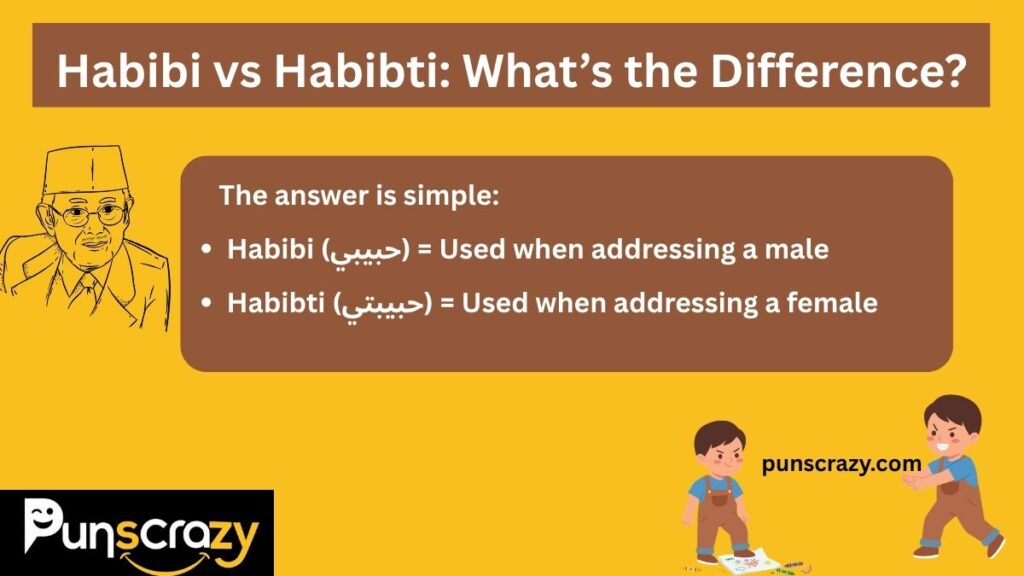
One of the most common questions people ask after learning the habibi meaning is:
What is the female version of Habibi?
The answer is simple:
- Habibi (حبيبي) = Used when addressing a male
- Habibti (حبيبتي) = Used when addressing a female
Both words come from the same root and carry the same emotional warmth. The difference is grammatical rather than emotional.
Meaning of Habibi
The word Habibi translates most closely to:
- My beloved
- My dear
- My love
- Darling
When speaking directly to a man, Arabic speakers typically use Habibi.
Examples:
Thank you, Habibi.
How are you today, Habibi?
I missed you, Habibi.
Meaning of Habibti
The habibti meaning is almost identical.
It also means:
- My beloved
- My dear
- My love
- Darling
However, speakers use it when addressing a woman.
Examples:
Good morning, Habibti.
You’re amazing, Habibti.
I love you, Habibti.
Why Arabic Uses Different Forms
Arabic is a gendered language.
Many nouns, adjectives, and expressions change depending on whether the person being addressed is male or female.
This isn’t unique to Habibi.
You’ll see similar patterns throughout Arabic vocabulary.
Habibi vs Habibti at a Glance
| Feature | Habibi | Habibti |
|---|---|---|
| Arabic | حبيبي | حبيبتي |
| Gender | Male | Female |
| Meaning | My beloved | My beloved |
| Romantic Use | Yes | Yes |
| Friendly Use | Yes | Yes |
| Family Use | Yes | Yes |
Common Mistake Non-Arabic Speakers Make
Many learners assume Habibi works for everyone.
Technically, native speakers often understand the intent. However, using the correct form sounds much more natural.
For example:
- To a man → Habibi
- To a woman → Habibti
That small detail instantly improves your Arabic communication.
Other Arabic Terms Similar to Habibi
Arabic contains many beautiful expressions of affection.
While Habibi remains the most famous internationally, several alternatives appear regularly in everyday speech.
Understanding these expressions helps you appreciate the richness of Arabic communication.
Habibi vs Hayati
Hayati (حياتي) literally means:
My life
Many Arabic speakers use it as a deeply affectionate phrase.
Examples:
Thank you, Hayati.
I miss you, Hayati.
Compared with Habibi:
| Habibi | Hayati |
|---|---|
| My beloved | My life |
| Very common | Common |
| Friendly or romantic | Usually more emotional |
| Universal usage | Often more intimate |
Habibi vs Qalbi
Qalbi (قلبي) means:
My heart
This expression often carries stronger emotional weight.
Examples:
You are my heart, Qalbi.
Thank you, Qalbi.
Many couples use Qalbi as a romantic nickname.
Habibi vs Rouhi
Rouhi (روحي) means:
My soul
Among Arabic love expressions, Rouhi ranks among the most intimate.
Because it refers to someone’s soul, it often conveys profound affection.
Examples:
I can’t wait to see you, Rouhi.
Good night, Rouhi.
Habibi vs Azeezi
Azeezi (عزيزي) translates roughly to:
My dear
This expression often sounds slightly more formal.
You may hear it in:
- Business communication
- Friendly conversation
- Written correspondence
Comparison Table of Popular Arabic Affectionate Words
| Arabic Term | English Meaning | Common Usage |
|---|---|---|
| Habibi | My beloved | Universal |
| Habibti | My beloved | Universal |
| Hayati | My life | Romantic |
| Qalbi | My heart | Romantic |
| Rouhi | My soul | Deep affection |
| Azeezi | My dear | Friendly/formal |
Which Term Is Most Common?
Across the Arab world, Habibi remains the most versatile.
That’s why it appears more frequently in:
- Songs
- Movies
- Social media posts
- Everyday conversations
Its flexibility gives it an advantage over more specialized expressions.
How Arabs Actually Use Habibi in Daily Life
Many online articles explain the dictionary meaning but fail to show how people genuinely use the word.
In reality, Habibi appears constantly in daily conversation.
For native speakers, using the word often feels as natural as saying “friend” or “dear.”
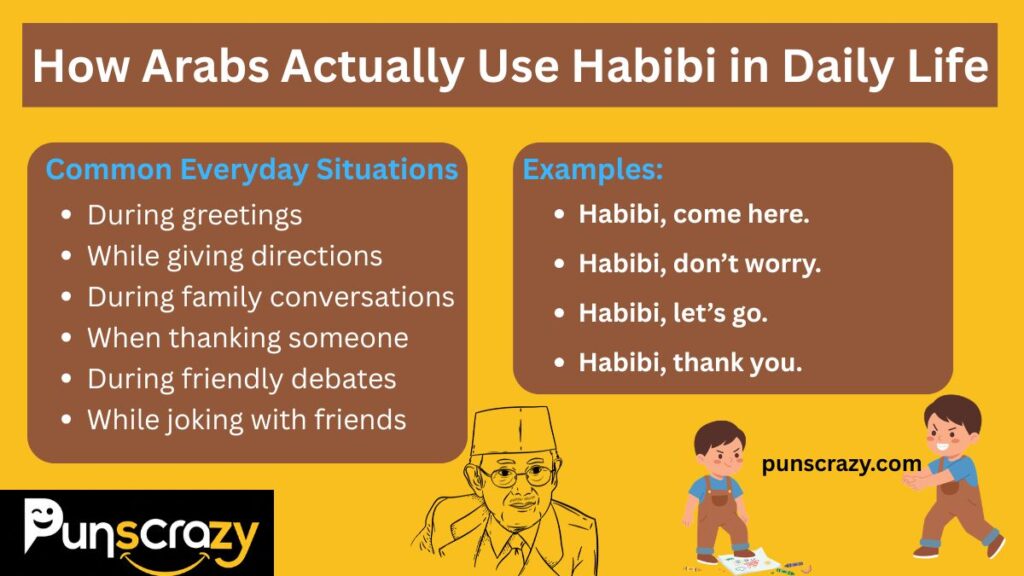
Common Everyday Situations
You may hear Habibi:
- During greetings
- While giving directions
- During family conversations
- When thanking someone
- During friendly debates
- While joking with friends
Examples:
Habibi, come here.
Habibi, don’t worry.
Habibi, thank you.
Habibi, let’s go.
Common Arabic Phrases Containing Habibi
Several popular expressions include the word.
| Phrase | Meaning |
|---|---|
| Ya Habibi | Oh my beloved |
| Shukran Habibi | Thank you, my dear |
| Sabah Al Khair Habibi | Good morning, my beloved |
| Masa Al Khair Habibi | Good evening, my beloved |
| Ahlan Habibi | Welcome, my dear |
Habibi in Family Conversations
Family interactions represent one of the most common uses.
Parents frequently say:
Come here, Habibi.
Grandparents often use it as well.
The term creates emotional closeness without sounding overly formal.
Habibi Among Male Friends
Many Western audiences find this usage surprising.
In numerous Arab countries, men comfortably address close male friends as Habibi.
There is usually no romantic implication.
Instead, the word expresses:
- Trust
- Brotherhood
- Familiarity
- Respect
This reflects broader values within Arab culture, where warm interpersonal communication is often encouraged.
Habibi in Business and Hospitality
Although primarily informal, Habibi occasionally appears in customer interactions.
For example:
Welcome, Habibi.
What can I get for you, Habibi?
This usage reflects hospitality rather than personal affection.
In regions famous for hospitality traditions, such as the Gulf states and parts of the Levant, visitors may hear the word frequently.
Regional Differences in Usage
The overall meaning remains stable across the Arab world.
However, frequency varies.
| Region | Usage Frequency |
|---|---|
| Lebanon | Very common |
| Egypt | Very common |
| UAE | Common |
| Saudi Arabia | Common |
| Jordan | Very common |
| Morocco | Moderate |
| Tunisia | Moderate |
Lebanon Greetings and Everyday Speech
In many Lebanon greetings, Habibi appears naturally.
People often use it with:
- Friends
- Relatives
- Neighbors
The expression helps maintain warmth in conversation.
Egypt Films and Popular Culture
Classic and modern Egypt films helped popularize Habibi throughout the Arabic-speaking world.
Many iconic romantic scenes feature the word.
As Egyptian cinema expanded internationally, so did awareness of Habibi.
Habibi Meaning on Social Media
The rise of social media dramatically expanded the global popularity of Habibi.
Millions of users now encounter the word online before ever hearing it in person.
This shift changed how many people understand the expression.
Habibi Meaning on TikTok
The phrase habibi meaning on TikTok generates thousands of searches every month.
On TikTok, users often employ Habibi in:
- Comedy videos
- Travel content
- Couple content
- Dance videos
- Voiceovers
- Trending sounds
Many creators use the word because it sounds warm, catchy, and culturally distinctive.
Why Habibi Became a Viral TikTok Trend
Several factors contributed to the viral TikTok phenomenon.
These include:
- Arabic music tracks
- Short-form video culture
- International creators
- Easy pronunciation
- Meme potential
Combined, these factors produced major social virality.
Habibi Meaning on Instagram
On Instagram, Habibi frequently appears in:
- Captions
- Stories
- Reels
- Relationship posts
- Travel content
Common examples include:
Dubai, Habibi.
Miss you, Habibi.
My favorite person, Habibi.
These uses generally signal affection or admiration.
Habibi Meaning in Instagram Comments
In Instagram comments, users often write:
- Habibi ❤️
- Thanks Habibi
- Looking great Habibi
The tone is usually positive and friendly.
Habibi Meaning on WhatsApp
The phrase habibi meaning on WhatsApp often relates to personal conversations.
In WhatsApp chats, Habibi commonly appears between:
- Couples
- Friends
- Family members
Examples:
Good morning, Habibi.
Drive safely, Habibi.
See you later, Habibi.
Because WhatsApp focuses on private communication, the word often carries stronger emotional weight.
Habibi Meaning on Snapchat
Snapchat usage differs slightly.
The word often appears in:
- Streak messages
- Private snaps
- Couple interactions
- Flirty exchanges
In many cases, context determines whether the word signals friendship or attraction.
Habibi in Songs, Memes, and Pop Culture
The internet transformed Habibi from a regional expression into a global phenomenon.
Today, countless users recognize the word without speaking Arabic.
Arabic Music and Global Exposure
One major reason is Arabic music.
For decades, singers across the Middle East have incorporated Habibi into lyrics.
Because the word sounds melodic and emotionally expressive, it works well in music.
Many listeners learn the word through songs before learning its meaning.
Habibi in Viral Memes
The phrase also became popular through viral memes.
Popular meme formats often combine Habibi with:
- Exaggerated reactions
- Travel jokes
- Dubai references
- Gaming humor
Examples include:
Come to Dubai, Habibi.
Relax, Habibi.
Trust me, Habibi.
The Dubai Meme Effect
One phrase became particularly famous:
Dubai, Habibi.
Although often humorous, the phrase helped introduce millions of people to Arabic vocabulary.
As content creators repeated it, global familiarity increased.
Trending Sounds and Dance Videos
Many trending sounds feature Arabic lyrics containing Habibi.
These sounds spread through:
- Dance videos
- Comedy clips
- Lifestyle content
- Travel reels
As users reused the audio, the word reached entirely new audiences.
Why Habibi Became Globally Recognizable
Several factors combined to create worldwide popularity:
- Music exposure
- Travel culture
- Internet memes
- TikTok influence
- Influencer content
- Social sharing
The result is remarkable.
Few Arabic expressions enjoy the same level of international recognition.
Popularity of Habibi in the Digital Age
The internet has dramatically increased search interest surrounding Habibi.
Many users now search:
- What does Habibi mean?
- Is Habibi romantic?
- Habibi meaning in text
- Habibi meaning on TikTok
- Female version of Habibi
Google Trends and Search Growth
Data from Google Trends consistently shows recurring spikes in interest.
These viral spikes often occur when:
- Songs go viral
- TikTok trends emerge
- Memes gain traction
- Influencers use the term
Popularity Over Time
The word has experienced sustained growth because it connects with audiences emotionally.
Unlike many internet slang terms that disappear quickly, Habibi possesses:
- Historical depth
- Cultural significance
- Linguistic authenticity
That combination helps maintain long-term popularity.
Global Queries Continue to Rise
Today, Habibi attracts searches from:
- North America
- Europe
- Asia
- Australia
- South America
This global curiosity demonstrates how a centuries-old Arabic expression successfully adapted to modern digital culture.
Key Takeaways
- Habibi vs Habibti depends on the gender of the person being addressed.
- Habibti is the female version of Habibi.
- Similar Arabic expressions include Hayati, Qalbi, Rouhi, and Azeezi.
- Habibi appears constantly in daily conversation throughout the Arab world.
- The word is extremely common on TikTok, Instagram, WhatsApp, and Snapchat.
- Music, memes, and travel content accelerated global popularity.
- The expression remains one of the most recognizable examples of an Arabic term of endearment worldwide.
Can Non-Arabic Speakers Say Habibi?
As the word continues spreading through music, travel, and social media, many people wonder whether it’s appropriate for non-Arabic speakers to use it.
The short answer is:
Yes, non-Arabic speakers can say Habibi.
However, context and cultural awareness matter.
Using the word respectfully usually receives a positive response. Using it randomly without understanding its meaning can sometimes sound forced or awkward.
Why Many Non-Arabic Speakers Use Habibi
People often learn the expression through:
- Arabic music
- International friendships
- Travel experiences
- Movies and television
- TikTok videos
- Online conversations
Because Habibi conveys warmth and friendliness, it naturally appeals to people outside the Arab world.
When Habibi Sounds Natural
The word generally feels natural when:
- Speaking with close friends who use it
- Talking with Arabic-speaking family members
- Participating in cultural exchanges
- Using it in a playful and respectful way
- Communicating with someone who already uses the term
Examples:
Thank you, Habibi.
Good to see you, Habibi.
Have a great day, Habibi.
When Habibi Can Feel Awkward
Problems usually arise when people use the word excessively.
For example:
- Calling strangers Habibi immediately
- Using it in every sentence
- Using it without understanding the meaning
- Assuming all Arabic speakers use it identically
Just because a phrase appears in memes doesn’t mean it fits every real-life situation.
Understanding Cultural Nuance
One of the most important aspects of the habibi cultural meaning is understanding cultural nuance.
Language reflects relationships.
A word that sounds perfectly natural between family members may sound unusual between strangers.
When in doubt, observe how native speakers use it.
That approach almost always works best.
Common Mistakes People Make With Habibi
The growing popularity of Habibi has created several misconceptions.
Let’s clear up the most common ones.
Assuming Habibi Is Always Romantic
This is probably the biggest misunderstanding.
Many people hear Habibi in love songs and conclude it always means:
- Boyfriend
- Girlfriend
- Lover
In reality, friends, relatives, and even shopkeepers may use the word.
The relationship determines the meaning.
Confusing Habibi and Habibti
Another common mistake involves gender.
Remember:
- Habibi = addressing a male
- Habibti = addressing a female
Using the wrong form won’t usually cause major confusion, yet using the correct one sounds more natural.
Treating Habibi as Internet Slang
Some people assume Habibi emerged from TikTok.
That’s not true.
The word existed for centuries before social media.
Unlike temporary internet slang, Habibi has deep roots in Classical Arabic and broader Middle Eastern culture.
Believing It Means the Same Everywhere
Arabic includes numerous regional dialects.
Although Habibi generally retains its core meaning, usage patterns differ between countries.
For example:
- Lebanon greetings may use it frequently.
- Egyptian speakers may use it casually.
- Gulf speakers may use it differently depending on the setting.
The core idea remains the same. The frequency varies.
Overusing Habibi
Because the word sounds appealing, some learners start using it constantly.
Imagine calling everyone “darling” all day.
Eventually, it sounds unnatural.
Moderation matters.
Assuming Habibi Equals Flirting
Many searches focus on:
- Is Habibi romantic?
- Is Habibi flirting?
- What does Habibi mean from a guy?
- What does Habibi mean from a girl?
The answer depends entirely on context.
Sometimes it’s flirting.
In some cases, it’s friendship.
Sometimes it’s family affection.
The surrounding conversation provides the real clue.
How to Respond When Someone Calls You Habibi
Another popular search query is:
How should I respond when someone calls me Habibi?
The best response depends on the relationship.
Friendly Responses
If a friend says Habibi, you can respond warmly.
Examples:
- Thanks, Habibi.
- Appreciate it, Habibi.
- You’re the best.
- Anytime, my friend.
These responses maintain the friendly tone.
Romantic Responses
When a romantic partner uses Habibi, you can answer affectionately.
Examples:
- Miss you too, Habibi.
- Love you, Habibi.
- You’re my favorite person.
- Can’t wait to see you.
In romantic settings, the emotional meaning becomes clear.
Casual Responses
Sometimes no special response is needed.
For example:
Habibi, how are you?
You might simply answer:
I’m good, thank you.
The conversation flows naturally.
Flirty Responses
On dating apps such as Tinder, Bumble, or Hinge, Habibi occasionally appears in flirty messages.
Examples include:
Looking great, Habibi.
Good morning, Habibi.
Potential responses:
- You’re sweet.
- That’s cute.
- You’re making me smile.
- I like that nickname.
Again, context matters.
Respectful Responses
If you’re unsure about the intention, keep your reply neutral.
Examples:
- Thank you.
- Appreciate it.
- That’s kind of you.
- Nice to hear from you.
These responses work in almost every situation.
Habibi Meaning in Dating Apps and Online Conversations
The rise of online communication has created entirely new contexts for Habibi.
Today, users encounter the word across:
- Tinder
- Bumble
- Hinge
- Snapchat
Habibi on Tinder and Bumble
When used on Tinder Bumble conversations, Habibi often signals attraction.
Examples:
Good morning, Habibi.
How’s your day going, Habibi?
These messages often feel warmer than standard greetings.
However, the word alone doesn’t confirm romantic interest.
Many Arabic speakers use it naturally regardless of romantic intent.
Habibi as a Hinge Signal
Some users interpret Habibi as one of several Hinge signals indicating interest.
Common accompanying signs include:
- Frequent messaging
- Compliments
- Heart emojis
- Personal questions
- Continued engagement
Together, these cues suggest attraction more clearly than the word itself.
Habibi in Warm Chats
In warm chats, Habibi creates a sense of familiarity.
It softens conversations and helps establish rapport.
That’s one reason the word remains popular in online communication.
Habibi Meaning in Text Messages
When people search for habibi meaning in text, they usually want to know whether someone is expressing affection.
Possible meanings include:
- Friendship
- Admiration
- Warmth
- Attraction
- Love
Again, context determines the answer.
Frequently Asked Questions About Habibi
What does Habibi mean in English?
The most common English translations include:
- My beloved
- My love
- My dear
- Darling
The exact meaning depends on the relationship and context.
What does Habibi mean in Arabic?
The Arabic word Habibi literally means:
My beloved
It comes from the root associated with love and affection.
Is Habibi romantic?
Sometimes.
A romantic partner may use Habibi to mean “my love.”
Friends and family members may use the same word without romantic intent.
What is the female version of Habibi?
The female version is:
Habibti
Arabic speakers use Habibti when addressing a woman.
What is the difference between Habibi and Habibti?
The difference is grammatical.
| Word | Used For |
|---|---|
| Habibi | Male |
| Habibti | Female |
Both share the same core meaning.
What does Habibi mean from a guy?
A man may use Habibi to express:
- Friendship
- Affection
- Respect
- Romance
The surrounding context determines which meaning applies.
What does Habibi mean from a girl?
A woman may use Habibi in the same ways:
- Friendly affection
- Family affection
- Romantic affection
Again, context is essential.
Can friends say Habibi?
Absolutely.
Across the Arab world, friends frequently use Habibi.
Many uses have nothing to do with romance.
Is Habibi slang?
No.
Although many people encounter it online, Habibi is a genuine Arabic word with centuries of history.
Can I call someone Habibi?
Yes.
However, it’s usually best to reserve it for people you know rather than complete strangers.
What does Habibi mean on TikTok?
On TikTok, Habibi often appears in:
- Comedy content
- Couple videos
- Travel videos
- Trending sounds
- Dance clips
The meaning usually remains “my dear” or “my beloved.”
Why do Arabs say Habibi so often?
Many Arabic-speaking cultures value warm communication.
Habibi serves as a versatile expression of affection, friendliness, and hospitality.
What does Habibi mean in relationships?
In relationships, Habibi often means:
- My love
- Darling
- Sweetheart
- My beloved
It is one of the most common romantic nicknames in Arabic.
Key Takeaways About Habibi Meaning
Before wrapping up, here are the most important points.
Habibi Is More Than a Translation
The word carries emotional depth that simple English translations cannot fully capture.
Context Changes Everything
The same word may mean:
- My love
- My friend
- My dear
- My beloved
Understanding the relationship between speakers is crucial.
Habibi Is Not Just Romantic
Friends, family members, and acquaintances often use the word.
Habibti Is the Female Form
If you’re addressing a woman, Habibti is generally the correct choice.
Social Media Accelerated Global Popularity
Platforms such as:
- TikTok
- Snapchat
introduced Habibi to millions of people worldwide.
The Word Reflects Arabic Culture
The expression embodies values often associated with Arab hospitality, emotional warmth, and interpersonal connection.
Conclusion
The true habibi meaning goes far beyond a simple dictionary definition. While the word literally translates to my beloved, its real power comes from how people use it in everyday life.
Across the Arab world, Habibi functions as a versatile term of endearment that can express friendship, family affection, hospitality, admiration, or romantic love. A parent may say it to a child. Friends may use it casually. Couples may use it as a deeply personal nickname.
That flexibility explains why the Arabic term continues to resonate globally.
Thanks to music, travel, movies, memes, and social media, Habibi has become one of the most recognized Arabic expressions in the world. Yet despite its worldwide popularity, its heart remains the same. The word represents warmth, connection, affection, and genuine human closeness.
Whether you encounter Habibi in a text message, a TikTok video, an Instagram comment, or a real-life conversation, understanding the context will help you understand the meaning.
And most of the time, if someone calls you Habibi, it’s a sign that they’re speaking with kindness.