
If you’ve landed here after seeing PTSO in a text, a school newsletter, or a work email, you’re probably wondering which version is the real one. Here’s the short answer: PTSO most commonly and verifiably stands for Parent Teacher Student Organization — a school-based group that connects parents, teachers, and students around fundraising, events, and communication. You may also see PTSO used informally online as a texting or chat abbreviation, but unlike the school meaning, there’s no single, agreed-upon definition for that usage yet.
This guide breaks down both sides clearly: the documented, real-world meaning of PTSO in education, and an honest look at why the “internet slang” version of PTSO is so inconsistent across the web. By the end, you’ll know exactly what PTSO means in any context you encounter it, how to respond to it, and how it compares to similar acronyms like PTO, PTA, and PTSA.
The Short Answer: What PTSO Actually Means
In plain terms: PTSO = Parent Teacher Student Organization. It’s the most established and verifiable meaning of the acronym, used by thousands of K-12 schools across the United States as the formal name for their parent-and-teacher volunteer group.
Outside of education, PTSO sometimes shows up as a casual texting acronym or chat abbreviation in group chats, Instagram comments, or Discord servers. The problem is that different corners of the internet assign it different meanings — some say it relates to style or hype, others tie it to encouragement or instructions. None of these have the consistency or documentation that the school-based meaning has, so treat any slang definition you see online as context-dependent guesswork, not an official answer.
Key takeaway: If someone uses PTSO in a school, parenting, or community context, they almost certainly mean Parent Teacher Student Organization. If you see it in a casual chat or on social media, the meaning depends entirely on the conversation around it — there’s no fixed dictionary definition to fall back on.
PTSO in Schools: Parent Teacher Student Organization
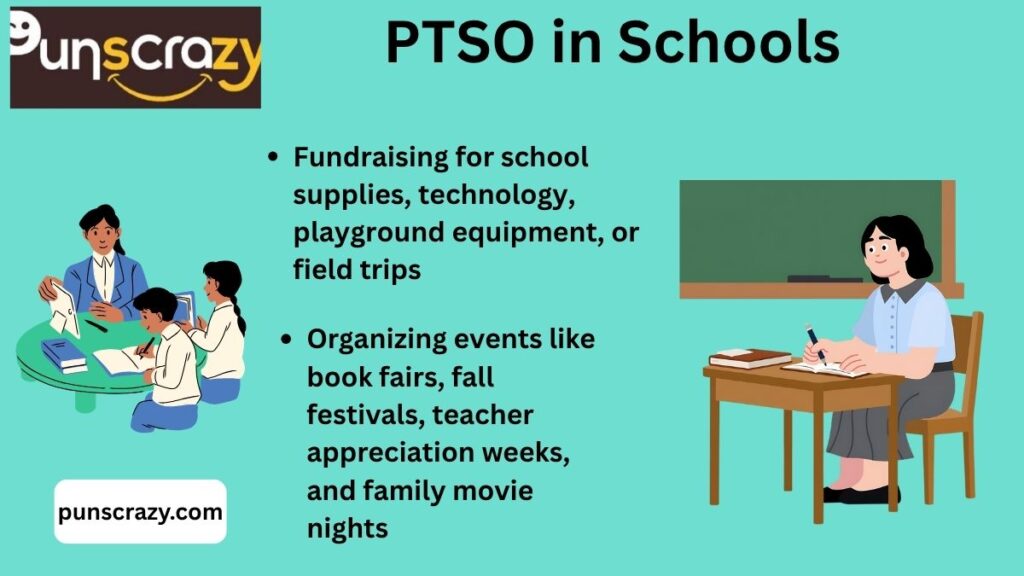
A Parent Teacher Student Organization is a volunteer-run group that operates within an individual school to support students, teachers, and the broader school community. Unlike a district-wide or state-affiliated structure, a PTSO is typically independent and self-governed, meaning the school sets its own bylaws, budget, and membership rules rather than following a national parent organization’s framework.
What a PTSO Actually Does
PTSOs handle a wide range of responsibilities that directly affect day-to-day school life. Common activities include:
- Fundraising for school supplies, technology, playground equipment, or field trips
- Organizing events like book fairs, fall festivals, teacher appreciation weeks, and family movie nights
- Facilitating communication between school administration and families through newsletters or parent meetings
- Supporting teachers with classroom supply requests, grants, or volunteer staffing
- Advocating for students on issues like school safety, extracurricular funding, or facility improvements
Because PTSOs are independently structured, the scope of their work can vary significantly from one school to the next. A PTSO at a large suburban elementary school might manage a six-figure annual budget, while a PTSO at a small rural school might focus on a handful of low-cost community events.
Why Schools Choose the PTSO Structure Specifically
Not every school defaults to a PTA. Some deliberately choose a PTSO structure for a few practical reasons:
- No dues to a national organization. Since a PTSO isn’t affiliated with the National PTA, 100% of funds raised stay at the school level rather than partially going toward national or state membership dues.
- More flexible bylaws. Independent groups can adapt their structure to fit the specific needs of their school community without following a standardized national template.
- Direct student involvement. Middle and high schools especially favor the PTSO model because it formally gives students a seat at the table, rather than treating them only as the group’s beneficiaries.
- Faster decision-making. Without layers of state or national approval, a PTSO can often respond to urgent needs — like an unexpected supply shortage or a last-minute event — more quickly than an affiliated PTA chapter.
This independence is a trade-off, though. PTSOs don’t receive the training resources, liability insurance options, or advocacy support that come with national PTA membership, so the leadership team has to build those systems on its own.
PTSO vs. PTA vs. PTO: What’s the Real Difference
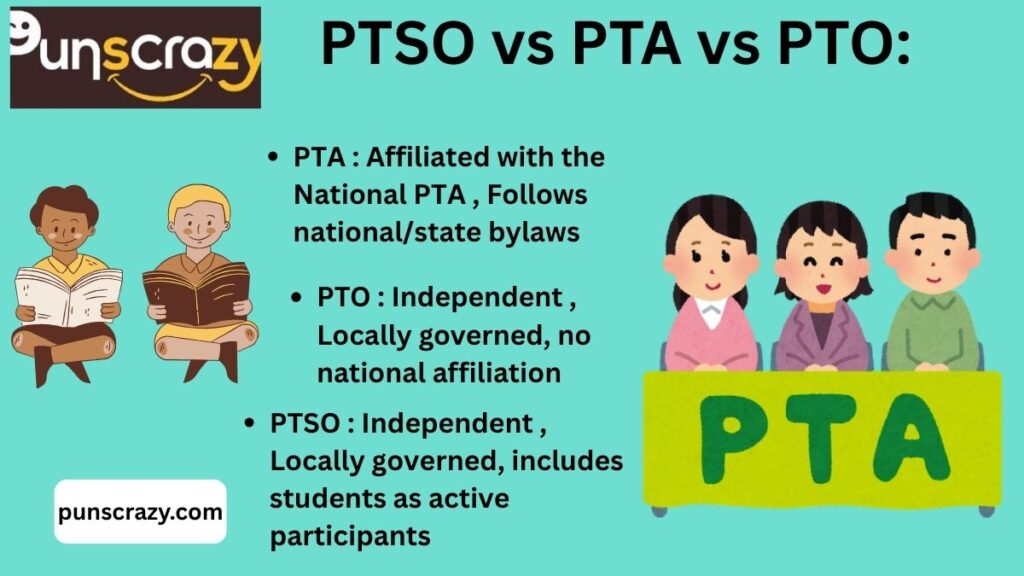
This is one of the most common points of confusion, since all three acronyms describe similar parent-teacher groups but differ in structure and affiliation.
| Acronym | Full Name | Affiliation | Governance |
| PTA | Parent Teacher Association | Affiliated with the National PTA | Follows national/state bylaws, pays dues to a parent organization |
| PTO | Parent Teacher Organization | Independent | Locally governed, no national affiliation |
| PTSO | Parent Teacher Student Organization | Independent | Locally governed, includes students as active participants |
The defining feature of a PTSO compared to a PTA or PTO is the explicit inclusion of students as members or participants, not just beneficiaries. This is especially common at the middle school and high school level, where student councils or student representatives sit alongside parents and teachers in planning meetings — something less typical in a traditional PTA structure.
Expert tip: If you’re trying to figure out which type of group your child’s school has, check the school’s official website or the “About Us” section of the parent organization’s page. Schools almost always state explicitly whether they’re a PTA, PTO, or PTSO, since the distinction affects whether they pay dues to a national body.
How to Join or Start a PTSO at Your Child’s School
If your school doesn’t have a parent-teacher group yet, or you’re considering joining an existing one, the general process looks like this:
- Check with the front office or principal to see if a PTSO, PTO, or PTA already exists
- Attend an open meeting — most PTSOs welcome new members at any point in the school year
- Review the bylaws if you’re starting one from scratch, to define membership, voting rights, and officer roles
- Establish a bank account and basic budget for fundraising and expenses
- Recruit a core leadership team, typically a president, vice president, treasurer, and secretary
- Schedule regular meetings and set a communication channel (email list, app, or social media group) to keep parents informed
Common PTSO Roles
Most PTSOs follow a similar leadership structure, even though the group itself is independently run:
- President — oversees meetings, sets agendas, represents the PTSO to school administration
- Vice President — supports the president and often manages event coordination
- Treasurer — manages the budget, fundraising income, and expense tracking
- Secretary — takes meeting minutes and handles official communication
- Volunteer Coordinator — recruits and schedules parent volunteers for events
- Student Representatives — at the middle and high school level, students often hold a seat to represent the student body’s interests
Why “PTSO” Is Also Showing Up as Internet Slang
If you searched for PTSO because you saw it in a text message rather than a school flyer, here’s where things get murkier. A growing number of slang and texting-guide websites claim PTSO stands for things like a style compliment, an instruction, or an encouragement phrase. The issue is that these sites don’t agree with each other — which is a strong signal that none of them are documenting an actual, established slang term.
The Problem: No Two Sources Agree on the Slang Meaning
When you compare multiple sites that claim to define PTSO as internet slang, you’ll find wildly different expansions, often published around the same time, each presented as the “real” meaning. That kind of disagreement doesn’t happen with genuinely established slang. Terms like FYI, ASAP, or TTYL have one consistent meaning across virtually every source because they emerged organically from real, repeated usage. PTSO doesn’t show that same pattern.
What this tells us: PTSO has likely become a target for low-effort SEO content rather than a term with real, organic adoption in texting, Instagram, TikTok, or Snapchat culture. That doesn’t mean nobody has ever typed “PTSO” casually — it means there’s no reliable, single definition you can apply to every instance you see.
How to Tell Real Slang From Made-Up SEO Slang
Knowing how to spot the difference is genuinely useful, since this pattern shows up constantly with newer or obscure acronyms. Watch for these warning signs:
- Inconsistent definitions across multiple “definitive” sources — a red flag that no one is actually documenting real usage
- No appearance in established slang references with consistent community-driven definitions
- Articles published in tight clusters with similar structure (FAQ sections, “in 2026” framing, near-identical formatting) — often a sign of templated content production
- Vague or contradictory example sentences that don’t reflect how people naturally text
- Claims of viral TikTok or Instagram trends without any verifiable trend data, hashtag volume, or named creators behind it
Genuine internet slang, by contrast, tends to have a traceable origin — a specific platform, community, or even a single viral post — and a meaning that stays stable as it spreads.
What to Do If Someone Texts You “PTSO” and You’re Not Sure What They Mean
Rather than guessing based on a slang dictionary that might be wrong, use the conversation itself to figure out the intent:
- Read the surrounding message. Slang almost always makes more sense in context than in isolation.
- Check the relationship. A school parent group chat versus a close friend’s DM versus a coworker’s Slack message all point toward very different meanings.
- Look at tone and emojis. Playful emojis suggest a casual or joking usage; a plain, formal message suggests it might be a typo or shorthand for something specific to that conversation.
- Just ask. A simple “what do you mean by PTSO?” is faster and far more accurate than searching for a definition that may not apply to your situation.
Real-world example: A parent in a school group chat texts, “Reminder — PTSO meeting moved to Thursday.” Here, context makes it instantly clear this refers to the Parent Teacher Student Organization, not slang. Compare that to a friend texting “ptso 😂” under a photo — without more context, that’s genuinely ambiguous, and no dictionary can reliably tell you what they meant.
Other Legitimate Meanings of PTSO
Acronyms frequently get reused across unrelated industries, and PTSO is no exception. While Parent Teacher Student Organization is by far the most documented and widely recognized meaning, you may occasionally encounter PTSO used as a localized or organization-specific abbreviation in other settings, such as internal naming conventions within a specific company, agency, or technical team. These uses are typically not standardized, meaning the same three letters can refer to something entirely different depending on the organization using them — much like how “PM” can mean “project manager,” “afternoon,” or “private message” depending on context.
If you encounter PTSO in a workplace document, internal memo, or technical report and the meaning isn’t obvious, the most reliable approach is to check your organization’s internal glossary or simply ask a colleague, rather than relying on a generic online definition.
Common Mistakes People Make With PTSO
A few mix-ups come up repeatedly when people search for this acronym:
- Confusing PTSO with PTSD. These are completely unrelated — PTSD (Post-Traumatic Stress Disorder) is a recognized medical and psychological diagnosis, while PTSO is not a medical term in any standard context. If you see “PTSO” in a serious or sensitive conversation, it’s worth double-checking it wasn’t a typo for PTSD.
- Confusing PTSO with PTO (Paid Time Off). In a workplace setting, PTO almost always means Paid Time Off, while PTSO is essentially never used this way. If you see PTSO in an HR document, it’s far more likely to be a typo or an organization-specific term than a reference to leave time.
- Assuming a single fixed slang meaning exists. As covered above, trusting one slang-dictionary page without cross-checking can lead you to a confidently wrong answer.
- Mixing up PTSO with PTSA. PTSA stands for Parent Teacher Student Association, the National PTA’s version of a group that includes students — distinct from an independent PTSO, even though the names are nearly identical.
Best Practices for Using and Interpreting PTSO Correctly
A few habits will keep you from misreading or misusing the acronym, whether you’re a parent leader, a teacher, or just someone trying to decode a text message:
- State the full name on first use in any official document, email, or flyer — e.g., “Parent Teacher Student Organization (PTSO)” — so there’s no ambiguity for new families or staff.
- Don’t assume school families know the difference between PTSO, PTO, and PTA. Many parents use these terms interchangeably even when their school uses one specifically, so a brief explanation in welcome materials goes a long way.
- Avoid using PTSO as casual slang in mixed audiences. Since the meaning isn’t standardized outside of schools, using it that way in a professional or unfamiliar setting risks confusion.
- When in doubt in a text or DM, mirror the question back. Asking “what do you mean by that?” costs nothing and avoids responding based on a guess.
Quick Comparison Table: PTSO Meanings at a Glance
| Context | Likely Meaning | How Established It Is | Where You’ll See It |
| School or parenting | Parent Teacher Student Organization | Highly established, documented and consistent | School websites, newsletters, flyers, parent group chats |
| Texting or social media | Unconfirmed / context-dependent slang | Not established — definitions conflict across sources | Group chats, Instagram comments, TikTok captions |
| Workplace or internal docs | Organization-specific abbreviation | Varies by company — not standardized | Internal memos, technical reports |
| Easily confused with | PTSD, PTO, PTSA | N/A | Often mistyped or assumed interchangeable |
Frequently Asked Questions
1. What does PTSO mean in text messages and online chats?
PTSO most commonly stands for “Put That Stuff On,” a slang phrase used to compliment someone’s outfit, style, or overall appearance.
2. How is PTSO used on social media?
People often comment “PTSO” on photos or videos when someone is wearing a fashionable outfit or showing off a stylish look.
3. Is PTSO a compliment?
Yes. In most cases, PTSO is a positive compliment that means someone looks good, fashionable, or well-dressed.
4. Does PTSO have other meanings?
Yes. Depending on the context, PTSO can also refer to organizations such as a Parent-Teacher-Student Organization, though the slang meaning is more common online.
5. When should I use PTSO?
Use PTSO in casual conversations, social media comments, or texts when you want to praise someone’s clothing, fashion sense, or overall style.
6. Is PTSO appropriate for professional communication?
Not usually. Since PTSO is primarily internet slang, it’s best reserved for casual and social settings rather than formal workplace communication.
7. Why has PTSO become popular in 2026?
The term continues to trend on platforms like TikTok, Instagram, and X because fashion-focused content creators and viewers frequently use it as a quick compliment.
Conclusion
The clearest, most reliable answer to “what does PTSO mean” is Parent Teacher Student Organization — a real, well-documented type of school community group that blends elements of a traditional PTA with direct student involvement. If you’re a parent, teacher, or student trying to get involved at your school, that’s almost certainly the PTSO you’re dealing with.
If you came across PTSO in a text message or on social media, the honest answer is that no single slang definition has been reliably established, despite plenty of websites confidently claiming otherwise. Your best bet is always context: who sent it, what platform you’re on, and what the rest of the conversation says. When in doubt, just ask — it’s faster and far more accurate than trusting a guess dressed up as a definition.
You May Also Like
What Does ATP Mean in Text? A Complete Guide to Its Meanings Across Contexts
CFS Meaning: What It Stands For & How People Use It Today 2026
GNG Meaning: Definition, Usage, and Context Explained 2026

Will Jack is the creative mind behind Punscrazy, a humor-focused platform dedicated to clever wordplay and lighthearted entertainment. With a passion for puns and witty expressions, he curates and creates engaging content that brings smiles to readers around the world. His work blends creativity with simplicity, making humor accessible for everyday moments, social media captions, and casual fun.