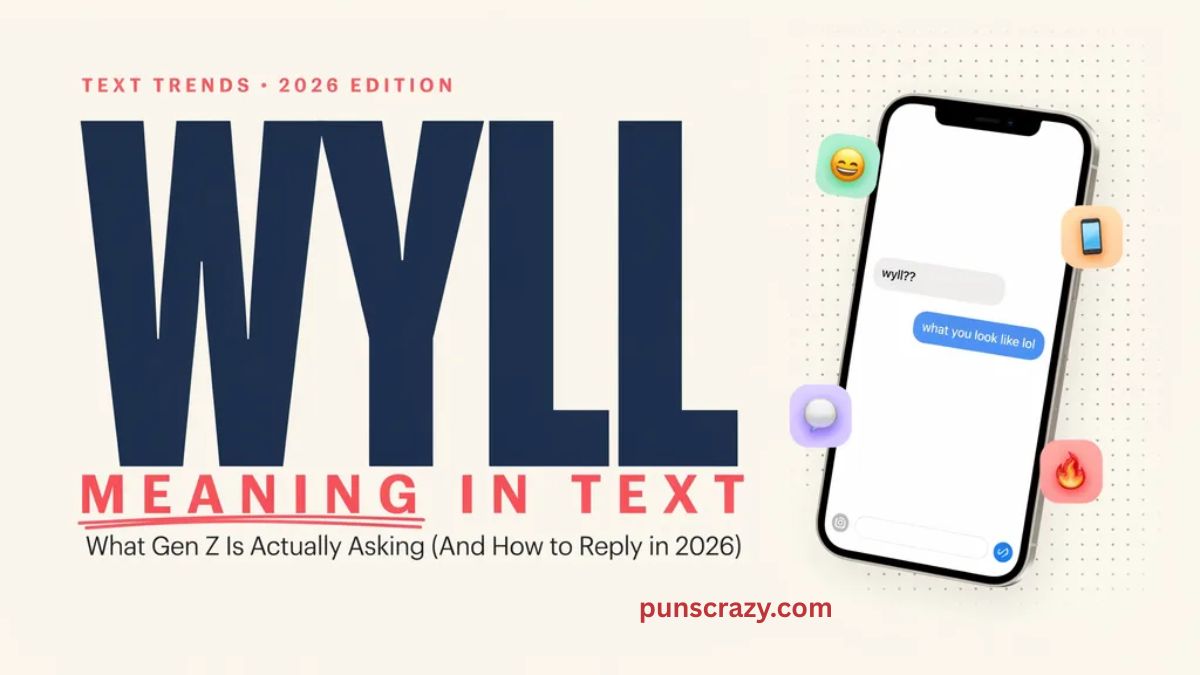
You’re mid-scroll, minding your own business, when a message pops up: “wyll?” Four letters. No punctuation. Zero context. Your brain stalls. Is it a typo? An acronym? Some inside joke you missed? You re-read it twice and still feel stuck. Don’t worry — you’re not alone. Thousands of people search “WYLL meaning in text” every single day because this particular piece of Gen Z slang throws people off the first time they see it.
Here’s the thing: once you understand it, it’s one of the most straightforward terms in modern internet slang. The confusion isn’t about complexity — it’s about context. And context, as you’ll learn, is everything with WYLL.
This guide covers where it came from, what it actually means, how it shifts across platforms, and exactly how to respond when it lands in your inbox.
What Does WYLL Mean in Text?
It’s a piece of casual text slang used to ask someone about their physical appearance — usually a request for a photo, selfie, or at minimum a description. It shows up constantly in Snapchat chats, Instagram DMs, TikTok comment sections, and dating apps.
Here’s a quick-reference snapshot:
| Feature | Detail |
| Full form | What You Look Like |
| Type | Gen Z texting slang / chat abbreviation |
| Tone | Casual, curious, sometimes flirty |
| Primary platforms | Snapchat, Instagram, TikTok, dating apps |
| Safe for work? | No |
| First widespread use | Early 2020s, peaked 2024–2026 |
Simple enough on paper. The tricky part? The tone shifts dramatically depending on who’s asking, where they’re asking it, and what your relationship is with them. A best friend texting “wyll after that haircut 👀” is completely different from a stranger on a dating app firing it off as an opener.
That distinction matters. Let’s dig into it.
Where Did WYLL Come From? (The Origin Story Your Competitor Skipped)
Most slang guides jump straight to definitions and skip the history. That’s a mistake because understanding where a term comes from tells you a lot about how to use it.
WYLL emerged from Black internet culture in the early 2020s, specifically through platforms like Twitter (now X), Snapchat, and eventually TikTok. It grew out of a broader tradition of shorthand communication in online communities where speed and brevity were prized above everything else.
By 2023, it had crossed into mainstream zoomer slang territory. TikTok accelerated that spread dramatically — videos explaining Gen Z texting acronyms racked up millions of views, and WYLL appeared in nearly every roundup. By 2024, it had landed firmly in everyday social media slang usage among teens and young adults across the US, UK, and Australia.
What made it stick? A few reasons:
- It’s phonetically intuitive — say “wyll” out loud and it sounds like “will,” which makes it easier to absorb than something like “ISTG” or “IKYFL”
- It fills a genuine conversational gap — there wasn’t a clean, casual shorthand for “show me what you look like” before this
- It works across multiple tones without changing its spelling — friendly, curious, or flirty, it’s still just “wyll”
The 2025–2026 surge in Google searches for WYLL meaning in text reflects a specific pattern: the slang moved beyond its core Gen Z audience and started reaching millennials, parents, and anyone who communicates with someone under 25.
Every Meaning of WYLL — Ranked by How Often You’ll See It
WYLL isn’t a one-size-fits-all term. Here are all five ways it’s actually used, ranked from most to least common.
The Most Common Use: Asking for a Photo
This is the bread-and-butter interpretation. Someone wants to send a selfie, see your face, or get a visual check on who they’re talking to. It’s the digital equivalent of walking into a room and looking around to see who’s there.
Real example:
“Hey, been talking for a week now, wyll?” [Person sends a casual selfie]
The request feels low-stakes when framed as four letters. That’s intentional — saying “can you send me a photo of yourself?” sounds weirdly formal by comparison. WYLL keeps it breezy.
Genuine Curiosity About Someone’s Appearance
Not every WYLL carries romantic weight. Sometimes it’s just pure human curiosity — especially on anonymous platforms, gaming servers, or in communities where people interact as usernames rather than faces.
Online friendships can run deep for months before someone asks “wait, what do you actually look like?” That’s WYLL in its most innocent form. There’s no flirtation involved — just the natural human instinct to attach a face to a voice.
Flirty or Romantic Interest
On dating apps like Tinder or Bumble, WYLL takes on a different energy entirely. Here, it’s often a shorthand screening question — “are we physically compatible before I invest more time in this conversation?”
That’s not cynical, it’s just honest. Dating apps are visual by design. WYLL in this context is a flirty message that moves the interaction from text to image, from abstract to real.
The telltale signs it’s flirty rather than just curious:
- It comes with an emoji (especially 👀 or 😏)
- It appears early in the conversation before much rapport is built
- The sender has already offered their own photo
A Verification or Trust Check
This one shows up a lot in Discord servers, online gaming communities, and anonymous chat platforms. When someone’s been talking to a user whose identity feels uncertain — or who claimed something hard to verify — “wyll” becomes a soft request for proof.
It’s not quite “are you who you say you are?” but it rhymes with that. Think of it as a visual request for authenticity rather than attraction.
Playful Banter Between Close Friends
This is the meaning most slang guides completely miss. Among tight friend groups, WYLL can be pure comedy — teasing someone after they claim they look good, or asking sarcastically after a rough Monday morning.
“Haven’t slept in 36 hours and just ran through the rain to catch the bus. wyll rn 😭”
Here, it’s not a genuine request for a photo. It’s a punchline. The person sending it already knows how the other person looks. Reading this version correctly saves you from sending an earnest selfie in response to an obvious joke.
How WYLL Shows Up Across Different Platforms
The same word reads differently depending on where it lands. Platform culture shapes meaning just as much as the word itself.
Snapchat and Instagram DMs — Its Natural Habitat
Snapchat DMs and Instagram messages are where WYLL thrives. Both platforms are built around visual identity — profile pictures, stories, snaps. Asking “wyll” in these environments feels native, even expected.
The unspoken rule on Snapchat specifically: if you ask, you should be ready to share back. Reciprocity is a social norm in snap conversations. Asking without offering feels one-sided fast.
TikTok Comments and Duets
On TikTok, WYLL operates more publicly. Someone might drop it in a comment on a faceless creator’s video — essentially crowd-sourcing a face reveal request. Creators sometimes respond with duets or stitches specifically because WYLL comments drive engagement.
It’s become part of the TikTok economy: curiosity = clicks.
Dating Apps (Tinder, Hinge, Bumble)
Tinder slang and Bumble chat culture normalized WYLL as an early-conversation move. On apps where photos are literally the first thing you see, asking WYLL can feel redundant — unless someone’s profile is limited, shows only group photos, or the person genuinely wants a more candid, current image.
When it works: after a few messages of genuine conversation, it signals real interest. When it doesn’t: as an opener with zero context, it reads as impatient or shallow.
Discord and Online Gaming
In gaming communities, WYLL surfaces during friendship-building moments. After a great co-op session or weeks of voice chatting, curiosity about a teammate’s appearance is completely natural.
The tone here is almost always friendly rather than flirty. Gaming communities developed their own version of online jargon around this — asking WYLL is almost a rite of passage in some servers, signaling that you’ve moved from “teammate” to “actual friend.”
iMessage and Casual Group Chats
In friend group texts, WYLL usually appears in response to something someone said — a new look, an outfit mention, a dramatic story. It’s reactive, playful, and almost never a serious request.
“Just dyed my hair purple” “WYLL RIGHT NOW”
That’s the group chat version. It’s excited, it wants the selfie, and it’s coming from people who already know each other well.
What About Professional or Work Chats?
Short answer: don’t. Not ever.
WYLL has no place in professional settings — not in Slack, not in Teams, not in work emails, not in formal communication of any kind. Even if you work somewhere with a casual culture, asking a colleague what they look like crosses from friendly into uncomfortable territory fast.
What to do instead if you haven’t met someone yet? Check their LinkedIn. Look at the company directory. If it genuinely matters, let it come up organically in a video call.
Is WYLL Rude, Flirty, or Just Curious? Reading the Room
WYLL isn’t inherently any of these things. It’s a blank canvas that the sender’s tone, timing, and relationship paint.
When It Feels Totally Normal
- Between friends who’ve been chatting online for a while
- In response to someone mentioning a physical change (new haircut, outfit, etc.)
- On gaming platforms or anonymous communities where faces are rarely shared
- When both people are already exchanging casual updates
When It Feels Flirty (And That’s Fine)
- On dating apps or platforms where attraction is part of the context
- When paired with flirty emojis or warm tone
- When the sender also offers their own photo
- When mutual interest has already been established through conversation
It Crosses a Line
This is where nuance matters most. WYLL can tip from curious to uncomfortable in a few specific situations:
- Unsolicited from a stranger with no established rapport
- Repeated asks after someone hasn’t responded or has changed the subject
- Combined with pressure — “come on, just send one” — which turns a casual ask into harassment
- Sent to someone who’s expressed discomfort with sharing photos online
The difference between curiosity and invasion isn’t the word — it’s the behavior surrounding it. One ask, gracefully accepted or declined, is fine. Pushing past that boundary is not.
How to Respond to WYLL — Every Scenario Covered
Your comfort level drives your response. There’s no wrong answer here — only honest ones.
You’re Comfortable — Here’s How to Reply Naturally
If you’re fine sharing, keep it casual:
- Send a recent selfie without overthinking it
- Reply with a description if you’d rather not send a photo: “5’9, dark hair, currently looking like I survived a Monday”
- Use humor to keep the energy light: “Like someone who just found the perfect parking spot 😌”
Funny and Clever Replies That Deflect Without Drama
These work when you want to keep the conversation going without actually answering:
- “Like a limited edition — not available for preview”
- “You couldn’t handle it honestly”
- “Somewhere between a vibe and a mystery“
- “Google ‘main character energy’ — that’s close enough”
The right joke lands better than an awkward non-answer. It shows you’re confident enough to play with the question rather than stress about it.
Neutral Replies When You’re Still Sizing Someone Up
- Buy time: “Lol why? 👀” — this turns the question back on them without shutting it down
- Redirect: “Depends, what’s this for?”
- Offer a description instead of a photo: “Pretty normal looking, nothing dramatic”
How to Decline Without Making It Weird
You don’t owe anyone a photo. Full stop. Here’s how to say no without starting a war:
- “Not really comfortable sharing photos with people I just met, no offense”
- “I keep this stuff offline — but I’m happy to keep talking”
- “I’ll pass on that, but what were you saying about…?” — redirect to something they mentioned
The key is confidence without hostility. Most reasonable people will respect it.
Replying on Dating Apps vs. Friend Chats — The Difference Matters
On a dating app, declining WYLL might signal mismatched expectations — appearance is generally part of the conversation there. That’s okay. Just be direct.
In a friend group chat, the same decline might just mean “I look terrible right now and I’m not sending evidence.” That’s relatable. Everyone gets it.
Common Misconceptions About WYLL
Misconception: It Always Means Someone Wants a Photo
Sometimes it’s conversational. Someone might text “wyll rn” meaning “describe your vibe right now” rather than literally requesting an image. Read the energy of the full conversation, not just the four letters.
Misconception: It’s Always Flirty
Context is doing so much work here. WYLL between two friends who’ve been gaming together for six months is not a romantic gesture. It’s curiosity. Don’t assign flirty intent where there isn’t any — you’ll make things awkward unnecessarily.
Misconception: Older Slang Dictionaries Have the Right Definition
Internet slang evolves fast. Some sites still list outdated or incomplete definitions. If a definition feels off based on the context you’re seeing, trust the context. Language is living — dictionaries lag behind.
Misconception: WYLL = “Who You Looking Like”
This is a real source of confusion. “Who you looking like” is a different question entirely — it asks for a celebrity comparison or style reference, not your actual face. The mix-up happens because both questions orbit appearance. But they’re asking for completely different things.
WYLL = show me your face. “Who you looking like?” = what’s your vibe, who’s your style twin?
If you’re unsure which someone meant, just ask. “You mean send a pic or like, vibes?” — that’s a totally acceptable clarification.
Misconception: WYLL Always Means Send a Full Selfie
Some people use WYLL to mean a general vibe check rather than a literal image. They might be happy with a description, an aesthetic, or even just your reaction to the question. Don’t stress about producing a photo if you’d rather not — feel out what the person actually needs.
WYLL vs. Similar Slang — Know the Difference
| Term | Full Meaning | Tone | Most Common Platform |
| WYLL | What You Look Like | Curious / Flirty | Snapchat, IG, Dating Apps |
| WYD | What You Doing | Casual | Universal |
| WYA | Where You At | Casual / Urgent | iMessage, Snap |
| WYLD | Why You Lying / Wild | Disbelief / Playful | Twitter/X, TikTok |
| HMU | Hit Me Up | Friendly / Flirty | Universal |
| ASL | Age, Sex, Location | Retro internet | Old-school chat rooms |
| PFP | Profile Picture | Neutral | All platforms |
| NGL | Not Gonna Lie | Honest / Casual | Universal |
| IRL | In Real Life | Neutral | Universal |
| FR | For Real | Emphasis | TikTok, Twitter |
Knowing these related acronyms saves you from confusion when several appear in the same message. “wyll fr, hmu after” — that’s three separate pieces of chat lingo that together mean: “send me a pic, seriously, and then message me.”
When You Shouldn’t Use WYLL — Real Talk
Knowing when not to use a slang term is just as important as knowing what it means.
Any Professional Setting, Full Stop
Work chats, team Slacks, business emails, Zoom follow-ups — WYLL doesn’t belong anywhere near formal communication. Even if your workplace is relaxed, mixing office slang with a request about someone’s appearance is a fast path to an uncomfortable situation. Keep it out of professional tone environments entirely.
When You’ve Just Met Someone and There’s No Rapport Yet
Timing is everything. Asking WYLL as a conversation opener — before trust, warmth, or genuine connection — signals that appearance is your primary interest. That might be fine on a dating app where context is clear. Everywhere else, build rapport first.
Cross-Cultural or International Conversations
Online jargon doesn’t always translate. Someone from a different country or digital culture might not recognize WYLL at all — or worse, might interpret it as something completely different. When you’re not sure someone’s familiar with modern slang, spell it out or skip it.
When Someone Has Already Shown Discomfort
If someone changed the subject, responded with a short non-answer, or hasn’t replied — that’s a signal. Asking again isn’t persistence, it’s pressure. One ask is enough.
With Anyone Under 18
This one deserves its own callout. Asking minors about their physical appearance via social media slang — regardless of intent — is inappropriate. Full stop. If you’re an adult and you’re not sure of someone’s age, don’t ask WYLL. The risk isn’t worth it and the ethics aren’t ambiguous.
FAQs
What does WYLL mean in texting?
It means “What You Look Like” — a casual request to send a selfie, show your appearance, or describe what you look like. It’s one of the most common pieces of Gen Z texting slang in 2026.
Is WYLL always asking for a photo?
Not always. Sometimes it’s asking for a vibe or description rather than a literal image. Context tells you which.
Where did WYLL originate?
It grew out of Black internet culture in the early 2020s and spread mainstream through TikTok and Snapchat by 2023–2024.
Is it okay to ask someone WYLL?
Depends entirely on context. Between friends or in established conversations, yes. As a cold opener or in professional settings, no.
How do I turn down a WYLL request without being rude?
Be direct and brief: “Not really comfortable sharing photos here, but happy to keep chatting.” That closes it gracefully without drama.
What if someone keeps asking WYLL after I’ve said no?
That’s a boundary issue, not a slang issue. Persistent requests after a clear decline are harassment regardless of how casual the phrasing is. It’s completely valid to stop responding.
Is WYLL appropriate for teens to use?
Between peers in casual snap conversations or friend group chats — generally fine. Teens should still practice the same judgment about who’s asking and whether it feels safe.
Are there other meanings of WYLL outside of texting?
Not really. This is purely digital slang — you won’t see it in formal writing, news headlines, or anywhere outside casual online communication.
The Bottom Line on WYLL
Four letters. Infinite contexts.
WYLL means “What You Look Like” — but what it feels like depends entirely on who sends it, where they send it, and what’s been established between you before it arrives. In a group chat with close friends, it’s playful. On a dating app, it’s direct. From a stranger with no context, it can feel invasive.
The most important skill here isn’t memorizing the definition — it’s reading the room. Gen Z slang like WYLL thrives precisely because it’s flexible. That same flexibility is what makes it confusing until you’ve seen it a few times in the wild.
Now you have. You know what it means, where it came from, how it behaves across different platforms, and exactly how to respond — whether you want to share, deflect, joke, or decline.

Will Jack is the creative mind behind Punscrazy, a humor-focused platform dedicated to clever wordplay and lighthearted entertainment. With a passion for puns and witty expressions, he curates and creates engaging content that brings smiles to readers around the world. His work blends creativity with simplicity, making humor accessible for everyday moments, social media captions, and casual fun.









1 thought on “WYLL Meaning in Text — What Gen Z Is Actually Asking (And How to Reply in 2026)”