You’ve seen the letters everywhere. A Craigslist post that says “ISO vintage record player.” A camera menu with an “ISO 400” setting. A downloaded file ending in .iso. A dating app bio that reads “ISO someone who actually replies to texts.” Same three letters, four completely different meanings.
That’s the thing about ISO meaning — it’s not one definition, it’s several, and which one applies depends entirely on where you spot it. This guide breaks down every major use of ISO, from internet slang and texting slang to the actual International Organization for Standardization, camera settings, file formats, and date codes. By the end, you’ll be able to spot the right meaning instantly, no matter the context.
Key Takeaways
- ISO meaning depends entirely on context — there is no single universal definition
- As internet slang, ISO stands for “In Search Of” and signals a search request on marketplaces, forums, and dating apps
- As a formal acronym, ISO refers to the International Organization for Standardization, headquartered in Geneva, Switzerland, and the name comes from the Greek word “isos,” meaning “equal”
- In photography, ISO measures camera sensor sensitivity to light, trading brightness for potential noise
- .iso files are disk images, commonly used for OS installers and bootable drives
- ISO 8601 standardizes date formatting globally, while ISO 3166 and ISO 4217 standardize country and currency codes
- Reading the platform and surrounding context is the fastest way to identify which ISO meaning applies
What Does “ISO” Actually Mean?
At its core, ISO has two unrelated origins that happen to share the same four-letter shorthand.
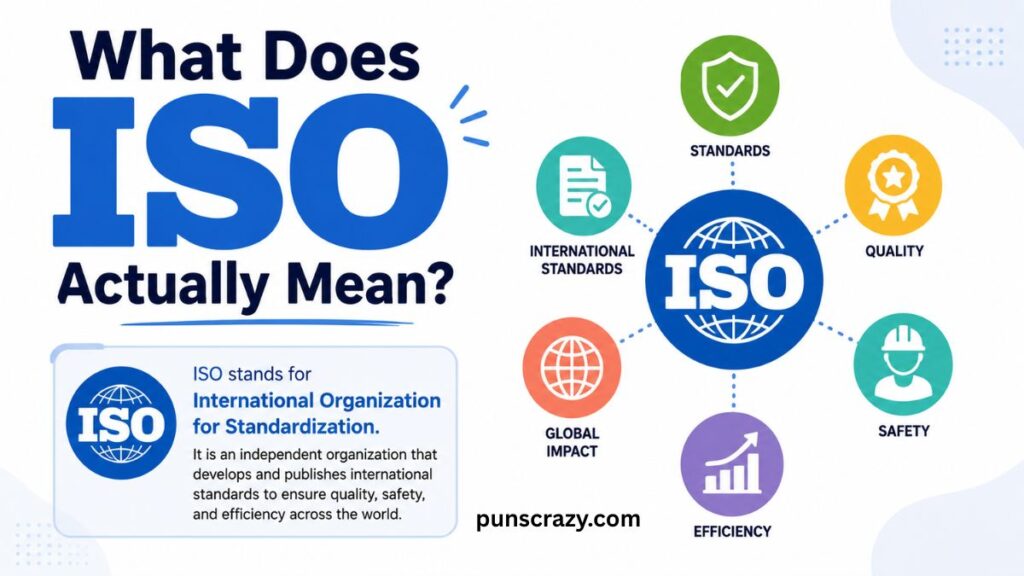
- As internet slang and chat terminology, ISO stands for “In Search Of.” It’s a search request — someone announcing they’re looking for, seeking, or trying to find an item, a person, or a piece of information.
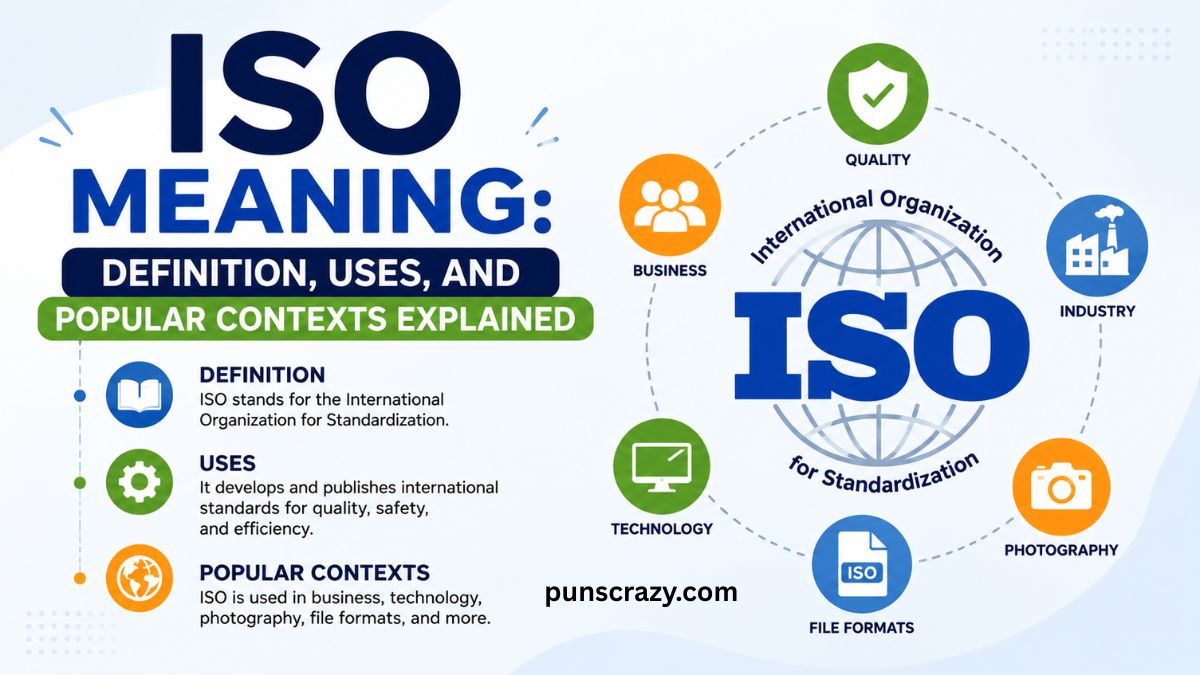
- As a formal acronym, ISO refers to the International Organization for Standardization, a Geneva-based body that creates international standards used by businesses and governments worldwide.
Beyond those two, ISO also shows up as a camera control (light sensitivity), a file format (.iso disk images), and part of ISO 8601 (the international date format) and ISO 4217 (currency codes). None of these meanings overlap — you have to read the room, or in this case, the platform, to know which one you’re dealing with.
ISO as an Acronym: International Organization for Standardization
What ISO (the Organization) Does and Why It Exists
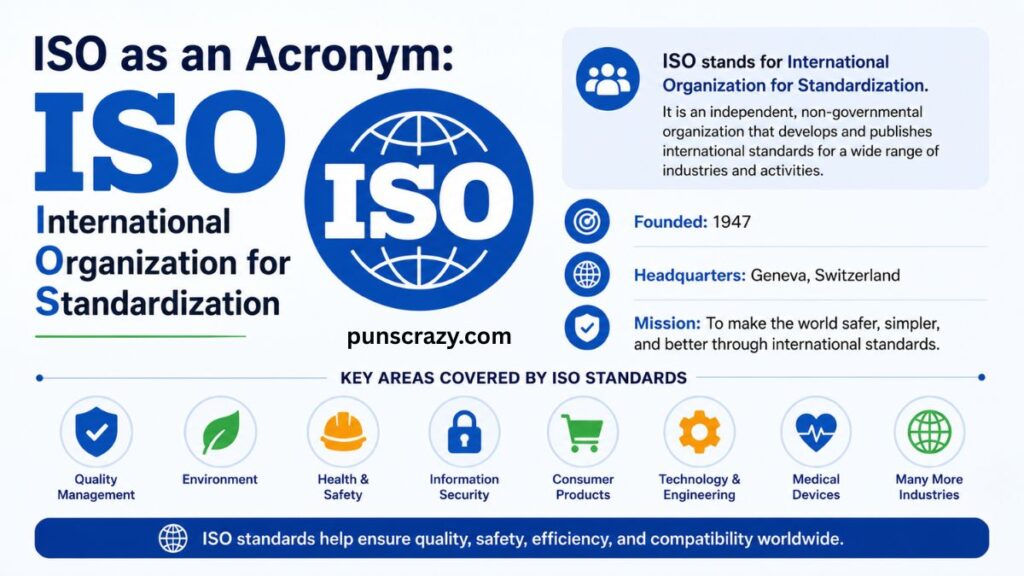
The International Organization for Standardization is an independent, non-governmental body headquartered in Geneva, Switzerland. It brings together national standards bodies from more than 170 countries to develop international standards that make products, services, and systems safe, reliable, and consistent — regardless of where in the world they’re made or used.
Founded in 1947, the organization exists because a bolt manufactured in Germany needs to fit a nut made in Japan, a medical device tested in the United States needs to meet the same quality standards as one built in Brazil, and a shipping container has to be handled the same way at every port on earth. Standardization is what makes global trade and technology actually function without constant reinvention.
How ISO Standards Get Created and Approved
ISO standards don’t come from a single government or company. They’re built through a consensus process involving technical committees made up of industry experts, engineers, scientists, and consumer representatives from member countries. A typical standard moves through these stages:
| Stage | What Happens |
| Proposal | A member body or industry group identifies a need for a new standard |
| Committee Draft | Technical experts draft the standard’s requirements |
| Enquiry Draft | The draft circulates to national standards bodies for feedback |
| Final Draft | Revisions are made based on international input |
| Publication | The standard is formally published and made available |
This process can take years, which is intentional — it ensures the resulting regulatory standards reflect genuine international agreement rather than one country’s preferences.
Well-Known ISO Standards People Actually Encounter
Most people interact with ISO standards without realizing it. A few of the most widely recognized:
- ISO 9001 — the global benchmark for quality management systems, used across manufacturing, services, and operational excellence programs
- ISO 27001 — the leading standard for information security management, adopted by companies handling sensitive data
- ISO 14001 — the standard for environmental management systems, guiding compliance for sustainability-focused organizations
- ISO 22000 — food safety management, relevant to manufacturing and supply chains
- ISO 13485 — quality management specifically for medical devices
Companies that pursue ISO certification for these standards typically go through third-party audits to prove they meet the documented requirements — it’s not a self-declared badge, it’s independently verified compliance.
Why “ISO” Isn’t Actually an Acronym
Here’s a detail that trips up almost everyone: ISO is not an acronym for “International Organization for Standardization.” If it were, the English acronym would be “IOS” and the French version (“Organisation internationale de normalisation”) would be “OIN.” Neither matches.
Instead, the founders deliberately chose “ISO” as a fixed name, drawn from the Greek word “isos”, meaning “equal.” The idea was that no matter the country or language, the organization’s short name would always read the same — a small but fitting detail for a body whose entire mission is making things consistent worldwide.
“ISO is a word, derived from the Greek ‘isos,’ meaning equal — chosen precisely so it would stay identical across every language.” — a naming convention the organization has maintained since 1947.
Who Uses ISO Certification and Why It Matters
ISO certification matters most to organizations operating internationally or in regulated industries. A manufacturer exporting products to the European Union, a software company handling customer data, or a hospital purchasing lab equipment will often require suppliers to hold relevant ISO certifications before doing business at all. It functions as a shared language of trust — quality assurance that doesn’t require every partner to independently verify every process from scratch.
In practical terms, certification can influence:
- Contract eligibility (some government and enterprise contracts require it)
- Insurance premiums (lower risk management exposure)
- Customer confidence in professional standards
- Access to certain international markets
ISO in Photography and Cameras
What ISO Controls and How It Affects Image Quality
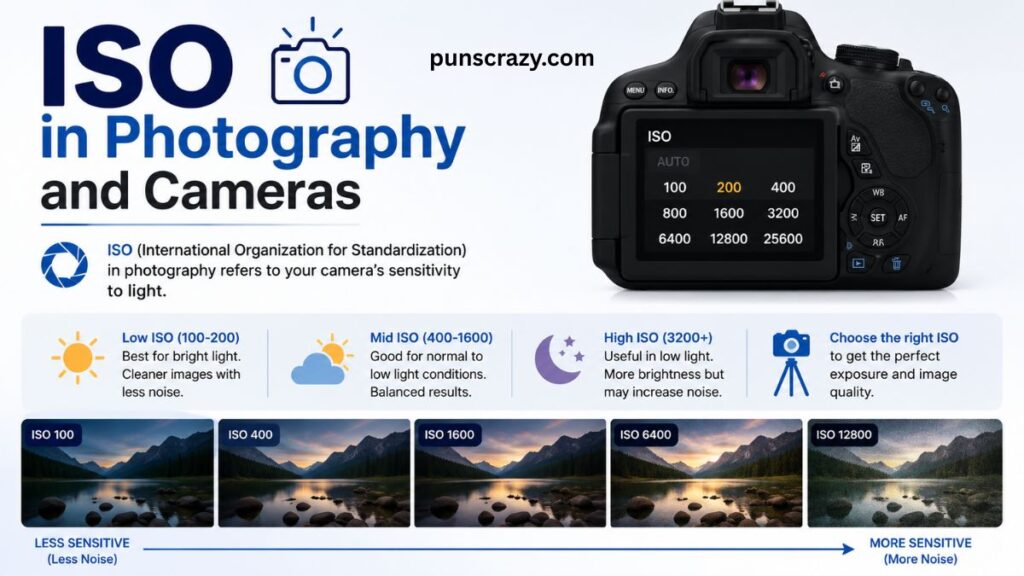
In photography, ISO measures your camera’s sensitivity to light. A lower ISO number means the camera sensor is less sensitive, producing cleaner images in bright conditions. A higher ISO number increases sensitivity, letting you shoot in dim environments — but at a cost.
That cost is visible noise, sometimes called grain: a speckled, gritty texture that becomes more pronounced as ISO climbs. This is the fundamental trade-off every photographer learns early — sensitivity versus cleanliness.
Low ISO vs. High ISO — When to Use Each
| ISO Range | Best Used For | Trade-Off |
| ISO 100–200 | Bright daylight, studio lighting | Cleanest image, needs strong light |
| ISO 400–800 | Overcast days, indoor lighting | Slight noise increase, more flexibility |
| ISO 1600–3200 | Evening, dim indoor scenes | Noticeable grain, useful for low-light photography |
| ISO 6400+ | Night scenes, fast action in darkness | Significant noise, only when no other option exists |
Expert tip: Modern cameras with larger sensors (full-frame especially) handle high ISO far better than older or smaller-sensor cameras. What counted as “unusable noise” at ISO 3200 a decade ago is often perfectly clean on today’s full-frame bodies.
ISO’s Relationship to Aperture and Shutter Speed
ISO is one-third of what photographers call the exposure triangle, alongside aperture (how much light the lens lets in) and shutter speed (how long the sensor is exposed to light). Adjusting any one of the three affects how bright or dark your image turns out, and each comes with its own visual side effect:
- Aperture changes depth of field (background blur)
- Shutter speed changes motion blur or freeze
- ISO changes noise and image brightness
Balancing all three — rather than relying on ISO alone — is what separates deliberate exposure control from just “cranking the sensitivity until it looks bright enough.”
Common Mistakes: Noise From Pushing ISO Too High
The most frequent beginner mistake is defaulting to a high ISO setting to “fix” a dark photo instead of first adjusting aperture or shutter speed, or simply adding light. Auto-ISO modes can make this worse by silently pushing sensitivity higher than necessary. A useful best practice: treat ISO as your last adjustment, not your first, since it’s the one most likely to visibly degrade image quality.
ISO File Format (.iso)
What a .iso File Actually Is
A .iso file is a disk image — a single file that contains an exact, byte-for-byte copy of the contents and structure of an optical disc (CD, DVD, or Blu-ray). Instead of handling dozens or hundreds of individual files, a .iso packages everything into one archive that behaves like a virtual disc when mounted.
The name itself nods back to ISO 9660, the actual ISO-published standard that defines how file systems on CD-ROMs are structured — so this is one of the rare cases where the slang-adjacent file extension and the International Standards organization are genuinely connected.
Common Uses — Software Installers, OS Images, Game Discs
You’ll most often run into .iso files when:
- Downloading an operating system installer (Windows, Linux distributions)
- Backing up or distributing physical game discs
- Archiving software installation media
- Creating bootable USB drives for system repair or installation
How to Open or Mount an ISO File
- Windows 10/11: Right-click the file and select “Mount” — it appears as a virtual drive
- macOS: Double-click the file, which mounts it automatically via Disk Utility
- Linux: Most distributions mount .iso files natively through the file manager, or via the mount command in terminal
No special software is required on modern operating systems, though tools like Rufus or balenaEtcher are commonly used when the goal is writing the ISO to a bootable USB drive.
ISO Date and Time Format (ISO 8601)
The YYYY-MM-DD Standard and Why It’s Used Globally
ISO 8601 defines a single, unambiguous way to write dates and times: YYYY-MM-DD for dates (e.g., 2026-07-08) and an optional THH:MM:SS for time. This matters because date formats vary wildly by country — 07/08/2026 means July 8th in the US and August 7th in most of Europe. ISO 8601 removes that ambiguity entirely by always ordering from largest unit (year) to smallest (seconds).
Where You’ll See It
- Database timestamps and log files
- API responses and request formats (nearly universal in software systems)
- International shipping and manufacturing documentation
- Scientific and technical publications
Any developer working across time zones or international teams relies on ISO 8601 specifically to avoid the kind of date-format confusion that causes real scheduling and data-processing errors.
ISO Country and Currency Codes
ISO 3166 and ISO 4217
Two more ISO standards show up constantly without most people realizing it:
- ISO 3166 assigns standardized two- and three-letter codes to every country (US, GB, JP, DE)
- ISO 4217 assigns three-letter codes to every currency (USD, EUR, JPY, GBP)
Real-World Examples
| Country | ISO 3166 Code | Currency | ISO 4217 Code |
| United States | US | US Dollar | USD |
| United Kingdom | GB | British Pound | GBP |
| Japan | JP | Japanese Yen | JPY |
| Germany | DE | Euro | EUR |
These codes power everything from international shipping labels to banking systems and e-commerce checkout forms — they’re the invisible plumbing behind global transactions.
ISO as Internet Slang (“In Search Of”)
Where This Usage Started and Why It Caught On
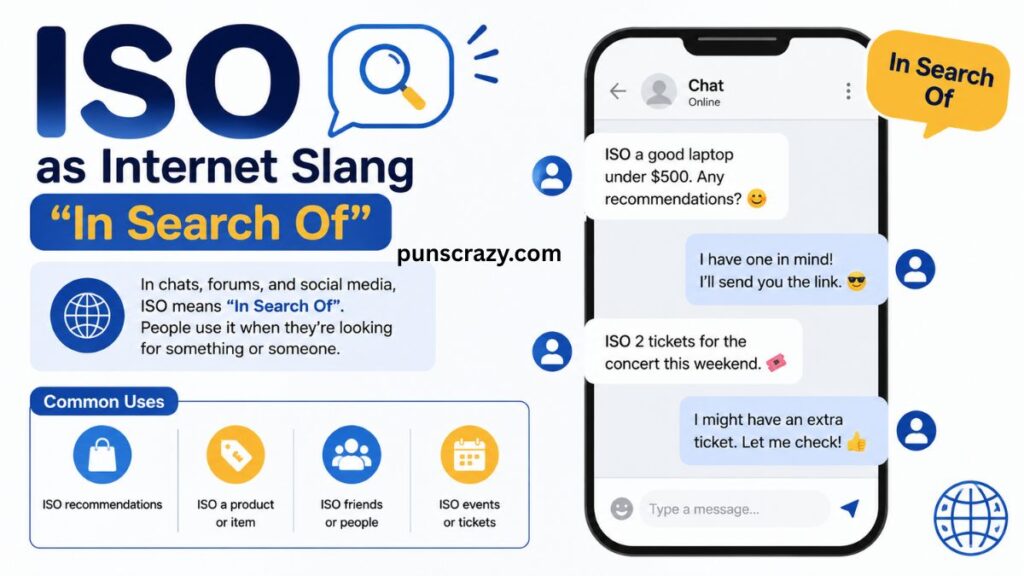
Long before social media existed, “ISO” was shorthand in print classifieds — newspaper want-ads used it to flag a search request in as few characters as possible. When online forums and classified listings sites like Craigslist and eBay emerged, the abbreviation carried over naturally, since the same need existed: signal quickly that you’re looking for something rather than offering it.
How It’s Used on Marketplaces and Forums
On platforms like Craigslist, Reddit, and Facebook Marketplace, “ISO” almost always precedes the item someone wants:
- “ISO a used road bike, size medium”
- “ISO study partners for organic chemistry”
- “ISO recommendations for a reliable plumber”
It functions as a resource discovery tool — a fast way to signal a product search or service request to an entire community at once, rather than messaging individuals one by one.
How It’s Used in Dating Apps and Casual Conversation
On dating apps like Tinder and in casual texting slang, ISO takes on a lighter, more personal tone. Instead of listing physical products, people use it to describe what they want in a romantic connection, friendship, or shared experience:
- “ISO someone to hike with this weekend”
- “ISO a plus-one for my cousin’s wedding”
- “ISO genuine connection, not just small talk”
This usage extends across Instagram, TikTok, Snapchat, and WhatsApp captions and bios, where it reads as a casual, low-pressure way to state intent without sounding overly formal.
How to Write a Clear ISO Post or Message
A good ISO post front-loads the key details so people can respond quickly. Follow this structure:
- Start with “ISO” followed immediately by the item or need
- Add specifics (size, condition, budget, timeframe)
- Mention your general location if relevant
- State how you’d like to be contacted
Example: “ISO a secondhand kids’ bike, ages 6–8, willing to pay up to $50, local pickup only — DM me.”
How to Respond to Someone’s ISO Post
If you’re on the other side of an ISO post and you have what someone’s looking for, keep your reply direct: confirm you have the item or can help, share a photo or relevant detail, and state your price or terms clearly. Vague replies like “I might have something” tend to get ignored in fast-moving marketplace threads.
ISO vs. Similar Terms
It’s easy to confuse ISO with a handful of related alternative acronyms used in the same marketplace and forum contexts.
| Term | Meaning | Typical Use |
| ISO | In Search Of | Requesting an item, service, or connection |
| WTB | Want To Buy | Specifically requesting to purchase something |
| LF | Looking For | Common in gaming communities and forums |
| FS | For Sale | Offering an item, opposite of ISO |
| FT | For Trade | Offering to swap rather than sell |
| ISOH | In Search Of Help | Requesting assistance rather than an item |
The key distinction: ISO is broader and more casual, covering items, services, people, and information, while WTB is narrower and implies an actual purchase transaction is intended.
How to Tell Which Meaning of ISO Applies
Context Clues by Platform
- Camera menu or photography forum → almost certainly the light-sensitivity setting
- Marketplace, classifieds, or dating app bio → “In Search Of”
- Business, manufacturing, or compliance discussion → the International Organization for Standardization
- File name ending in .iso → disk image file
- Database, API, or timestamp → ISO 8601 date format
Quick Decision Checklist
- Is it followed by an item, person, or request? → Slang meaning (“In Search Of”)
- Is it paired with a number like 100, 400, or 3200? → Photography setting
- Is it attached to a certification number like 9001 or 27001? → The standards organization
- Is it a file extension? → Disk image
- Is it part of a date string? → ISO 8601
FAQs
What is the ISO Meaning in text messages and online posts?
In online slang, ISO Meaning usually stands for “In Search Of.” People use it when they are looking for a specific item, service, recommendation, or piece of information.
How is ISO used on social media?
Users often post “ISO” followed by what they need, such as “ISO a graphic designer” or “ISO used furniture.” It helps others quickly understand what they are searching for.
Does ISO have more than one meaning?
Yes, ISO can have different meanings depending on the context. In casual online communication, it usually means “In Search Of,” while in business it may refer to standards developed by the International Organization for Standardization.
What is the difference between ISO and WTB?
ISO means “In Search Of,” while WTB stands for “Want To Buy.” ISO can be used for recommendations or services, whereas WTB specifically indicates a purchase intent.
Why do people use ISO instead of writing “looking for”?
ISO is shorter, saves space, and is widely recognized in online marketplaces, community groups, and social media platforms.
Where is ISO most commonly used?
ISO frequently appears in Facebook groups, local community forums, buy-and-sell marketplaces, and online discussion boards.
Is ISO still commonly used in 2026?
Yes, ISO remains a popular abbreviation in 2026, especially in social media groups, classified listings, and community recommendation posts.
Can ISO be used for services and recommendations?
Absolutely. People often use ISO when searching for contractors, tutors, restaurants, freelancers, or local recommendations.
Is ISO appropriate for professional communication?
ISO works best in informal and community-based settings. In formal business communication, writing out “looking for” or “seeking” is usually clearer.
What are some examples of ISO in a sentence?
Examples include “ISO a reliable web designer” or “ISO recommendations for family-friendly restaurants.” Both indicate that the person is actively searching for something.
Conclusion
Understanding ISO Meaning helps you recognize how this short term changes based on where it is used. In online chats, social media, gaming, and marketplaces, ISO often has a different purpose than in professional or technical settings. Knowing the context makes it easier to understand messages correctly and avoid confusion. It also helps you communicate more clearly when using the term yourself.
The guide on ISO Meaning shows that one abbreviation can have several meanings across different situations. The key is to look at the conversation, platform, or industry where it appears. When you understand the intended context, ISO becomes much easier to interpret. This knowledge can improve everyday communication and help you stay informed when reading posts, messages, listings, or online discussions.
Read more:
KMS Meaning in Text: The Real 2026 Guide to This Viral Slang Everyone Keeps Misreading
YFM Meaning in Text: The Ultimate 2026 Guide to “YFM” Slang You See Everywhere Online
IDT Meaning in Text: The Ultimate 2026 Guide to This Viral Chat Slang Everyone Misreads

Will Jack is the creative mind behind Punscrazy, a humor-focused platform dedicated to clever wordplay and lighthearted entertainment. With a passion for puns and witty expressions, he curates and creates engaging content that brings smiles to readers around the world. His work blends creativity with simplicity, making humor accessible for everyday moments, social media captions, and casual fun.