If you’ve been scrolling through a Reddit thread, a group chat, or a work Slack channel and hit a wall at the letters “IIRC,” you’re not alone. It’s one of those internet acronyms that shows up constantly but rarely gets explained. So here’s the short version: IIRC meaning “If I Recall Correctly” (sometimes written as “If I Remember Correctly”). It’s a small phrase that does a big job — it tells the reader that what follows comes from memory, not from a confirmed fact.
By the end of this guide, you’ll know exactly what IIRC means, where it came from, how to use it correctly in a sentence, when it’s appropriate (and when it isn’t), and how it stacks up against similar hedging language like AFAIK, IMO, and FWIW. We’ll also cover how it shows up differently on WhatsApp, Instagram, TikTok, and in professional emails, so you can use it with confidence no matter where you’re typing.
Key Takeaways
- IIRC means “If I Recall Correctly” or “If I Remember Correctly” — a memory-based hedge, not a statement of fact
- It originated in 1990s Internet Relay Chat (IRC) communities and has stayed relevant for over 30 years
- Use it in casual chats, forums, and informal work messages — skip it in formal, legal, financial, or client-facing writing
- It differs from AFAIK (current knowledge), IMO (opinion), and TBH (candor) — each signals a slightly different kind of uncertainty
- The single most important rule: match the hedge to your actual confidence level, so the person reading it knows exactly how much to trust what follows
What Does IIRC Mean?
IIRC stands for “If I Recall Correctly” or “If I Remember Correctly.” Both phrasings mean the same thing, and people use them interchangeably. It’s a memory-based statement — a way of sharing information while openly admitting you’re not 100% certain about it.
Here’s the quick-reference version:
| Element | Detail |
| Acronym | IIRC |
| Full phrase | If I Recall Correctly / If I Remember Correctly |
| Category | Internet acronym, chat acronym, texting abbreviation |
| Function | Hedges a statement based on memory |
| Tone | Polite, cautious, sometimes sarcastic |
| First popularized | Internet Relay Chat (IRC) communities, 1990s |
| Common platforms today | Reddit, Discord, WhatsApp, Slack, X, forums |
Think of IIRC as the digital cousin of saying “I think” or “unless I’m mistaken.” It softens a claim just enough to protect the speaker if they turn out to be wrong, while still giving the listener useful information.
iirc vs. IIRC — Does Capitalization Matter?
Not really. You’ll see it written both ways — IIRC in all caps on forums and older internet spaces, and iirc in lowercase in casual texting, where capitalization is often skipped entirely. Both are understood the same way. The lowercase version tends to show up more in fast, informal texting (similar to how people write “lol” or “brb” without capitals), while the uppercase version is more common in written posts, comments, and forum replies where acronyms are typically capitalized for clarity.
Where IIRC Came From
Understanding the origin of IIRC helps explain why it still works so well today.
Its Roots in 1990s Internet Relay Chat and Usenet
IIRC traces back to the early Internet Relay Chat (IRC) networks and Usenet newsgroups of the 1990s. These were real-time, text-only communication platforms where typing speed mattered and character limits (or at least social norms around brevity) encouraged short forms. Communities built around IRC, tech forums, and early bulletin boards developed a shared shorthand — LOL, BRB, AFK, and IIRC among them — to keep conversations moving without sacrificing nuance.
IIRC specifically filled a gap that plain statements couldn’t: it let someone share a fact from memory while flagging that the fact hadn’t been double-checked. That’s a genuinely useful piece of conversational awareness, and it’s part of why the phrase never went out of style the way some 90s internet slang has.
How It Spread From Chatrooms to Modern Messaging
As online communication moved from dial-up chatrooms to smartphones, IIRC came along for the ride. It found a natural home on Reddit, tech forums, and Discord, then expanded into everyday texting and social media communication on platforms like WhatsApp, Instagram, and eventually TikTok comment sections. The core meaning hasn’t changed in three decades — that’s a rare thing in internet culture, where slang usually mutates or disappears within a few years.
How to Use IIRC in a Sentence
Using IIRC correctly is straightforward once you see the pattern. It typically goes at the start of a sentence, though it can also slot into the middle or end.
Step-by-Step: Placing IIRC in a Sentence
- Start of sentence: “IIRC, the meeting got moved to 3 PM.”
- Middle of sentence: “The meeting, IIRC, got moved to 3 PM.”
- End of sentence: “The meeting got moved to 3 PM, IIRC.”
All three are grammatically fine. The version you choose mostly comes down to rhythm and how much emphasis you want on the uncertainty. Starting with IIRC front-loads the caution; ending with it feels more like an afterthought or a light double-check.
Real Examples Across Different Tones
- Polite/cautious: “IIRC, you mentioned you’re allergic to shellfish — let me know if that’s changed.”
- Genuinely unsure: “IIRC the flight leaves at 6:45, but I’d double-check the confirmation email.”
- Sarcastic: “IIRC, you’re the one who said we didn’t need reservations.” (used when the speaker is actually quite sure — and pointing out someone else’s mistake)
That third example matters. A lot of new users assume IIRC always signals genuine doubt, but in practice, people frequently use it when they’re fairly confident — it’s a conversational qualifier that softens the delivery of a correction, not necessarily an admission of fuzzy memory.
Punctuation and Grammar Rules
IIRC is typically followed by a comma when it opens a sentence, matching how you’d punctuate “However,” or “In my opinion,”. Mid-sentence, it’s usually set off with commas on both sides. There’s no strict rule requiring punctuation — casual texting often skips it — but including it improves message clarity, especially in longer or more formal messages.
IIRC Across Platforms and Situations

Context changes how IIRC lands. Here’s how it typically plays out across different communication channels.
Texting and Messaging Apps
On WhatsApp and standard texting, IIRC shows up in casual, low-stakes exchanges — confirming plans, recalling a shared memory, or double-checking a detail with a friend. Because these are one-on-one or small group chats, tone is usually easy to read from context, so misunderstandings are rare.
Social Media and Forums
On Reddit, X, and other discussion boards, IIRC is extremely common in comment sections and reply threads, especially when someone is correcting a post or adding context to a discussion. It signals “I’m contributing this from memory, so verify it yourself if it matters.” This is also where IIRC’s sarcastic use shows up most, since social media comments often involve some degree of friendly (or not-so-friendly) sparring.
Instagram, TikTok, and Snapchat
On Instagram and TikTok, IIRC appears less in captions and more in comment replies — for example, someone recalling which movie a clip is from, or confirming a detail about a trend. Snapchat usage tends to mirror texting: quick, informal, low-stakes recall between friends.
Gaming and Fandom Chats
In gaming communities and fandom online forums, IIRC is a staple for recalling lore, patch notes, or strategy details that aren’t currently on-screen to verify. “IIRC, that boss is immune to fire damage” is a completely normal sentence in a gaming Discord server.
Dating Apps
In dating app conversations, IIRC often shows up when someone references a detail from an earlier message — a shared interest, a mentioned hometown, or a previous joke. Using it shows attentiveness without overstating certainty, which tends to read as thoughtful rather than careless.
Work Emails and Professional Messaging
This is where things get more nuanced. IIRC does appear in work emails and professional emails, but it’s best reserved for informal internal communication — a quick Slack message to a teammate, for instance. It’s less appropriate in client-facing emails, contracts, or anything with HR (Human Resources) implications, where precision matters more than brevity.
When to Avoid IIRC
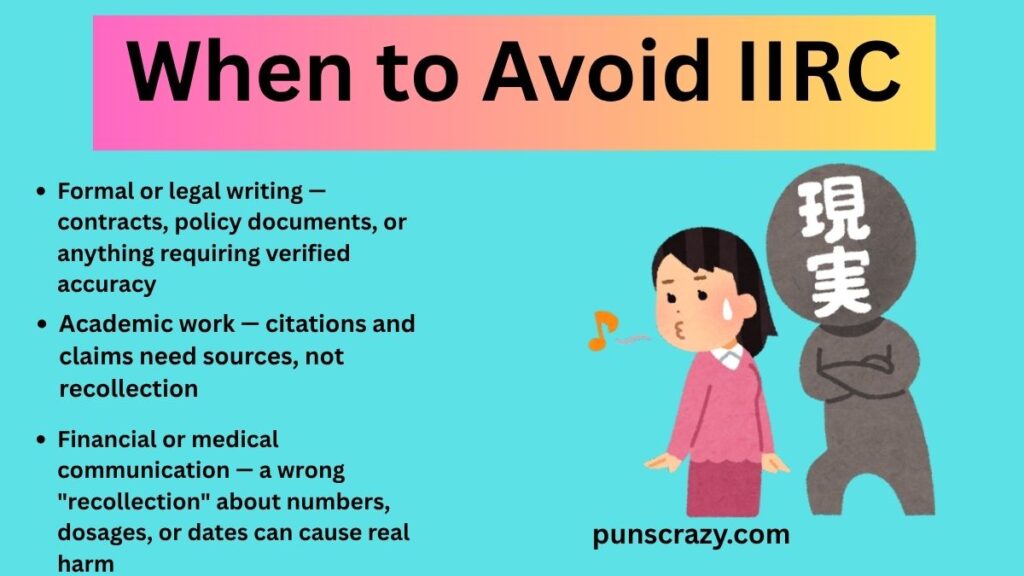
Not every context calls for a memory hedge. Skip IIRC in:
- Formal or legal writing — contracts, policy documents, or anything requiring verified accuracy
- Academic work — citations and claims need sources, not recollection
- Financial or medical communication — a wrong “recollection” about numbers, dosages, or dates can cause real harm
- Client-facing professional messages — it can read as unprepared rather than casual
Expert tip: If getting the fact wrong would cause a real problem, don’t hedge with IIRC — verify the information first, then state it plainly or cite your source.
IIRC vs. Similar Acronyms
IIRC belongs to a small family of uncertainty markers and hedging language used across online conversations. Here’s how they compare:
| Acronym | Full Phrase | Signals | Best Used When |
| IIRC | If I Recall Correctly | Memory-based uncertainty | Recalling a fact, date, or detail |
| AFAIK | As Far As I Know | Knowledge-based uncertainty (current info) | Sharing what you currently understand, which could be incomplete |
| IMO / IMHO | In My Opinion / In My Humble Opinion | Subjective viewpoint | Sharing a personal take, not a fact |
| FWIW | For What It’s Worth | Offering input without authority | Adding a comment that may or may not be useful |
| TBH | To Be Honest | Candor or blunt honesty | Sharing a frank opinion or admission |
| FYI | For Your Information | Neutral information-sharing | Passing along a fact with no uncertainty attached |
| IDK | I Don’t Know | Complete lack of knowledge | Admitting you simply don’t have the answer |
IIRC vs. AFAIK
These two get confused often because both express uncertainty, but the distinction is meaningful. IIRC relies on memory — you’re recalling something you learned or experienced before. AFAIK relies on current knowledge — you’re describing the limits of what you know right now, which may just be incomplete rather than misremembered. “IIRC, the store closes at 9” (recalling a past fact) reads differently than “AFAIK, the store is still open” (describing present-day knowledge that might be outdated).
IIRC vs. IMO
IMO signals an opinion; IIRC signals a recollection. “IMO, that restaurant is overrated” is a subjective judgment. “IIRC, that restaurant closed last year” is a factual claim the speaker isn’t fully sure about. Mixing these up can confuse the listener about whether you’re stating a fact or a preference.
How to Respond When Someone Uses IIRC
When someone hedges with IIRC, there are three natural ways to respond:
- Confirm it: “Yep, that’s right — good memory.”
- Gently correct it: “Close, but I think it was actually Thursday, not Wednesday.”
- Ask for clarification: “Are you sure? Can you double check?”
Because IIRC already signals openness to being wrong, responding with a correction rarely comes across as rude — the speaker built in room for that possibility from the start. This is part of what makes IIRC useful for online etiquette: it lowers the social cost of being mistaken for everyone involved.
Common Mistakes People Make With IIRC
- False modesty: Using IIRC when you’re actually completely certain, just to sound less blunt. This can undercut your credibility if people start noticing the pattern.
- Missing sarcasm: Because tone doesn’t always translate in text, a sarcastic IIRC can be misread as genuine uncertainty, and vice versa. When it matters, add context or a follow-up line.
- Overuse: Sprinkling IIRC into every other sentence dilutes its meaning and makes a message harder to read. Save it for moments where the hedge actually adds something.
- Using it where precision is required: As covered above, IIRC has no place in contexts where being wrong has real consequences.
Best Practices for Using IIRC
- Use it when you genuinely want to flag memory-based uncertainty — that’s its actual job
- Pair it with a follow-up if accuracy matters: “IIRC it’s Thursday, but I’ll confirm”
- Reserve it for casual and semi-formal contexts, not formal writing
- Read your message back before sending if tone (sarcastic vs. sincere) might be unclear
Is IIRC Still Relevant in 2026?
Yes — and this is worth stating plainly rather than hedging on it. IIRC remains one of the more durable pieces of internet vocabulary, largely because the underlying need it serves — flagging memory-based uncertainty quickly — hasn’t gone away. Newer slang tends to cycle in and out with trends and platforms, but hedging acronyms like IIRC, AFAIK, and TBH have stayed functionally useful across three decades of shifting internet culture because they solve a communication problem rather than signaling a trend or in-group identity.
If anything, the rise of AI-assisted writing and voice-to-text messaging has reinforced the value of these short qualifiers, since they’re quick to type or dictate and instantly recognizable across generations of internet users — from people who first encountered IIRC on IRC and Usenet to teens using it in TikTok comments today.
FAQs
What is the IIRC Meaning in online chats?
IIRC Meaning stands for “If I Recall Correctly” or “If I Remember Correctly.” People use it when sharing information they believe is accurate but are not completely certain about.
How do you use IIRC in a sentence?
You can write, “IIRC, the meeting starts at 10 AM.” It helps show that you are recalling information from memory.
Is IIRC used on social media?
Yes, IIRC is commonly used on social media platforms, forums, messaging apps, and online communities to express uncertainty politely.
What is the difference between IIRC and IMO?
IIRC refers to remembered information, while IMO means “In My Opinion” and expresses a personal viewpoint rather than a memory.
Is IIRC considered professional?
IIRC is acceptable in casual workplace chats and informal emails. In formal business communication, it is usually better to write out the full phrase.
Why do people use IIRC instead of writing the full phrase?
Using IIRC saves time and keeps online conversations short. It is a widely recognized internet abbreviation.
Can IIRC be used when you’re not completely sure?
Yes, that is exactly its purpose. IIRC signals that you are relying on memory and that the information may need verification.
Is IIRC still popular in 2026?
Yes, IIRC remains a commonly used internet acronym in 2026, especially in online discussions, forums, gaming communities, and messaging apps.
Are there similar abbreviations to IIRC?
Yes, similar terms include “AFAIK” (As Far As I Know) and “IMHO” (In My Humble Opinion). These acronyms also help indicate the level of certainty behind a statement.
Should IIRC be written in uppercase or lowercase?
Both forms are correct. You can write IIRC or iirc, depending on your writing style and the platform you are using.
Conclusion
Understanding the IIRC Meaning helps you follow online conversations with more confidence. This common acronym is used when someone is sharing information they remember but are not completely certain about. Knowing how and when it is used can make chats, forums, and social media discussions easier to understand. It also helps you communicate more clearly in casual digital conversations.
The IIRC Meaning is simple, but it plays an important role in online communication. It shows that a person is recalling information from memory rather than stating a fact with complete certainty. By recognizing this abbreviation and its context, you can better interpret messages and avoid confusion. Keeping the meaning in mind will help you navigate modern internet slang and understand everyday online discussions more effectively.
Gyatt Meaning: What It Really Means, Where It Came From & How to Use It
Sigma Meaning Slang: What It Really Means in Modern Conversations (2026)
Poignant Meaning: What It Really Means and How to Use It 2026

Will Jack is the creative mind behind Punscrazy, a humor-focused platform dedicated to clever wordplay and lighthearted entertainment. With a passion for puns and witty expressions, he curates and creates engaging content that brings smiles to readers around the world. His work blends creativity with simplicity, making humor accessible for everyday moments, social media captions, and casual fun.