Heard someone say “orgo” and had no idea what they meant? Whether it came from a classmate, a text message, or a TikTok comment, this guide covers every meaning of Orgo Slang Meaning — where the term came from, who uses it, and exactly how to use it yourself.
✅ Key takeaway: “Orgo” = organic chemistry in academic contexts. “Orgo” = organic (food/lifestyle) in wellness contexts. Rarely, it abbreviates “organizational” in corporate shorthand. Everything else you’ve read claiming otherwise is filler.
What Does Orgo Mean?
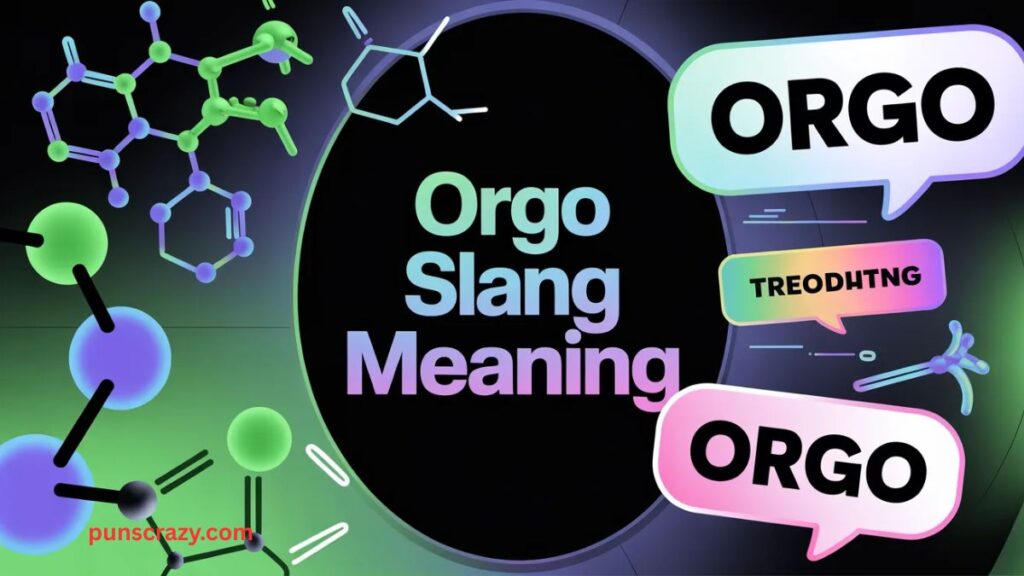
“Orgo” is informal shorthand for organic chemistry — specifically, the notoriously difficult college course that trips up thousands of pre-med students every year.
That said, Orgo Slang Meaning isn’t limited to just one definition. Context shapes its meaning more than you’d think. In a college dorm, “orgo” almost always means organic chemistry. But in a grocery store conversation, it might mean “organic” — as in organic produce or organic skincare. In a corporate Slack message, you might even see it used as shorthand for “organizational.” We’ll cover all of these meanings, but the first one is still the most common by far.
Real-World Examples of Orgo in a Sentence
Academic Context
“I failed my first orgo exam. I need to find a study group this weekend.”
Casual Text
“Can’t come out tonight — orgo midterm on Thursday and I haven’t even started the mechanisms.”
Lifestyle / Organic
“I only buy orgo milk now. Yes, it costs twice as much. No, I don’t care.”
Social Media Caption
“Orgo has humbled me. Three hours studying functional groups and I still can’t name them correctly.”
Where Did Orgo Come From? Origin and History
The Academic Roots — Organic Chemistry Nickname
Organic chemistry earned the nickname “orgo” on American university campuses — likely sometime in the 1970s or 80s, when the course became a standard requirement for pre-med programs. Students needed a shorthand. “Organic chemistry” is a mouthful when you’re already exhausted from studying it. So “orgo” stuck.
The shortening follows a natural linguistic pattern. English speakers love clipping multi-syllable academic nouns — “bio” for biology, “psych” for psychology, “econ” for economics. “Orgo” fits right into that tradition. The “-o” ending gives it a slightly playful, almost self-deprecating tone, which is fitting for a course with a reputation for breaking GPAs and pre-med dreams.
How College Culture Spread It Beyond Campus
For decades, “orgo” lived almost exclusively inside university walls — dorms, dining halls, pre-med advising offices. Then the internet happened. Study blogs, forums, and eventually Reddit and TikTok turned campus slang into digital-native vocabulary. Anyone who’d ever taken the course — or lived with someone who had — picked up the word. Today, even people who’ve never set foot in a chemistry lab recognize “orgo” because of the sheer volume of content tagged with it online.
Timeline: How Orgo Evolved
1970s–80s
Campus slang emerges at US universities, mainly among pre-med undergrads referring to organic chemistry
1990s
Usage spreads through word of mouth as pre-med culture grows; first appearances in print student newspapers
2005–2012
Online forums like The Student Doctor Network and early Reddit boards bring “orgo” to digital audiences nationwide
2015–2019
“Organic” food trend pushes “orgo” into a second casual meaning in lifestyle conversations and social media captions
2020–2026
TikTok study culture explodes; #orgo becomes a recognized hashtag with millions of views; the word goes fully mainstream
Orgo in Academic and Professional Settings
Orgo as Short for Organic Chemistry — What Students Actually Mean

Ask any pre-med, biology, or biochemistry student in the US what “orgo” means and they’ll answer without hesitation: it’s Organic Chemistry I and II, the two-semester sequence that every aspiring doctor, pharmacist, and biomedical researcher has to survive. The course covers carbon-based molecules, reaction mechanisms, stereochemistry, and spectroscopy — concepts that are notoriously abstract and cumulative. Miss one week and you’re playing catch-up for the rest of the semester.
The word carries emotional weight that “organic chemistry” doesn’t quite capture. When a student says “orgo is killing me,” they’re not just describing a course. They’re communicating stress, sleeplessness, and a very specific kind of academic dread. That emotional shorthand is part of why the nickname persists.
Why Orgo Has a Reputation (Pre-Med Culture and Weed-Out Classes)
Orgo is widely known as a “weed-out” course — a deliberately difficult class designed to thin out pre-med students who aren’t ready for medical school. Whether that framing is fair gets debated endlessly on Reddit’s r/premed. What isn’t debated: orgo has one of the highest failure and withdrawal rates of any undergraduate science course. That reputation feeds the slang. The word “orgo” almost functions as a battle scar — shorthand for “I survived something hard.”
💡 Interesting note: Studies of pre-med attrition consistently show that organic chemistry is the single course most cited by students who switch majors or abandon medical school aspirations. It’s not just slang — it’s a cultural milestone.
How Professors and Academic Communities Use the Term
Faculty use “orgo” too — more than you’d expect. Even professors teaching the course will say it in office hours, syllabus discussions, and advising emails. It signals approachability. A professor who says “orgo” instead of “organic chemistry” subtly communicates that they understand what students are going through. In that sense, the slang does social work — it bridges the gap between instructor and student.
Orgo in Medical School Conversations
Once students enter medical school, “orgo” becomes a fond (or not-so-fond) memory reference. You’ll hear phrases like “orgo flashbacks” when a biochemistry concept resurfaces, or “orgo vibes” when a class feels brutal. It’s nostalgic shorthand for the gauntlet they already ran. Some medical school applicants strategically mention orgo in interviews to demonstrate perseverance — proof they tackled something genuinely hard and didn’t quit.
Orgo Slang in Everyday Text and Online Chat
How It Shows Up in Texts and DMs
In casual texting, “orgo” pops up almost exclusively in academic contexts — usually as a reason someone can’t hang out, a complaint about workload, or shared commiseration. It’s rarely used in isolation. More often it appears mid-sentence, naturally embedded in a longer thought.
Typical text exchange
“Hey are you coming to the party?” / “Can’t, orgo lab report is due at midnight and I haven’t touched it.”
Tone and Context — When It’s Serious vs. Joking
Tone matters a lot when understanding “Orgo” slang meaning. “Orgo is actually kind of interesting once you understand the patterns” reads as sincere, while “Orgo has consumed my entire will to live” is almost certainly hyperbolic humor. Students use the word both ways — sometimes in the same sentence. Reading the surrounding context and the person is the best guide.
Does Orgo Appear on WhatsApp and Messaging Apps?
Yes, but naturally — not as a formal acronym or coded term. It travels wherever students do. WhatsApp group chats for study groups are practically built on orgo-related panic messages. Group names like “Orgo Study Gang” or “Orgo Survivors” are common. The word doesn’t change meaning on any specific platform. It’s just campus slang that happens to travel well digitally.
Orgo Across Social Media Platforms in 2026
Orgo shows up differently depending on the platform. Here’s what the landscape actually looks like right now.
TikTok
Biggest platform for orgo content. Study vlogs, reaction videos, and “orgo explained in 60 seconds” clips dominate #orgo. Millions of views collectively.
r/premed, r/college, and r/chemistry use orgo constantly — study tips, vent threads, professor reviews, and “did anyone else fail orgo?” posts.
X (Twitter)
Academic meltdown tweets peak during midterms and finals. “Orgo” appears in organic chemistry rants, study streaks, and pre-med humor accounts.
Study aesthetic accounts use #orgo alongside flat-lay photos of textbooks and coffee. Less conversational, more visual — but the hashtag stays active.
Urban Dictionary
Multiple user-submitted entries confirm the organic chemistry meaning as primary, with several submissions specifically calling it “the class that ruins lives.”
📈 TikTok is now the single biggest driver of orgo-related content in 2026. The study culture wave — fueled by the pandemic era’s remote learning surge — permanently embedded academic slang like orgo into mainstream Gen Z vocabulary.
Does Orgo Mean Anything Outside of Chemistry?
Yes — though these secondary meanings are much less common. It’s worth knowing them so you’re not caught off guard.
Orgo as Slang for “Organic” (Food, Lifestyle, Beauty)
Among people who prioritize organic food, clean beauty, or natural living, “Orgo” slang meaning often refers to a casual shortening of “organic.” Think: “grabbed some orgo tomatoes at the farmers market” or “my whole skincare routine is orgo now.” It’s more of an informal quirk than an established slang term — you’d recognize it in context rather than look it up. The food and wellness communities on Instagram and TikTok use it this way, but loosely.
Orgo in Organizational Contexts
Less commonly, “orgo” shows up in corporate shorthand for “organizational” — as in org charts, org design, or organizational restructuring. You might see it in internal documents or Slack messages at tech companies where teams abbreviate aggressively. “We’re doing an orgo redesign next quarter” would mean an organizational redesign. This usage is niche and context-dependent — don’t assume it unless you’re clearly in a workplace setting.
What Orgo Does NOT Mean — Clearing Up Misconceptions
Some word-meaning sites pad their content with speculative uses that simply don’t exist in practice. Let’s be direct about what orgo is not:
- It has no established meaning in dating app culture
- It has no specific LGBT community usage
- It isn’t a physics or aerospace term
- It isn’t a medical abbreviation in clinical settings
- It has no verified gang-related or coded meaning
If you’ve read those claims elsewhere, they were invented for SEO padding. The actual documented meanings are organic chemistry, organic (food/lifestyle), and occasionally organizational. That’s the honest list.
Orgo vs. Similar Slang Terms — What’s the Difference?
Orgo lives in a family of academic shorthand terms. Here’s how it compares to the ones you’ll hear most often.
| Term | Full meaning | Common context | Tone |
|---|---|---|---|
| Orgo | Organic Chemistry / Organic | Pre-med, college, lifestyle | Casual, often stressed |
| Bio | Biology | High school, college | Neutral, widely used |
| Chem | Chemistry (general) | High school, early college | Neutral |
| Biochem | Biochemistry | Upper-level undergrad, med school | Technical, slightly daunting |
| Org | Organization (singular) | Professional, non-profit, campus groups | Neutral to formal |
| Orgs | Organizations (plural) | Campus life, NGOs, corporate | Neutral |
The key distinction between “orgo” and “org”: the terminal “o” in orgo comes from the word “organic,” not “organization.” They’re completely different abbreviation lineages that just happen to look similar. Don’t mix them up in professional settings.
Is Orgo Still Popular? Trends and Usage in 2026
More Mainstream Than Ever — Here’s Why
Short answer: yes, orgo is more widely recognized in 2026 than it’s ever been. The study culture content wave on TikTok that peaked around 2021–2023 permanently expanded the audience for academic slang. Words like orgo, “Pomodoro,” “spaced repetition,” and “MCAT” went from niche pre-med vocabulary to common Gen Z reference points.
Pre-med enrollment hasn’t shrunk, either. Interest in healthcare careers surged post-pandemic — which means more students taking orgo, more people searching for help with it, and more organic chemistry content floating around social media than ever before.
Who Uses It Most — Demographics and Communities
- Undergraduate students in STEM programs, especially pre-med and biology majors
- Medical school students and applicants reflecting on their undergrad experience
- Tutors, study influencers, and academic content creators
- Parents of college students who’ve absorbed the term from their kids
- People in organic food and wellness communities (secondary, lifestyle meaning)
How Usage Has Shifted from 2020 to 2026
In 2020, orgo was primarily text-based — Reddit threads, study blogs, group chats. By 2026, it’s video-native too. Thousands of TikTok creators have built audiences partly around orgo content. The emotional register hasn’t changed much — it still signals difficulty, community, and commiseration — but the audience has broadened considerably beyond active students. Alumni, prospective students, and people who’ve never taken chemistry all recognize and use the word now.
How to Use Orgo Correctly — and When to Avoid It
Contexts Where Orgo Fits Naturally
- Texting or messaging classmates about coursework
- Social media posts about studying, pre-med life, or academic stress
- Casual conversations with anyone who’s been through college science
- Study group communication, tutoring sessions, office hours chat
- Organic food or lifestyle conversations (secondary meaning only, add context)
Situations Where It Could Confuse or Mislead
Avoid “orgo” in formal academic writing, professional emails, or any document where precision matters. A lab report should say “organic chemistry,” not “orgo.” A medical school personal statement probably shouldn’t use it either — unless you’re deliberately crafting a casual, self-aware voice, and even then, tread carefully. The word reads as student slang; decide if that’s the impression you want.
⚠️ If you’re using “orgo” to mean “organic food” in a conversation with a student or pre-med, expect confusion. The chemistry meaning is so dominant that it’ll almost certainly be their first interpretation. Add context — “orgo as in organic produce” saves the mix-up.
How to Respond When Someone Drops “Orgo” in Conversation
Context almost always makes the meaning clear. Is the person a student? Chemistry. Are they at a farmers market? Organic food. Corporate meeting? Possibly organizational. When you’re genuinely unsure, just ask — “orgo as in organic chem?” lands naturally and doesn’t feel pedantic at all.
Frequently Asked Questions
What does “orgo” mean in slang?
Primarily, it’s informal shorthand for organic chemistry — the famously difficult college science course required for pre-med and biology majors. Secondarily, it can mean “organic” in a food or lifestyle context.
Is orgo only used by students?
No. It started with students but spread to anyone who’s been through pre-med culture, study content creators, and people who follow organic lifestyle trends. Even parents of college students use it now.
What class is orgo short for?
Organic Chemistry — typically the two-semester sequence (Orgo I and Orgo II) taught to undergraduate pre-med, biology, and chemistry students.
Does orgo have a different meaning in texting?
Not really. The meaning stays consistent across text, chat, and social media. Context determines which sense is active — chemistry or organic lifestyle — but the word itself doesn’t shift.
Is orgo still used in 2026?
Absolutely. It’s more mainstream than ever, thanks to study culture on TikTok and the continued popularity of pre-med content online.
Can orgo refer to organic food or lifestyle?
Yes, but as a secondary and less common usage. You’ll see it in wellness communities and organic food conversations. It’s recognizable but not dominant — organic chemistry is still the primary association for most people.
What’s the difference between “orgo” and “org”?
“Org” is short for organization — a completely separate word with no connection to chemistry. “Orgo” comes from “organic.” They share letters but nothing else. Don’t confuse them, especially in professional settings.
The Bottom Line on Orgo Slang
“Orgo” does a lot of work in very few letters. It carries the weight of a notoriously brutal course, the solidarity of a shared academic struggle, and — in a completely different lane — the casual shorthand of people who care about what goes into their food.
Most of the time, you’ll encounter it in an academic context. A student saying “orgo is destroying me” doesn’t need a glossary entry. They need a study group and probably some sleep. But now you know every layer of the word — where it came from, how it evolved, who uses it, and exactly when to deploy it yourself.

Will Jack is the creative mind behind Punscrazy, a humor-focused platform dedicated to clever wordplay and lighthearted entertainment. With a passion for puns and witty expressions, he curates and creates engaging content that brings smiles to readers around the world. His work blends creativity with simplicity, making humor accessible for everyday moments, social media captions, and casual fun.