You’ve seen it everywhere. In comment sections, text messages, group chats, and even on dating apps. Someone does something ridiculous and the reply is just two letters: SMH. Simple. Devastating. And somehow, perfectly enough.
But what does SMH actually mean — and are you using it right? Let’s break it all down.
What Does SMH Actually Mean?
SMH stands for “Shaking My Head.”
That’s it. No secret second meaning, no hidden layer. When someone types SMH, they’re doing the digital version of slowly shaking their head at something they find frustrating, foolish, or just painfully avoidable.
Quick Definition: SMH = Shaking My Head. Used to express disbelief, frustration, disappointment, or mild annoyance in response to something you can’t quite believe just happened.
Think of it as the written equivalent of watching someone walk into a glass door and going …really?
The emotion behind SMH sits in a specific lane — it’s not rage, not laughter. It’s that quiet, exasperated feeling of I can’t believe this. A digital shrug crossed with a head shake. Disappointed, but not surprised.
Common emotional range SMH covers:
- Disbelief — “You did what now?”
- Frustration — mild irritation at something avoidable
- Annoyance — when someone keeps making the same mistake
- Disappointment — let down, but not shocked
- Sarcasm — playful judgment between friends
- Amusement — sometimes it’s just funny-sad
The Origin Story — Where Did SMH Come From?
Here’s where internet culture gets interesting.
SMH didn’t pop up overnight. It grew quietly in the early 2000s, first appearing in online forums and early internet communities — the kind of places where shorthand ruled because nobody wanted to type full sentences on a dial-up connection.
The earliest confirmed entry for SMH appeared on Urban Dictionary in 2004, defined simply as “shaking my head” — used to show disbelief or exasperation. But the abbreviation was circulating in forums and chat rooms even before that entry was logged.
Then something shifted around 2010–2012. Twitter exploded. Black Twitter in particular turbocharged SMH into mainstream use, deploying it with precision humor and cultural commentary. A bad political take? SMH. A celebrity doing something predictably ridiculous? SMH. A friend who burned dinner again? You already know.
By 2012, SMH wasn’t niche anymore. It was texting slang vocabulary for an entire generation.
SMH Timeline at a Glance:
| Year | Milestone |
| Early 2000s | First use in internet forums and chat rooms |
| 2004 | First documented Urban Dictionary entry |
| 2010–2012 | Goes mainstream via Twitter and Black Twitter |
| 2014–2016 | Crosses into Instagram captions and Snapchat chats |
| 2018–2020 | TikTok brings it to Gen Z as video text overlay |
| 2023–2026 | Still widely used; evolving with new variations like “smh fr fr” |
What makes SMH stick is that the gesture it represents — slowly shaking your head — is universally human. Every culture understands that motion. Converting it to an acronym was just natural compression.
How SMH Is Used in Real Conversations
Context is everything with SMH. The same two letters can mean very different things depending on tone, punctuation, and who’s sending it.
Scenario 1 — Genuine frustration:
“He showed up 45 minutes late and didn’t even apologize. SMH.”
Scenario 2 — Playful teasing:
“You put ketchup on a steak? SMH 😂”
Scenario 3 — Reacting to news:
“Politicians just voted themselves another pay raise. SMH.”
Scenario 4 — Self-directed:
“Forgot my coffee on the counter again. SMH at myself honestly.”
Notice the difference between SMH with no emoji (more serious, more resigned) versus SMH 😂 (light, jokey). That tiny emoji completely changes the temperature of the message.
How punctuation shifts the meaning:
- smh — casual, low energy disappointment
- SMH — more emphatic, genuinely fed up
- smh. — that period hits different. Cold. Done.
- smh 😂 — you’re laughing but also judging
- SMH fr fr — absolutely cannot believe this, intensified
SMH Across Different Platforms — Does Context Change It?
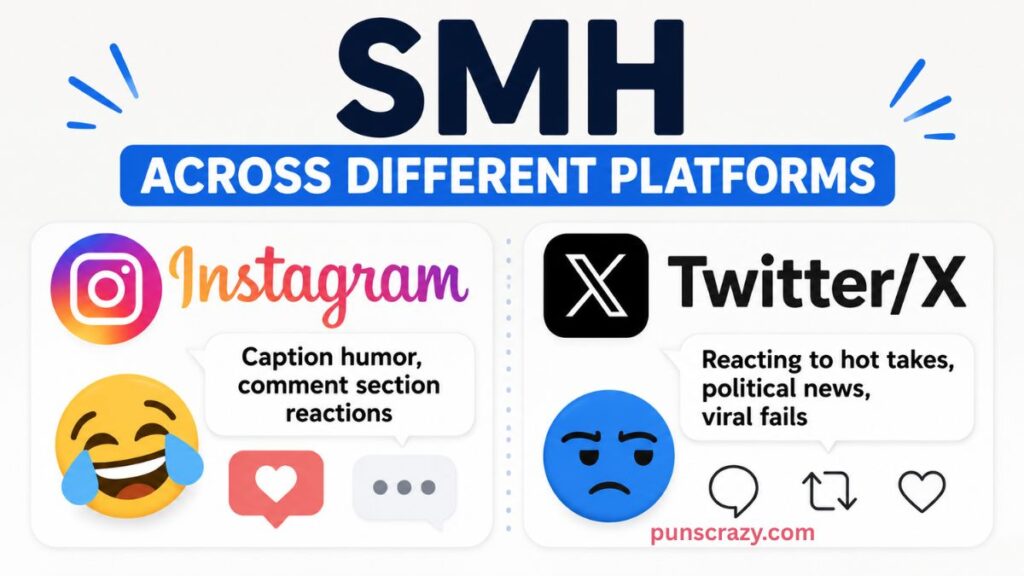
Short answer: yes. SMH travels across every major online platform but the tone shifts depending on where you are.
| Platform | Typical Usage | Predominant Tone |
| Twitter/X | Reacting to hot takes, political news, viral fails | Exasperated, sharp, political |
| Caption humor, comment section reactions | Playful, sarcastic | |
| TikTok | Video text overlays, comment sections | Ironic, generational humor |
| Snapchat | One-on-one casual texting | Lighthearted, quick |
| Group chats, family conversations | Varies widely — playful to genuine | |
| Forum threads, subreddit commentary | Dry, sardonic | |
| Discord | Gaming servers, community chats | Deadpan humor |
| Dating apps | Reacting to bad openers, red flags | Flirtatious or dismissive |
On Twitter/X, SMH often carries real emotional weight — it’s a reaction to something that genuinely bothers the writer. And on TikTok, it’s more often ironic or used as part of a comedic bit. On Snapchat and in text messages, it’s low stakes — the kind of thing you fire off without overthinking.
The platform shapes the subtext. Same acronym, different universe.
SMH Beyond Texting — Other Fields and Lesser-Known Meanings
Here’s something most people don’t know: SMH has a life outside of internet slang.
Other documented meanings of SMH:
- Sydney Morning Herald — Australia’s largest daily newspaper. Journalists, media professionals, and Australians regularly use SMH to refer to the publication. Context makes this instantly clear.
- Standard Mean Height — used in certain medical and statistical contexts
- Submucosal Hematoma (SMH) — a medical terminology term used in clinical documentation
- Aviation & Technical Fields — certain aviation and engineering databases list SMH as a locator code or technical shorthand
- Physics — in some academic papers, SMH appears in equations and unit shorthand
In everyday digital communication, none of these alternative meanings cause confusion. If someone texts you “SMH at that parking ticket,” they’re definitely not referencing an Australian newspaper. Context does all the heavy lifting.
The core meaning — shaking my head — dominates 99% of usage across all social media and messaging platforms globally.
Common Mistakes People Make With SMH
Even simple slang gets misused. Here’s what to watch for.
Mistake #1: “SMH my head”
This one’s everywhere — and it’s redundant. The H in SMH already stands for “head.” Saying “SMH my head” is like saying “shaking my head my head.” People do it anyway (language evolves, habits form), but technically it’s a double-up. The correct standalone form is simply SMH.
Mistake #2: Overusing it until it loses punch
Drop SMH into every message and it stops meaning anything. It’s like crying wolf — save it for moments that actually warrant a head shake.
Mistake #3: Using it in formal or professional settings
This is a real one. Sending SMH in a work email, a message to a client, or in any formal communication context reads as unprofessional — even if the sentiment is justified. Keep SMH in informal workplace chat at most, and even then, read the room. A Slack DM to a close colleague? Maybe fine. A reply-all to the whole company? Hard no.
Mistake #4: Misreading the tone
SMH can be playful OR genuinely frustrated. If you respond to a joking SMH with a serious apology, things get awkward fast. Look for surrounding emoji, punctuation, and context before deciding how to respond.
Mistake #5: Thinking it means “so much hate”
This definition floats around and it’s simply wrong. It doesn’t stand for “so much hate,” “so my heart,” or any other variation. Shaking my head is the original, universal, and correct meaning — full stop.
Terms You’ll See Alongside SMH — And When to Use Which
SMH doesn’t exist in isolation. It belongs to a whole ecosystem of similar abbreviations and reaction expressions. Here’s how they compare.
| Term | Full Meaning | Emotional Register | Best Used When… |
| SMH | Shaking My Head | Mild-medium disappointment | Something is foolish or avoidable |
| SMDH | Shaking My Damn Head | Stronger, more exasperated | You’re really fed up |
| SMFH | Shaking My F***ing Head | Intense frustration | At your absolute limit |
| FML | F*** My Life | Self-directed despair | Your own bad luck |
| IKR | I Know, Right? | Agreement + shared frustration | Validating someone’s complaint |
| LOL | Laugh Out Loud | Amusement | Something’s actually funny |
| Bruh | — | Deadpan disbelief | Gen Z catch-all for “really?” |
| NGL | Not Gonna Lie | Honest admission | Confessing something reluctant |
The 🤦 facepalm emoji deserves special mention here — it’s the visual twin of SMH. Many people use both together for emphasis: “smh 🤦♂️” to double down on the sentiment. The facepalm gesture and SMH occupy the same emotional space: this is embarrassing to witness.
SMH fr fr is a 2023–2026 evolution worth knowing. Adding “fr fr” (for real, for real) cranks the intensity up. It’s not ironic anymore — you genuinely cannot believe what just happened.
How to Respond When Someone Sends You SMH
Getting an SMH in your direction can feel a little stinging if you’re not sure what to do with it. Here’s how to navigate it.
If the SMH is playful: Match the energy. Send one back, drop a meme, or lean into the joke. Don’t overthink it.
Them: “You ate the last slice of pizza smh” You: “And I’d do it again 😈”
If the SMH is genuinely frustrated: Acknowledge it. Don’t ignore it or go on the defensive immediately. A simple “okay fair” or “yeah that was dumb of me” defuses things fast.
If you’re unsure of the tone: Look at what came before it. Is this a lighthearted conversation? Probably playful. Has the person been expressing real frustration? Take it seriously.
What NOT to do:
- Don’t respond with a wall of text defending yourself to a jokey SMH
- Don’t ignore it entirely in a serious conversation
- Don’t assume it’s always negative — sometimes it’s just affectionate teasing
Sample reply scenarios:
“You forgot our plans again smh” → “I’m so sorry, genuinely. Can we reschedule?”
“You still use Internet Explorer?? SMH 😂” → “It has character, okay”
“Heard what happened at work. SMH.” → “Right?? I’m still processing it.”
SMH in Dating Apps and Romantic Conversations
On dating apps, SMH has carved out a very specific niche. It signals something without having to spell it out — and in the world of swiping and short openers, that economy of expression matters.
When SMH signals playful flirtation:
“You really opened with ‘hey’ smh, try harder 😄”
This is light teasing. It’s inviting a better response. The SMH here is almost a wink.
When SMH signals a genuine red flag reaction:
“He asked me to split the bill on the first date. SMH.”
No emoji. No softening. That’s real disappointment.
The punctuation rule applies especially hard on dating apps. A smh 😂 is an invitation. A smh. is a door closing.
Generational note: Gen Z uses SMH on dating apps to signal self-respect and standards. It’s a shorthand for “I know my worth and this doesn’t meet the bar.” Millennials use it more nostalgically — it’s been in their vocabulary for 15+ years and comes out naturally.
Pro tip: If you’re the one who caused someone’s SMH on a dating app, a self-aware reply usually lands better than getting defensive. Nobody wants to explain themselves to someone who can’t take light ribbing.
How Popular Is SMH? Trends and Data (2026)
SMH had its Google Trends peak somewhere between 2012 and 2016 — the golden era of Twitter slang bleeding into mainstream text messages. During that window, it was genuinely everywhere.
What’s happened since then is interesting. SMH hasn’t died — it’s matured.
Current trend snapshot (2026):
- Search volume remains consistently moderate — millions of people still look up “what does SMH mean” every month, driven largely by older users encountering it for the first time or parents trying to decode their kids’ messages
- TikTok gave SMH a second life as video text overlay, particularly in “can you believe this” style content
- Instagram reels comment sections still deploy SMH regularly
- Gen Z users sometimes treat SMH as slightly dated but still usable — like how older slang gets reclaimed ironically
- New variations like “smh fr,” “smh bestie,” and “smh core” reflect how the base term keeps evolving
The slang is no longer hot the way it was in 2014 — but it’s embedded. It’s part of the internet culture furniture now, the way “lol” is. You don’t even think about it; it just comes out.
Google Trends comparison: SMH vs. related terms (approximate 2024–2026 relative interest)
| Term | Relative Search Interest | Trend Direction |
| SMH meaning | High | Stable |
| SMDH meaning | Medium | Slight decline |
| LOL meaning | Very High | Stable |
| FML meaning | Medium | Declining |
| Bruh meaning | High | Growing |
| NGL meaning | High | Growing |
FAQs
What does SMH mean in texting?
It means “Shaking My Head.” People use it to show disbelief, frustration, or mild disappointment about something. It’s one of the most common pieces of texting slang in digital communication today.
Does SMH mean “so much hate”?
No. That definition occasionally pops up online but it’s incorrect. The real and only widely accepted meaning is “Shaking My Head.” Always has been.
What’s the difference between SMH and SMDH?
Intensity. SMDH (“Shaking My Damn Head”) is a stronger version — more exasperated, more done with whatever’s happening. SMH vs SMDH is essentially mild annoyance versus real frustration.
Can SMH be used positively?
Technically yes, but rarely. Someone might say “she pulled off that outfit, smh she’s gorgeous” — using it as a compliment wrapped in disbelief. This is less common and context-dependent.
Is “SMH my head” correct?
No — it’s redundant. The H already stands for “head.” The correct standalone term is just SMH.
What does SMH mean on Snapchat vs. Instagram?
Same core meaning, slightly different tone. On Snapchat, it tends to be more casual and personal. On Instagram, it often appears in comment sections as a public reaction to content — more performative, sometimes more sarcastic.
What does SMH mean in dating contexts?
On dating apps, SMH usually signals mild disappointment or playful judgment. It’s used to react to bad openers, questionable behavior, or red flags. The tone — serious or flirty — depends entirely on context and emoji use.
Is SMH rude?
It can be, depending on context and delivery. In casual texting between friends, it’s often harmless. Directed at someone seriously and without humor, it can feel dismissive or condescending. Read the room.
What does SMH stand for in professional fields?
Outside of internet slang, SMH is the abbreviation for the Sydney Morning Herald (Australia’s major newspaper) and appears in some medical terminology and technical documentation. None of these overlap with social media usage.
Conclusion
Here’s what it all comes down to: SMH is one of those rare pieces of internet slang that perfectly captures a feeling that’s hard to put into words. Not rage. Not laughter. That specific, resigned, I-can’t-believe-this-is-real sensation of slowly shaking your head.
It started in early internet forums, exploded through Twitter, matured across every social media platform, and now it’s just… part of how people talk online. Two letters, infinite context.
Use it right and it lands perfectly. Use it in a work email to your CEO and, well — SMH at yourself.
The next time someone does something baffling in your group chat, you know exactly what to type.

Will Jack is the creative mind behind Punscrazy, a humor-focused platform dedicated to clever wordplay and lighthearted entertainment. With a passion for puns and witty expressions, he curates and creates engaging content that brings smiles to readers around the world. His work blends creativity with simplicity, making humor accessible for everyday moments, social media captions, and casual fun.