If you’ve ever stared at an Opel badge and wondered what the word actually means, here’s the answer up front: Opel isn’t an acronym, a German word, or a hidden code. It’s a family surname. The brand is named after Adam Opel, a locksmith’s son who started sewing machines in Rüsselsheim in 1862 and had no idea his name would end up on millions of cars, from the Corsa to the electric Grandland, more than 160 years later.
That short answer satisfies the curiosity most people arrive with. But it also raises better questions: Where did the Opel surname come from? Why does the logo have a lightning bolt in it? Is Opel still German-owned? And why do British drivers know the exact same cars under a completely different name? This guide works through all of it, with the real history behind each piece, not recycled trivia.
What Does Opel Mean? The Short Answer
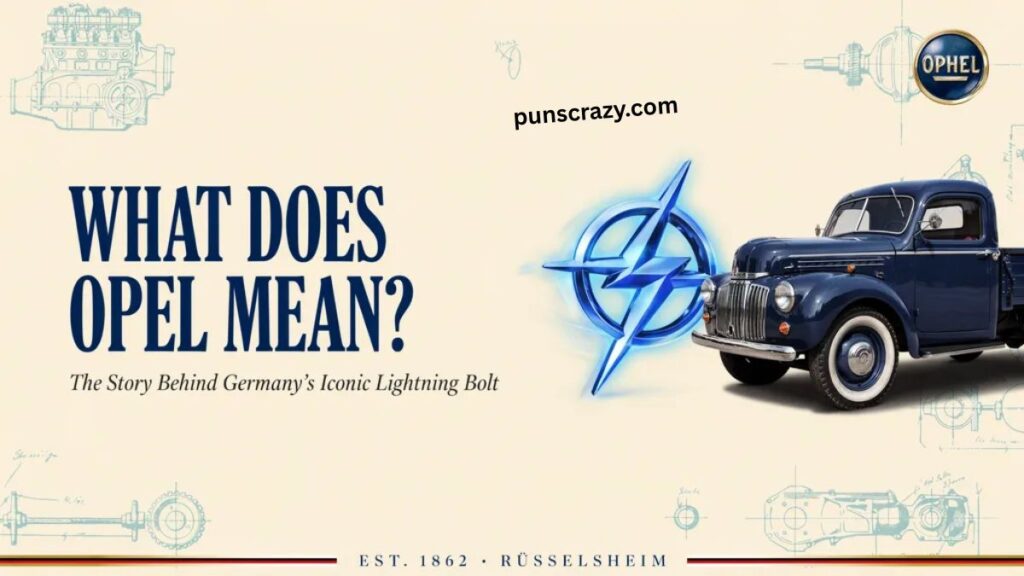
Opel meaning, in the strictest sense, is a proper noun — a family name that became a company name. There’s no German dictionary entry for “opel” as a common word, and it doesn’t translate into English, French, or any other language. When people search “what does Opel mean,” they’re really asking about brand origin, not linguistics, and the origin traces to one man.
Quick Facts About Opel
| Fact | Detail |
| Founder | Adam Opel |
| Founded | 1862, Rüsselsheim, Germany |
| Original product | Sewing machines |
| First car | 1899 (System Lutzmann) |
| Headquarters | Rüsselsheim am Main, Germany |
| Current parent company | Stellantis (since 2017) |
| UK sister brand | Vauxhall |
| Logo symbol | Lightning bolt, from the German word “Blitz” |
| Current CEO | Florian Huettl |
Where the Name “Opel” Comes From
It’s a Surname, Not an Acronym
A lot of car-brand names are built from initials or invented words. BMW stands for Bayerische Motoren Werke. Fiat stands for Fabbrica Italiana Automobili Torino. Opel breaks that pattern entirely. Opel does not stand for anything. No acronym, no backronym, no hidden phrase. It’s simply what it looks like: somebody’s last name, carried forward by the family business he built.
This matters for search intent because “does Opel stand for anything” is one of the most common follow-up questions people ask right after learning the basic Opel definition. The honest answer disappoints acronym-hunters, but it’s also what makes the Opel name meaning genuinely interesting — it’s a story about a person, not a marketing formula.
The German Linguistic Roots of “Opel”
Surname researchers generally trace “Opel” to older German naming patterns, though the exact etymology isn’t settled the way, say, a place-name origin might be. What is well documented is that Opel is a real, pre-existing German family surname, not something invented for branding purposes. So when someone asks about Opel meaning in German, the most accurate answer is: it’s a family name with regional German roots, used the same way “Schmidt” or “Bauer” function as surnames — common, recognizable, and tied to family lineage rather than to any object or concept.
Who Was Adam Opel? The Man Behind the Brand
From Locksmith’s Son to Industrialist
Adam Opel was born on May 9, 1837, in Rüsselsheim, to a locksmith father. He trained in his father’s trade before doing something fairly unusual for the era: he traveled through France and Belgium as a young man, working in machine shops and absorbing manufacturing techniques that were more advanced than what was common in his hometown at the time. That hands-on, cross-border apprenticeship shaped everything he built afterward.
By 1862, at just 25 years old, he’d returned to Rüsselsheim and opened his own workshop. He wasn’t building cars. He was building sewing machines, and doing it well enough that the business grew steadily for two decades.
Sewing Machines Before Cars — How the Company Actually Started
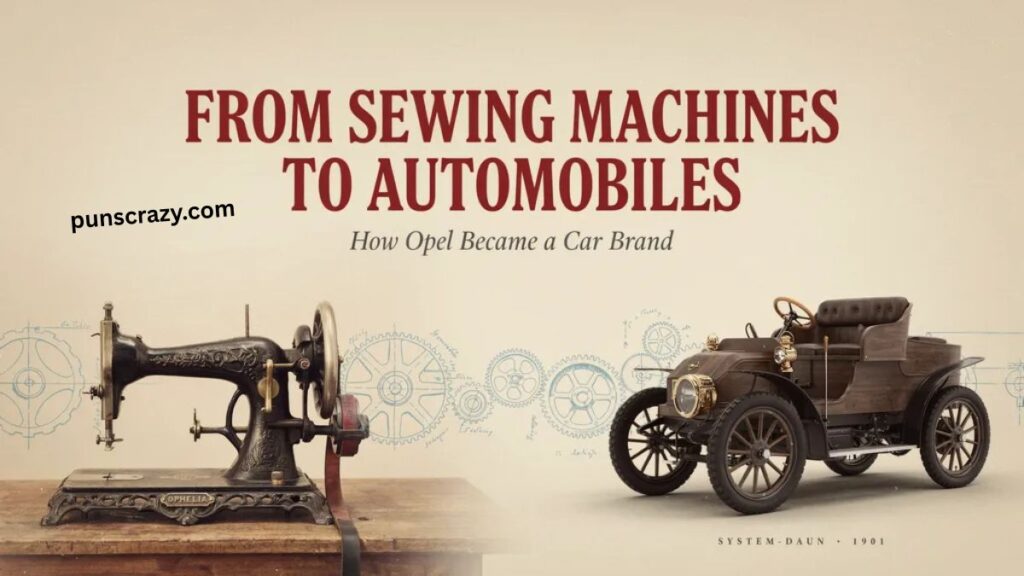
Here’s a detail that surprises a lot of readers: the company that would eventually become one of Germany’s largest automakers didn’t touch a car for its first 37 years. Adam Opel’s sewing machine business was successful enough on its own that by the 1880s, the company was among Germany’s leading sewing machine manufacturers.
Key takeaway: Opel’s foundation wasn’t automotive engineering — it was precision mechanical manufacturing. That expertise in tight tolerances and reliable, repeatable machine work is exactly what later made the jump into bicycles, and then automobiles, possible.
From Sewing Machines to Automobiles: How Opel Became a Car Brand
The Bicycle Years
In the mid-1880s, Opel added bicycles to its product line, riding the massive bicycle boom sweeping Europe at the time. This wasn’t a side project. Opel bicycles became genuinely popular, and the manufacturing discipline required for two-wheeled precision machines gave the company’s engineers a natural bridge toward the far more complex challenge of a horseless carriage.
1899: Opel’s First Car
Adam Opel died in 1895, before the company ever built a car. It was his five sons — Carl, Wilhelm, Heinrich, Friedrich, and Ludwig — who pushed the business into automobiles. They partnered with engineer Friedrich Lutzmann and released the company’s first automobile in 1899, known as the “System Lutzmann.”
That first Opel car wasn’t a runaway success, but it planted the flag. Within a decade, Opel had become one of the largest car manufacturers in Germany, a position it would hold, in various forms, for most of the 20th century.
The Sons Who Took Over After Adam Opel’s Death
It’s worth pausing on this: Opel’s transformation from sewing-machine maker to automaker happened almost entirely under the second generation, not the founder. Adam Opel built the industrial foundation and the trusted name. His sons made the strategic bet on automobiles at exactly the right historical moment, as Germany’s automotive industry was starting to take shape. Without that generational handoff, “Opel” might be a footnote in sewing machine history rather than a household name in European driveways.
The Opel Logo: Meaning and the Hidden Story Behind the Lightning Bolt
This is the part of the Opel meaning story that most articles skip, and it’s genuinely the best piece of it.
The Original Opel Logo (Before the Bolt)
Opel’s earliest branding was fairly plain — wordmarks and simple emblems typical of the era. There was no lightning bolt yet. That came from an entirely different product line: trucks.
Where the Lightning Bolt Really Comes From — The Blitz Connection
In 1929, General Motors acquired an 80% stake in Opel, becoming full owner by 1931. That same year, Opel launched a new light truck and ran a public naming competition to name it. The rules were oddly specific: the name had to be exactly five letters long, easy to pronounce in essentially any language, and it had to be a genuine German word.
The winning entry was “Blitz” — German for “lightning.”
Opel’s designers stylized the truck’s badge with two angled strokes representing a lightning bolt, shaped like a stretched-out letter “Z,” running through the wordmark. That symbol stayed attached to the commercial truck line for decades. The Opel Blitz truck went on to become one of the most widely produced vehicles in Germany through the 1930s and into World War II, which cemented the lightning bolt firmly in the public’s mind as an Opel symbol.
It took roughly three decades for that truck emblem to migrate to the entire company. In the early 1960s, Opel formally adopted a circle-enclosed lightning bolt as its official brand-wide logo, replacing the various zeppelin and rocket motifs the company had experimented with since the late 1930s. From there, the mark went through repeated redesigns — chrome and 3D effects in the 1980s, flatter and more minimal treatments for digital screens in later decades — but the core lightning-bolt-in-a-circle shape has stayed recognizably intact for over 60 years.
The hidden story, in one line: Opel’s most iconic symbol wasn’t designed for cars at all. It was named by a public contest for a delivery truck, and it only became the company’s face decades later.
What the Logo Symbolizes Today
Today’s Opel logo meaning centers on speed, energy, and forward motion — values that make sense for a car brand, even though the symbol’s real origin is a naming contest for commercial trucks. Stellantis has kept the lightning bolt through every recent Opel redesign, including illuminated “Blitz” badges now appearing on newer models like the Astra, because it’s one of the most recognized automotive emblem shapes in Europe.
Does OPEL Stand for Anything? (Debunking the Acronym Myth)
To put this to rest clearly: no, OPEL is not an acronym. It isn’t short for any phrase in German, English, or otherwise. This confusion tends to happen because so many automakers do use acronyms (BMW, FIAT, SEAT), so people assume every car brand name must be one. Opel is simply proof that isn’t always true — the Opel full meaning is nothing more, and nothing less, than a family name that became a global brand.
Who Owns Opel Now? Ownership History
The General Motors Era (1929–2017)
General Motors began acquiring Opel in 1929 and owned the company outright by 1931, holding it for the better part of nine decades. Under GM, Opel became the centerpiece of the American giant’s European operations, supplying engineering and platforms that were shared across GM’s global brands. That relationship wasn’t always smooth — friction between Opel’s German management and GM’s American leadership was a recurring theme, especially as the company struggled through difficult periods in the 1990s and 2000s.
Stellantis and the PSA Acquisition (2017–Present)
In 2017, General Motors sold Opel (along with Vauxhall) to Groupe PSA, the French company behind Peugeot and Citroën, ending nearly 90 years of American ownership. PSA later merged with Fiat Chrysler Automobiles in 2021 to form Stellantis, and Opel has operated as one of Stellantis’s core European brands ever since.
Under Stellantis, Opel has pushed hard into electric mobility. Recent model launches — the Grandland Electric, Frontera Electric, and Mokka GSE Electric — reflect a brand strategy built around affordable EVs for the European mass market, engineered largely out of its historic home base in Rüsselsheim.
Opel vs. Vauxhall: Same Cars, Different Name
If you’ve spent time in the UK, you may know these exact cars under a completely different badge. Vauxhall is Opel’s sister brand, and they’ve shared vehicles, platforms, and ownership for decades. The Opel Astra is the Vauxhall Astra. Opel Corsa is the Vauxhall Corsa. The Opel Mokka is the Vauxhall Mokka.
| Region | Brand Name | Owner |
| Mainland Europe | Opel | Stellantis |
| United Kingdom | Vauxhall | Stellantis |
| Underlying vehicles | Identical or near-identical platforms | Shared engineering |
This dual-branding dates back to GM-era decisions about how to position its European operations, and Stellantis has kept the arrangement rather than merging the two names, since both carry decades of regional brand loyalty.
Opel Timeline: Key Dates in Brand History
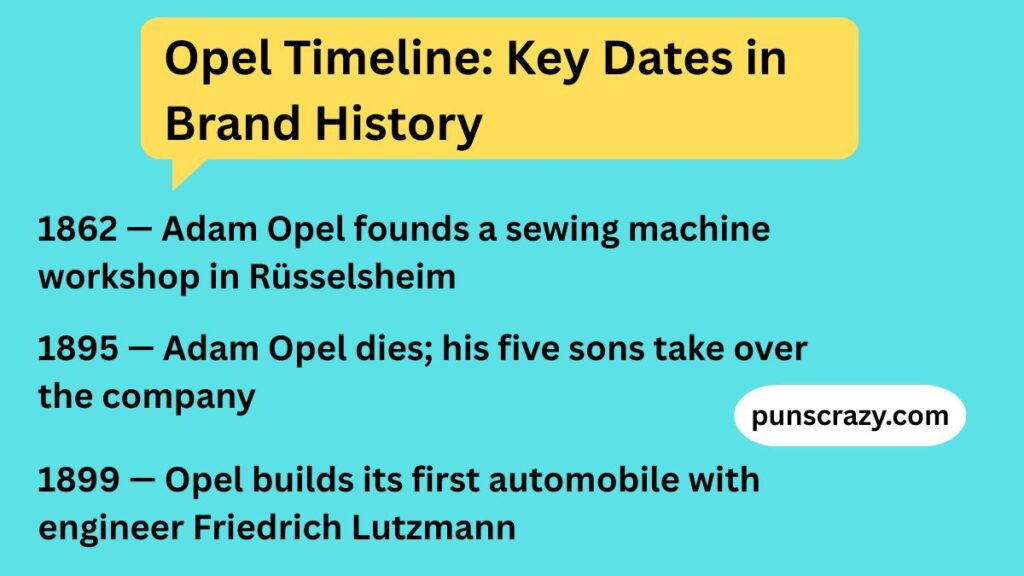
- 1862 — Adam Opel founds a sewing machine workshop in Rüsselsheim
- Mid-1880s — Opel begins producing bicycles
- 1895 — Adam Opel dies; his five sons take over the company
- 1899 — Opel builds its first automobile with engineer Friedrich Lutzmann
- 1929–1931 — General Motors acquires full ownership of Opel
- 1930 — The “Blitz” name is chosen for a new Opel truck through a public naming contest
- Early 1960s — The lightning-bolt-in-a-circle badge becomes Opel’s official company-wide logo
- 2017 — GM sells Opel and Vauxhall to Groupe PSA
- 2021 — PSA merges with Fiat Chrysler Automobiles to form Stellantis
- 2025–2026 — Opel expands its electric lineup (Grandland Electric, Frontera Electric, Mokka GSE Electric) and launches the GSE performance sub-brand
How Opel Compares to Other German Car Brands
Opel vs. Volkswagen
Both are mass-market German manufacturers competing for similar customers, but Volkswagen has remained under continuous German ownership and control since its founding, while Opel changed hands between American and French/Italian-American ownership. Volkswagen also operates as a much larger global conglomerate spanning Audi, Porsche, and Škoda, whereas Opel today functions as one brand within Stellantis’s broader European portfolio.
Opel vs. Mercedes-Benz and BMW (Mass-Market vs. Premium Positioning)
Mercedes-Benz and BMW compete in the premium and luxury segments. Opel has never chased that positioning — its brand identity has always centered on affordable German cars for everyday drivers, not performance flagships or luxury trims. That’s part of why the Opel brand meaning resonates the way it does across Europe: it represents accessible mobility, not aspiration-driven luxury.
How to Pronounce Opel (English vs. German)
Pronunciation trips up a lot of English speakers, partly because the name looks like it should rhyme with words it doesn’t. In everyday English, most people say it as two syllables: OH-pel, with the stress on the first syllable and a short, clipped second syllable. That’s the version you’ll hear from car dealers, reviewers, and casual conversation across English-speaking markets.
German pronunciation is close but slightly different in texture. Native speakers tend to render it closer to [ˈoːpl̩] — a longer, rounder “O” sound followed by a second syllable that almost drops the vowel entirely, landing somewhere between “Oh-pl” and “Oh-pel.” If you’re traveling in Germany or talking with German colleagues, leaning toward that softer, clipped ending will sound more natural than the flatter English version.
Neither pronunciation is “wrong” — they’re just regional variants of the same surname, the same way plenty of German names shift slightly in English mouths.
Why So Many People Search “Opel Meaning”
It’s worth addressing directly why this particular question gets searched so often, because the reasons aren’t all the same.
- Acronym confusion — Because BMW, FIAT, and SEAT are all acronyms, people assume Opel must be too, and go looking for the hidden phrase.
- Logo curiosity — The lightning bolt is distinctive enough that people want to know what it represents before they realize it started life on a 1930s delivery truck.
- Ownership confusion — Long-time drivers who remember Opel under General Motors are often surprised to learn it’s now part of Stellantis, and search to confirm who currently owns the brand.
- Vauxhall crossover — UK buyers researching a car online sometimes stumble onto Opel listings for the identical vehicle and want to understand the connection.
- General trivia and name research — Some searches come from people simply curious about surname origins and German naming conventions, unrelated to cars at all.
Understanding which of these someone is chasing is part of why a single, focused answer rarely satisfies the whole audience — which is also why this guide covers the name, the logo, the ownership, and the sister-brand relationship all in one place.
Frequently Asked Questions
What does Opel mean?
Opel is a German surname. It comes from the company’s founder, Adam Opel, who started the business as a sewing machine manufacturer in 1862. It isn’t a translated word or an acronym.
Is Opel a German brand?
Yes. Opel was founded in Rüsselsheim, Germany, in 1862, and its headquarters and primary engineering base remain there today, even though ownership has passed through American (General Motors) and now French-Italian (Stellantis) hands.
Does Opel stand for anything?
No. Despite the automotive industry’s habit of naming brands after acronyms, Opel is not one. It’s the founder’s surname, nothing more.
Who founded Opel, and when?
Adam Opel founded the company in 1862 in Rüsselsheim, Germany, originally to manufacture sewing machines.
What does the Opel logo represent?
The modern Opel logo, a lightning bolt inside a circle, represents speed and energy. It descends directly from the “Blitz” name given to an Opel delivery truck in 1930.
Why is there a lightning bolt in the Opel logo?
Because “Blitz” — the German word for lightning — was chosen through a public naming contest for a new Opel truck in 1930. The truck’s stylized lightning-bolt badge later became the entire company’s logo in the early 1960s.
Is Opel the same as Vauxhall?
They’re sister brands under the same parent company, Stellantis, selling largely identical vehicles under different names — Opel across mainland Europe, Vauxhall in the UK.
Who owns Opel today?
Stellantis, the multinational automotive group formed in 2021 from the merger of Groupe PSA and Fiat Chrysler Automobiles. PSA acquired Opel from General Motors in 2017.
Final Words
The real Opel meaning turns out to be simpler, and more human, than most people expect. There’s no acronym to decode and no clever wordplay hiding in the name. It’s a locksmith’s son from Rüsselsheim who built sewing machines, whose sons gambled on a strange new invention called the automobile, and whose surname ended up stamped on a lightning bolt logo that traces back to a public naming contest for a delivery truck. More than 160 years later, that same name sits on the hood of some of Europe’s most popular electric vehicles — proof that a good family name, backed by consistent engineering, outlasts just about any marketing gimmick.
Read more:
NGL Meaning: What Does NGL Stand For?
Fein Meaning: What Does “Fein” Really Mean in 2026?
Gyatt Meaning: What It Really Means, Where It Came From & How to Use It

Will Jack is the creative mind behind Punscrazy, a humor-focused platform dedicated to clever wordplay and lighthearted entertainment. With a passion for puns and witty expressions, he curates and creates engaging content that brings smiles to readers around the world. His work blends creativity with simplicity, making humor accessible for everyday moments, social media captions, and casual fun.