There’s a moment in almost every great story — the soldier’s last letter home, the childhood bedroom photographed before the move, the final scene between two people who both know they won’t meet again. You feel it instantly. But what do you call it?
Poignant. That’s the word.
Yet most people who reach for it aren’t entirely sure what it means. They know it sounds right. They sense it carries weight. But the precise, layered meaning of poignant — and what separates it from simply saying sad or touching — is something worth understanding properly.
This guide breaks it all down: the definition, the origin, the emotional nuance, how to use it well, how to avoid using it badly, and why it remains one of the most powerful words in the English language.
What Does Poignant Actually Mean?
The Core Definition — Beyond “Sad”
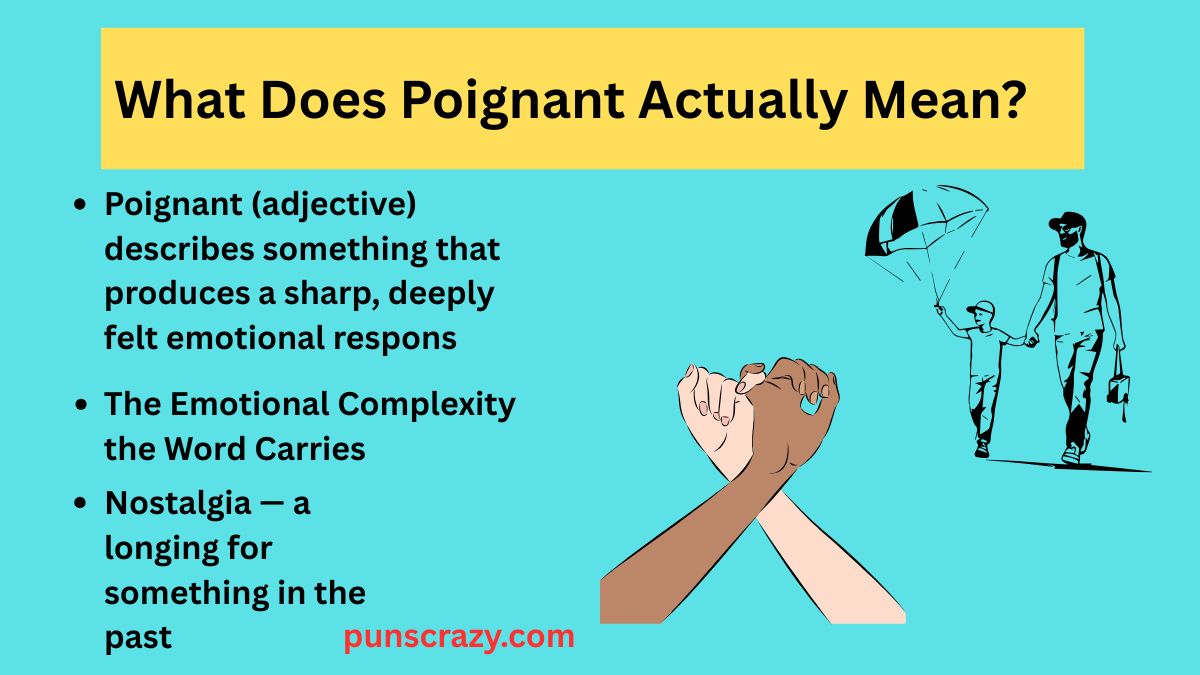
Poignant (adjective) describes something that produces a sharp, deeply felt emotional response — typically one that blends sadness, beauty, and profound meaning all at once.
Merriam-Webster defines it as: “deeply affecting; touching; designed to make an impression.”
But that definition only scratches the surface. What truly sets poignant meaning apart is its emotional complexity. Unlike sad, which describes a single, downward-facing emotion, poignant always carries a counterweight — a sense of beauty, significance, or love that makes the sadness meaningful rather than merely painful.
“Poignant moments aren’t just sad. They’re sad and beautiful and true, all at once.” — A distinction every serious writer understands.
Think of it this way: a funeral where strangers weep is sad. A funeral where someone laughs while telling a story that perfectly captures who the person was — that’s poignant.
The Emotional Complexity the Word Carries
Poignant sits at the intersection of several powerful emotions:
- Nostalgia — a longing for something in the past
- Empathy — feeling what another person feels
- Reflection — awareness of something meaningful passing or lost
- Bittersweet feeling — simultaneous joy and sorrow
- Regret — recognition of what can’t be changed
No single synonym captures all five of those at once. That’s precisely why the word exists — and why it’s worth using carefully.
Why One-Word Synonyms Always Fall Short
Here’s a quick look at what gets lost when you swap out poignant:
| Synonym | What It Captures | What It Misses |
| Sad | Sorrow | Beauty, meaning, complexity |
| Touching | Emotional impact | Depth of reflection |
| Heartbreaking | Grief intensity | Bittersweet quality |
| Moving | General emotion | Specificity of feeling |
| Sentimental | Fond emotion | The piercing quality |
None of these are wrong. They’re just narrower. Poignant does more work in fewer syllables.
Etymology and Origin of Poignant
From Latin pungere to Old French poignant — the “Piercing” Root
The word’s origin is physical before it becomes emotional. Poignant descends from:
- Latin: pungere — “to prick” or “to pierce”
- Old French: poignant — present participle of poindre, meaning “to prick or sting”
- Middle French: retained the same sharp, penetrating sense
That etymology matters. When something is poignant, it doesn’t drift over you — it pierces you. It breaks through emotional armor. The sensation is sharp, not dull. Sudden, not slow.
The physical origin of “piercing” or “pricking” explains why poignant moments feel like they hit rather than simply wash over you.
How the Word’s Meaning Shifted Over Centuries
In early 15th century English, poignant was used literally — describing physical sharpness, like a spear point or a pungent flavor. Spicy food was poignant. A sharp blade was poignant.
Over the following two centuries, language evolution slowly transferred the word’s energy from the physical world to the emotional one. By the 17th and 18th centuries, historical linguistics shows the word appearing increasingly in contexts of grief, beauty, and emotional reflection in English literature.
Today the physical meaning is essentially obsolete. Poignant belongs entirely to the emotional register — and it’s all the more powerful for that focused evolution.
First Recorded Use in English Literature
The Oxford English Dictionary traces poignant in its modern emotional sense to at least the early 17th century. Shakespeare’s contemporaries used it in contexts of sharp grief and acute emotional pain — early evidence that literary vocabulary recognized the word’s precision long before everyday speakers did.
The Emotional Nuance That Makes Poignant Unique
Poignant vs. Sad — A Critical Distinction
This is the most important distinction in the entire article. Get this wrong and you’ll misuse the word every time.
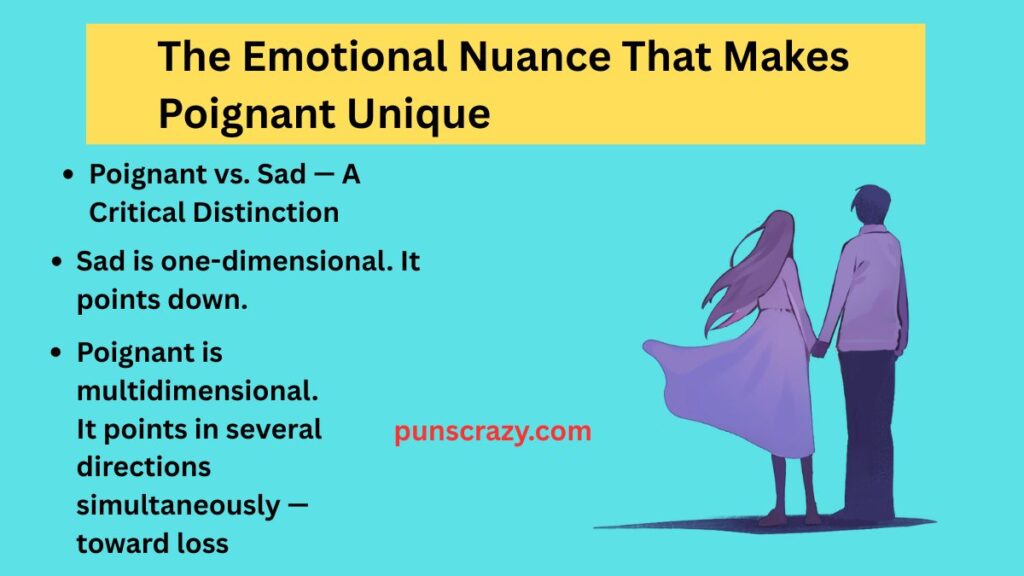
Sad is one-dimensional. It points down.
Poignant is multidimensional. It points in several directions simultaneously — toward loss and beauty, toward grief and love, toward what was lost and why it mattered.
A child crying because they dropped their ice cream is sad.
An elderly man watching his grandchildren play in the same yard where he played as a boy — knowing those children will one day stand in the same spot watching their grandchildren — is poignant.
The difference? Emotional depth, reflection, and meaning.
Why Poignant Always Implies Meaning, Not Just Pain
Here’s the test: if something is poignant, you can always answer the question “Why does this matter?”
- The war memorial is poignant because it represents real human sacrifice.
- The final scene between the estranged father and son is poignant because it’s both too late and not too late.
- The photograph of the empty playground is poignant because absence is its own presence.
Emotional resonance requires context. Poignant moments always carry that context inside them.
The Role of Bittersweetness: When Joy and Grief Coexist
Bittersweetness is perhaps the closest single concept to poignant. Both describe the coexistence of pleasure and pain. But poignant tilts slightly heavier toward the grief side — it has that piercing quality the etymology promises.
A bittersweet experience might be finishing a book you loved. A poignant moment is re-reading the last page and realizing you’ll never experience it for the first time again.
How to Use Poignant Correctly in Writing and Speech
Sentence Structure — Where the Word Lands Best
Poignant works as both an attributive adjective (before a noun) and a predicative adjective (after a linking verb).
Attributive examples:
- “The film’s most poignant scene comes in the final minutes.”
- “She wrote a poignant letter to her younger self.”
- “It was a poignant reminder of everything they’d lost.”
Predicative examples:
- “The moment was deeply poignant.”
- “What made the photograph so poignant was its simplicity.”
It pairs naturally with intensifiers like deeply, quietly, unexpectedly, and achingly — each of which adds a different shade of emotional intensity.
Formal vs. Informal Contexts
Poignant spans registers well, but it carries formal weight.
| Context | Works Well? | Notes |
| Literary essays | ✅ Excellent | Its natural home |
| Eulogies & tributes | ✅ Excellent | Dignified and precise |
| Journalism | ✅ Strong | Used in feature writing, criticism |
| Social media captions | ✅ Moderate | Works for Instagram, less so TikTok |
| Casual conversation | ⚠️ Use carefully | Can sound slightly stiff |
| Academic writing | ✅ Strong | Appropriate in critical analysis |
Real Sentence Examples Across Different Tones
In a literary context: “Steinbeck’s ending is quietly poignant — a mercy and a tragedy delivered in the same sentence.”
In journalism: “The documentary’s most poignant sequence shows the last survivor returning to the village after 60 years.”
But in everyday speech: “There was something poignant about seeing the old school demolished — like losing a version of yourself.”
In a social media caption: “Found this photo from ten years ago. Kind of poignant how much has changed.”
When NOT to Use Poignant — and What to Use Instead
Avoid poignant when:
- The emotion is purely negative with no deeper meaning → use heartbreaking or devastating
- The feeling is warm and light → use touching or sweet
- You’re describing minor disappointment → use bittersweet or simply sad
- The situation is trivial → the word loses all its power applied to small things
Rule of thumb: If you couldn’t write a paragraph explaining why the moment matters beyond its sadness, it probably isn’t poignant.
Poignant in Literature, Film, and Art

Classic Literary Examples
Some of the most celebrated uses of poignant emotional storytelling in the canon:
John Steinbeck — Of Mice and Men (1937) The novel’s ending — George shooting Lennie to protect him — is perhaps the most analyzed poignant moment in American literature. The act is simultaneously an act of love and an act of destruction. Steinbeck earns the word completely.
F. Scott Fitzgerald — The Great Gatsby (1925) Gatsby staring across the bay at the green light, reaching for something he can never touch. Reflective sadness, nostalgia, longing — poignancy built into the architecture of the novel itself.
Chimamanda Ngozi Adichie — We Should All Be Feminists (2014) Adichie’s personal anecdotes — the waiter who addressed only the male companion despite the woman paying — carry a poignant weight precisely because they’re so ordinary. The pain is in the mundanity.
How Screenwriters and Critics Use It
Film critics reach for poignant more than almost any other adjective in their vocabulary. Why?
Because cinema — with its combination of visual image, music, performance, and editing — is uniquely positioned to create emotional resonance that operates on multiple levels simultaneously.
When a critic writes that a movie ending is poignant, they mean the filmmakers have engineered a moment where several emotional truths land at once. The ending of Toy Story 3, for example, is widely described as poignant — not simply because Andy leaves his toys behind, but because every adult watching knows exactly what that moment represents in their own lives.
That recognition — I know this feeling — is the hallmark of genuine poignancy.
Poignant vs. Similar Words — What’s the Real Difference?
Understanding poignant in relation to its neighbors in emotional vocabulary is what separates precise writers from vague ones.
Poignant vs. Touching
| Poignant | Touching | |
| Emotional weight | Heavy, piercing | Lighter, warmer |
| Duration of impact | Lingers | Passes more quickly |
| Complexity | Multi-layered | More straightforward |
| Example use | War memorial | A child’s handmade gift |
Poignant vs. Heartbreaking
Heartbreaking describes extreme grief — pure pain with little redemptive quality. Poignant always carries beauty alongside the sorrow. A heartbreaking story devastates you. A poignant story moves you and leaves you grateful for having felt it.
Poignant vs. Evocative
Evocative is emotionally neutral — it simply means something summons memories or feelings. A smell can be evocative. A color can be evocative. Poignant is never neutral — it always carries emotional weight, and that weight always tilts toward the melancholic.
Poignant vs. Moving
Moving is broader and less specific. It means something stirred strong emotion — but which emotion? Moving could be joy, inspiration, grief, or awe. Poignant is more precise: that specific blend of beauty and sadness and meaning.
Quick Reference Table:
| Word | Emotional Valence | Complexity | Typical Use |
| Poignant | Sad + beautiful + meaningful | High | Literature, criticism, tributes |
| Touching | Warm, emotional | Low-Medium | Everyday speech |
| Heartbreaking | Pure grief | Medium | Tragedy, loss |
| Evocative | Neutral | Low | Memory, atmosphere |
| Moving | Mixed positive emotion | Low | General praise |
| Bittersweet | Joy + sadness | Medium | Personal reflection |
Common Mistakes People Make With Poignant
Using It as a Synonym for Simply “Sad”
This is the most frequent error. Poignant isn’t a fancy word for sad. It requires that additional layer of beauty, meaning, or reflection. A rainy Monday isn’t poignant. The last rainy Monday you spent with someone you’ll never see again — that could be.
Overusing It Until It Loses Weight
Poignant earns its power through careful deployment. Use it three times on one page and it starts to sound empty. The word needs space around it. Writers who pepper their prose with poignant end up saying nothing at all.
Applying It to Trivial Situations
“It was poignant when my coffee got cold.” No. That’s just inconvenient. Applying poignant to small frustrations drains the word of its dignity and signals to readers that you’re not choosing words carefully.
Confusing Poignancy and Poignant
A quick grammar note: the noun form is poignancy — not poignantness (which sounds awkward and isn’t standard).
- ✅ “The poignancy of the moment was undeniable.”
- ❌ “The poignantness of the moment…”
How Poignant Appears in Everyday Language Today
In Journalism and Obituaries
Poignant thrives in feature journalism and obituary writing — contexts where writers are expected to capture emotional truth without sentimentality. The New York Times, The Guardian, and The Atlantic use it regularly in long-form pieces where the emotional stakes of a story need precise articulation.
In Social Media and Cultural Commentary
On Instagram and similar platforms, poignant appears frequently in captions attached to reflective photography — sunset photography, return visits to childhood homes, tributes to lost pets, travel stories that carry a sense of time passing. It signals to followers that the post aims for something deeper than aesthetic appreciation.
On TikTok, the word appears in video captions and comment sections — particularly on videos exploring memory, loss, or nostalgia — though it’s less common than on text-heavy platforms like Twitter/X or WhatsApp status updates.
In Speeches, Eulogies, and Public Discourse
Political speeches, memorial addresses, and acceptance speeches reach for poignant when they want to acknowledge an emotion that transcends simple grief. When a speaker at a memorial says “This photograph is deeply poignant,” they’re inviting the audience to feel the complexity of the moment — not just its sadness.
Its Rising Use in Pop Culture Reviews and Streaming Criticism
With the explosion of prestige television and streaming platforms, poignant has become a staple of pop culture criticism. Review any acclaimed drama — The Bear, Succession, Slow Horses — and you’ll find reviewers reaching for poignant to describe scenes that hit on multiple emotional frequencies simultaneously.
Expert Writing Tips — Making Your Writing Poignant Without Saying the Word
Here’s the craft secret most writing guides skip: the best poignant writing doesn’t announce its poignancy. It creates the conditions for the reader to feel it without labeling it.
Show, Don’t Label — Techniques That Create the Feeling
Instead of writing “The moment was poignant,” do this:
- Name the specific detail that carries the emotional weight
- Let the contrast speak — joy and grief placed side by side
- Use restraint — understatement creates more emotional resonance than overstatement
Before: “It was a poignant farewell.”
After: “She waved until his car disappeared around the corner. Then she stood at the window for another ten minutes, waving at nothing.”
That’s poignant. The word itself isn’t needed.
Specific Detail Over General Emotion
Emotional storytelling lives in the particular, not the general. “He missed his father” tells us a fact. “He still set two coffee cups out every morning, three years after the funeral” makes us feel it.
The more specific the detail, the more universal the emotion. That’s the paradox at the heart of evocative writing.
The Sentence Rhythm That Amplifies Poignant Moments
Short sentences hit harder in emotional moments. They create space. They let the feeling breathe.
Long, winding sentences are wonderful for building context and atmosphere. But when the moment of emotional impact arrives, cut the sentence short. Stop. Let it land.
Example: “She had spent forty years building something she was proud of, something that had taken everything she had — her youth, her relationships, two decades of seven-day weeks.
Then it was gone.”
That final three-word sentence does more emotional work than the entire paragraph before it.
FAQs
1. What does “poignant” mean?
Poignant describes something that deeply touches the emotions, often causing feelings of sadness, sympathy, nostalgia, or reflection.
2. How do you use “poignant” in a sentence?
You can say, “The movie’s ending was poignant and stayed with me for days,” to describe a scene that had a strong emotional impact.
3. Is poignant always associated with sadness?
Not always. While it often involves sadness or bittersweet feelings, it can also describe moments that are deeply moving, meaningful, or heartfelt.
4. What are some synonyms for poignant?
Common synonyms include touching, moving, emotional, heartfelt, stirring, affecting, and powerful.
5. Can a memory be described as poignant?
Yes. A poignant memory is one that evokes strong emotions, often combining happiness with a sense of loss or nostalgia.
6. Is “poignant” a positive or negative word?
It is generally neutral. It describes emotional intensity rather than being strictly positive or negative.
7. When should I use the word “poignant”?
Use it when describing stories, speeches, experiences, memories, or moments that create a deep emotional response.
8. Why is “poignant” a useful word in writing?
It helps writers express emotional depth and convey how a person, event, or experience strongly affects feelings and emotions.
Conclusion
Understanding the Poignant Meaning helps you express emotions more clearly and accurately. This word is often used for moments, memories, stories, or experiences that create a deep emotional response. Knowing when and how to use it can improve both your writing and everyday communication. It adds depth to your language and helps describe feelings that are touching, moving, or bittersweet.
The Poignant Meaning goes beyond simple sadness. It often reflects emotions that stay with people because they feel personal and meaningful. By recognizing its correct usage, you can better understand books, conversations, and media where emotional impact matters. Keeping the Poignant Meaning in mind allows you to communicate thoughts and feelings with greater clarity, making your words more thoughtful and effective.
Read more:
PU Meaning in Text: The 2026 Guide to This Confusing Slang Everyone Misreads
FN Meaning Slang Explained for Text and Chat 2026
IDT Meaning in Text: The Ultimate 2026 Guide to This Viral Chat Slang Everyone Misreads

Will Jack is the creative mind behind Punscrazy, a humor-focused platform dedicated to clever wordplay and lighthearted entertainment. With a passion for puns and witty expressions, he curates and creates engaging content that brings smiles to readers around the world. His work blends creativity with simplicity, making humor accessible for everyday moments, social media captions, and casual fun.