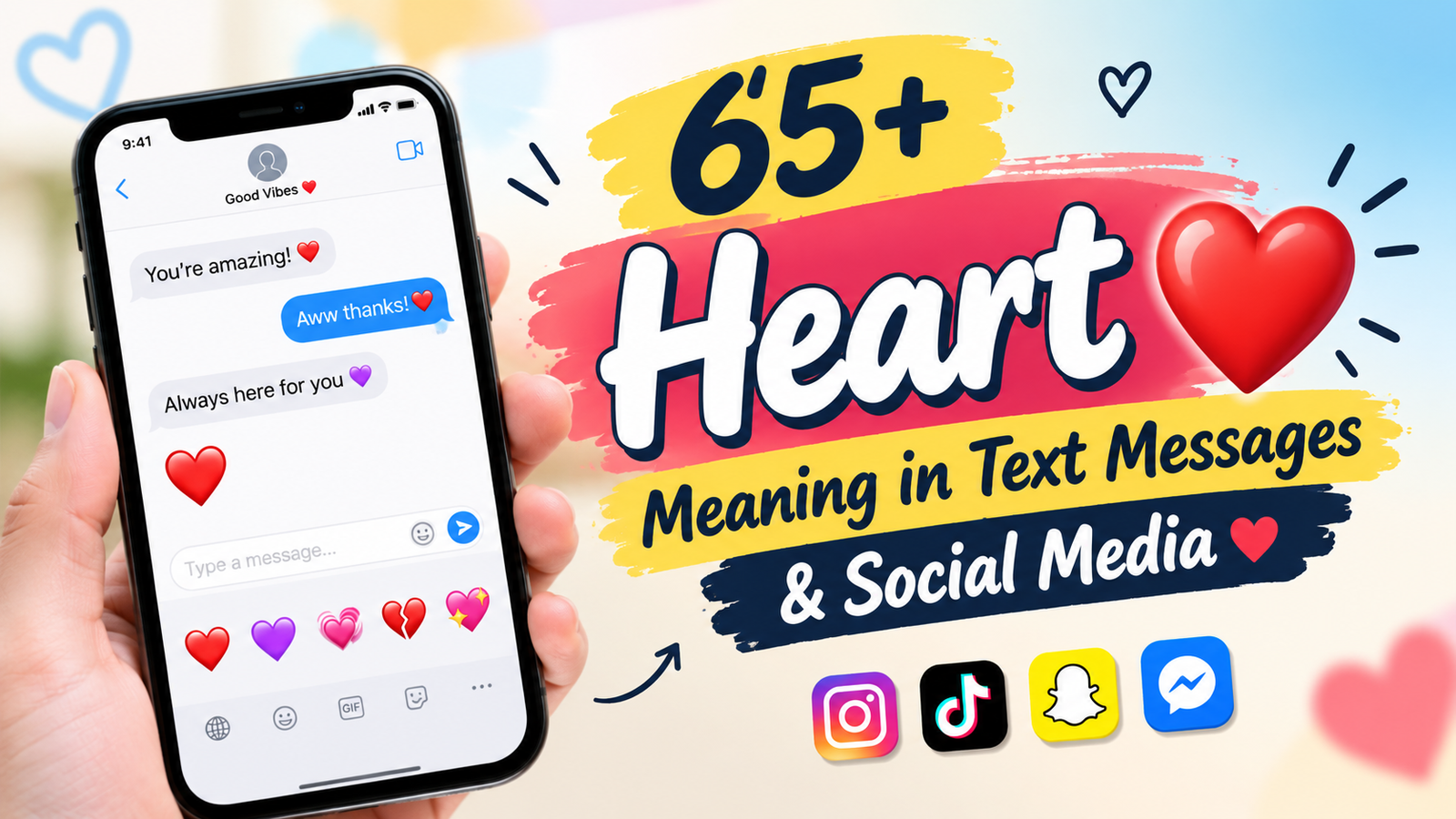
The Heart emoji Meaning in text refers to what a heart emoji (❤️) or other heart symbols communicate in text messages, chats, and social media. A heart can express love, affection, care, support, appreciation, friendship, or emotional connection, depending on the context. Different heart colors and styles can also carry slightly different meanings, making the choice of heart more significant than it may first appear.
A simple ❤️ can add warmth to a message, while 💙, 💜, 🖤, 💔, or 💕 may suggest different emotions or relationships. The meaning often depends on who sends it, the conversation, and the platform being used. Understanding these subtle differences can help you interpret messages more accurately and choose the right heart when replying.
From romantic texts to friendly conversations, heart emojis have become a common part of digital communication. This guide explores the Heart emoji Meaning in text, including popular heart colors, symbols, and their meanings across messaging apps and social media. You’ll discover how context changes interpretation and what different hearts can communicate without words.
Also Like:
WTV Meaning in Text: What It Really Means for You!
95+ IDEK Meaning in Text Messages, Snapchat & TikTok
277+ Funny Purple Puns & One-Liners That Will Make You Laugh 💜😂
SYD Meaning in Text, Chat, and Social Media
40+ Ash Meaning in Text Messages, Slang & Chat
What Does Heart Mean in Text?
At its core, a heart in text is shorthand for warmth. It’s a stand-in for feelings that would otherwise take a full sentence to explain — love, appreciation, comfort, excitement, or simple friendliness.
But “heart” as a texting symbol isn’t one fixed meaning. It shifts depending on three things:
- Who sent it — a partner, a friend, a family member, or a stranger all mean different things by the same emoji.
- What it’s replying to — a heart under a compliment reads differently than a heart under bad news.
- Which heart it is — color and style change the emotional temperature of the message.
In short: a heart is less a word and more a tone of voice. It tells you how something was said, not just that it was said.
Heart Full Form in Texting
Unlike acronyms such as LOL or BRB, “heart” isn’t actually short for anything — it’s not an abbreviation, it’s a symbol used in place of the word itself. When people type “heart” or use ❤️, they’re literally substituting the emoji or the word for the idea of love, care, or affection.
That said, you’ll sometimes see it used as informal shorthand in captions or comments, like:
- “Sending you all my heart” (love, support)
- “Heart this if you agree” (like/react to this post)
- “My heart 😭” (this is emotionally overwhelming, in a good way)
So while there’s no official “H-E-A-R-T” acronym breakdown, in digital slang, heart functions as a verb, a noun, and an emoji all at once — which is part of why it’s so flexible.
Short Meaning of Heart in Online Chat
If you need the one-line version: a heart in chat generally means “I care about this” or “this made me feel something good.”
That’s it at its simplest. Everything else — romance, friendship, gratitude, grief — is just a more specific flavor of that same base idea.
The Origin of the Heart Symbol in Digital Communication
The heart shape itself predates the internet by centuries. Historians trace the familiar rounded, symmetrical heart shape back to medieval and Renaissance art and manuscripts, where it was used to represent love and devotion long before anyone knew what a smartphone was.
The digital heart’s story really begins in the 1990s and early 2000s, when instant messengers like AIM and MSN Messenger let users type combinations like <3 to form a sideways heart out of a less-than sign and a number three. That little keyboard trick became one of the earliest widely recognized pieces of internet shorthand.
The heart emoji as we know it today arrived with the broader emoji set that originated in Japan in the late 1990s, later standardized by Unicode so it could display consistently across different phones and platforms. Once Unicode added multiple heart colors, the emoji stopped being just “love” and became a small color-coded emotional vocabulary.
Why Heart Became So Popular
A few reasons the heart has outlasted almost every other symbol in texting culture:
- It’s universal. You don’t need to share a language to understand a heart.
- It’s fast. One tap says what a sentence would take longer to type.
- It’s flexible. The same symbol works for romantic partners, best friends, parents, and even brands.
- It’s low-risk. A heart is often safer to send than a fully spelled-out emotional statement, especially early in a relationship or friendship.
- It’s built into the platforms themselves. Instagram, TikTok, and iMessage all use a heart as the default “like” or reaction, so people are conditioned to tap it dozens of times a day.
That last point matters a lot. A huge share of hearts sent today aren’t a deliberate romantic gesture — they’re a reflex, the same way a “haha” reply is a reflex.
Different Heart Emoji Meanings
Not all hearts are created equal. Color changes the message. Here’s a breakdown of the most common ones.
❤️ Red Heart
The classic. Red is the color most tied to romance, passion, and strong love — but it’s also used generally for “I really love this,” whether that’s a person, a meal, or a song. It’s the most intense and most commonly misread heart, since context matters so much here.
💛 Yellow Heart
Yellow leans platonic and happy. It’s associated with friendship, warmth, and good vibes rather than romance. On Snapchat specifically, a yellow heart has an extra meaning (covered below) tied to being someone’s #1 Best Friend.
💙 Blue Heart
Blue signals trust, calm, and loyalty. It’s a popular choice for close friendships, supportive messages, or a partner in a steady, secure relationship — less “butterflies,” more “I’ve got you.”
💚 Green Heart
Green usually points to nature, growth, or good health. It’s also become shorthand for supporting a cause or team with green branding. In some cultures, green can carry a jealousy connotation, so context and audience matter.
💜 Purple Heart
Purple often reads as deep, sometimes slightly more mature or spiritual affection — admiration, compassion, or a bond that runs a bit deeper than casual. In the U.S., “Purple Heart” also refers to a military honor, which is a separate cultural meaning entirely from the emoji’s everyday texting use.
🖤 Black Heart
Black doesn’t automatically mean something negative, but it does skew darker or more dramatic. It can represent dark humor, mourning, edgy aesthetics, or simply someone’s favorite color. Sending it in a romantic context to someone unfamiliar with your humor can come across as cold, so know your audience.
🤍 White Heart
White suggests purity, sincerity, or a “clean,” non-possessive kind of love. It’s often used for pure affection, minimalism-loving accounts, or peaceful/calm sentiments.
🩷 Pink Heart
Pink is soft, sweet, and affectionate without being as intense as red. It’s popular for cute, wholesome, or crush-adjacent messages — think “I like you” energy rather than “I’m in love with you.”
| Heart Color | Common Meaning |
|---|---|
| ❤️ Red | Romantic love, passion, strong affection |
| 💛 Yellow | Friendship, happiness, platonic warmth |
| 💙 Blue | Trust, loyalty, calm support |
| 💚 Green | Nature, health, growth, jealousy (context-dependent) |
| 💜 Purple | Deep affection, admiration, compassion |
| 🖤 Black | Dark humor, mourning, edgy style |
| 🤍 White | Purity, sincerity, gentle love |
| 🩷 Pink | Sweetness, crush energy, soft affection |
Heart Meaning on WhatsApp
On WhatsApp, hearts show up two main ways: as message reactions (a quick tap-and-hold response) and as emojis typed directly into a chat.
As a reaction, a heart usually just means “I liked this” or “this made me smile” — it’s low-effort and doesn’t carry heavy romantic weight unless the conversation already has that tone. As a typed emoji within a message, it behaves more like the general heart meanings above: red for love, blue for support, and so on.
Because WhatsApp is used heavily for family groups, work chats, and casual friend threads, a heart here is often more about warmth and closeness than romance specifically.
Also Like:
Inquiring Minds Want to Know: Everything You Need to Know
Training or Trainning: Which One Is Correct?
93+ Igh Meaning in Text on Snapchat, TikTok & More
54+ GC Meaning in Text Messages, Social Media & Chat
ALR Meaning in Text, Snapchat, TikTok & Social Media
Heart Meaning on Instagram
On Instagram, the heart is baked into the platform itself — it’s literally the “like” button. That means most hearts on Instagram are extremely low-commitment: someone scrolling their feed taps hearts on dozens of posts without a second thought.
Where it gets more meaningful is in comments and DMs. A heart left in a comment on a specific photo, or sent directly in a message, usually signals something more personal than the default double-tap. A red heart on someone’s selfie in the comments, for example, reads very differently than a heart on a meme repost.
Heart Meaning on TikTok
TikTok’s heart works similarly to Instagram’s — it’s the default “like” icon, so tapping it is often just an acknowledgment that you watched and enjoyed the video, nothing deeper.
In TikTok comments, though, hearts take on more nuance. Creators sometimes “heart” specific comments to highlight them, which fans treat as a small badge of recognition. A heart from a creator on your comment can feel like genuine appreciation, while a heart between friends in the comments functions more like a casual “same” or “agreed.”
Heart Meaning on Snapchat
Snapchat is the one platform where hearts aren’t just emojis — they’re part of a built-in Friend Emoji system tied to how often you snap specific people.
Emoji Friendship System
Snapchat automatically assigns emojis next to usernames based on snapping habits:
- 💛 Yellow Heart — You and this person are each other’s #1 Best Friends (you snap each other the most).
- 💕 Pink Hearts — You’ve been each other’s #1 Best Friend for two months straight.
- ❤️ Red Heart — You’ve held that #1 Best Friend status with each other for two weeks or more, building on the pink hearts.
These aren’t hearts you send on purpose — Snapchat generates them automatically, which is exactly why they carry weight. Seeing a yellow or red heart next to someone’s name is a visible sign of how much you two actually interact, not just how you feel.
Regular Chats
Outside the automatic system, hearts typed manually into Snapchat messages behave like they do everywhere else — red for strong affection, other colors for the more specific meanings covered above.
Heart Meaning in Real Conversations
Theory is one thing — here’s how it plays out in actual texts.
Example 1
Message: “I made it home safe ❤️” Meaning: A simple, affectionate sign-off. This isn’t a grand romantic statement — it’s warmth and reassurance, often used with partners or close family.
Example 2
Message: “Thanks for helping me move 💛” Meaning: Genuine, platonic gratitude. The yellow heart keeps it firmly in friend-zone warmth rather than romantic territory.
Example 3
Message: “Miss you already 🖤” Meaning: Depending on the relationship, this could be a moody, artsy way of expressing longing — common among people who use black as an aesthetic choice rather than a sad one.
Example 4
Message: “lol yeah ❤️” Meaning: Often just a reflexive, low-stakes reaction — closer to “haha, agreed” than any deep declaration. Tone here comes from the rest of the message, not the heart itself.
Heart Meaning vs. WYLL
These two get grouped together sometimes because both show up constantly in casual chats, but they mean completely different things.
- Heart is an emotional symbol — it expresses affection, appreciation, or warmth.
- WYLL stands for “What You Look Like” (short for “what do you look like?”) and is a direct question, usually asking for a photo or physical description, common on Snapchat and in conversations with someone you haven’t met in person.
In short: a heart tells someone how you feel. WYLL is asking someone a question about their appearance. If you get a WYLL, it has nothing to do with hearts — it’s a request, and you’re free to answer, deflect, or ignore it depending on your comfort level.
Common Misunderstandings About Heart Emojis
Assuming Every Heart Is Romantic
This is the biggest one. Most hearts sent day-to-day are casual — reactions to posts, sign-offs between friends, or quick “thanks!” replies. Reading romance into every heart leads to a lot of unnecessary confusion.
Ignoring Heart Color
Color carries real signal. Someone consistently sending you blue or yellow hearts is likely communicating friendship, not romance — swapping that for a red heart is often a deliberate shift.
Overthinking Every Heart
On the flip side, treating every single heart like a coded message to decode is exhausting and usually wrong. Sometimes a heart really is just a heart — a habit, a sign-off, a reflex.
What Heart Does NOT Mean
To clear up a few myths:
- A heart does not always mean romantic interest.
- A heart does not guarantee exclusivity or commitment.
- A heart is not the same as a verbal “I love you” — it’s softer and far more casual by default.
- A lack of a heart does not automatically mean someone is upset or uninterested — some people just don’t use emojis much.
- A black heart does not always mean sadness — for many people, it’s simply an aesthetic preference.
Similar Slang Terms and Related Abbreviations
A few other terms that often show up alongside hearts in casual texting:
- HRU — How are you
- WYD — What you doing
- HBU — How about you
- LMK — Let me know
- IRL — In real life
- RN — Right now
- TBH — To be honest
- HMU — Hit me up
- BRB — Be right back
- WYLL — What you look like
Knowing these makes fast, casual chats much easier to follow at a glance.
How to Reply When Someone Sends a Heart
How you respond depends on the relationship and what tone you want to set.
Polite Replies
- “Thank you! ❤️”
- “That’s so sweet of you.”
- “Appreciate you 🙂”
Friendly Replies
- “Love you too, friend 💛”
- “You’re the best.”
- “Right back at you 💙”
Flirty Replies
- “You’re making me blush ❤️”
- “Careful, I might send one back.”
- “😊❤️”
Boundary-Respecting Replies
- “That’s kind of you, but I want to keep things friendly.”
- A simple “🙂” without a matching heart, to keep tone neutral.
- No reply at all — perfectly acceptable if a heart feels like too much and you’re not sure how to respond yet.
There’s no rule that says you have to match energy. It’s completely fine to reply warmly without sending a heart back if that’s not where you’re at.
Is Heart Still Popular?
Yes — arguably more than ever. Emoji usage overall has continued climbing as messaging apps and social platforms build reactions directly into their interfaces, and the heart remains the single most recognizable and most-used emoji across most major platforms. Its role has shifted, though: a huge share of hearts today function as quick reactions (likes, taps, acknowledgments) rather than deliberate romantic statements, which is exactly why understanding context matters more than ever.
Heart in Gen-Z Slang Culture
Among younger users, hearts have picked up some extra layered meanings:
- Sending a specific heart color has become a small language of its own within friend groups — some groups assign inside-joke meanings to certain colors.
- Hearts are often used ironically or humorously, paired with sarcastic captions, rather than sincerely.
- A string of the same heart repeated (❤️❤️❤️) usually signals extra emphasis or excitement, not literal multiplication of feelings.
- Black and white hearts are popular in aesthetic-driven captions (moody edits, minimalist posts) more than as emotional statements.
- Combining hearts with other emojis (😭❤️, 🥹💛) has become a common way to express being “emotionally overwhelmed” in a good way.
Tips for Using Heart Emojis Correctly
- Match the relationship. Save red hearts for people you’re genuinely close to or romantically involved with.
- Pair with words when clarity matters. A heart plus a short sentence removes ambiguity fast.
- Consider your platform. A heart in a professional Slack or work email reads very differently than one in a personal text.
- Watch frequency. Sending hearts constantly can dilute their meaning; using them selectively keeps them meaningful.
- When in doubt, ask. If someone’s heart usage genuinely confuses you, it’s okay to just ask what they meant — better than guessing.
Heart Meaning in Text Messages & Social Media ❤️ From a Boy
When a guy sends a heart, meaning still depends heavily on context, but a few patterns show up often. A red heart from a guy who doesn’t usually use emojis can be a bigger signal than the same heart from someone who sends them constantly. Guys who are more reserved with affection in general may treat a heart as a meaningful gesture rather than a casual one — so tone, frequency, and what came before the heart in the conversation all matter more than the symbol alone.
Heart Emoji Meaning in WhatsApp
To expand on the earlier section: WhatsApp hearts often show up at the end of everyday check-ins — “good morning ❤️,” “get home safe 💙,” “miss you 🩷.” Because WhatsApp is so widely used for close-knit groups (family, partners, longtime friends), a heart there tends to lean warmer and more sincere than a heart dropped casually in a public comment section.
Heart Emoji Meaning in Instagram
Building on the earlier point: context on Instagram comes down to where the heart appears. A heart tapped as a like is essentially invisible — everyone does it constantly. A heart typed out in a comment, especially alongside a compliment, carries noticeably more intention because it took an extra deliberate step beyond the default double-tap.
❤️ Meaning From a Girl to a Guy
A red heart from a girl to a guy typically signals warmth, affection, or romantic interest, but — as with any heart — the surrounding conversation tells the real story. A heart after a compliment or a sweet message usually leans romantic. A heart as a quick reaction to a funny text is far more casual. If it’s a new or ambiguous relationship, the safest read is to notice the pattern over multiple messages rather than judging one heart in isolation.
Sparkling Heart Emoji Meaning
The sparkling heart (💖) adds an extra layer of excitement and glamour to a message. It’s commonly used for celebratory moments — engagements, exciting news, weddings, or simply telling someone they mean a lot in an upbeat, glowing way. Think of it as a heart with extra enthusiasm attached.
Red Heart Emoji Meaning in WhatsApp
A red heart in WhatsApp specifically often shows up in close relationships — partners, family members, or best friends — as a quick way to close out a message with warmth. Because WhatsApp skews toward more personal, ongoing conversations rather than public posts, a red heart there is usually sincere rather than performative.
Red Heart Emoji Meaning From a Guy to a Girl
Similar to the reverse scenario above, a red heart from a guy to a girl generally points toward romantic affection, especially if it’s paired with warm language. However, some guys use red hearts more loosely, as a general “I appreciate you” gesture toward friends or family too — so the relationship context and how often he sends hearts to other people matters for an accurate read.
❤️ Meaning of This Emoji Overall
Zooming out, the classic red heart emoji represents love, romance, deep affection, and strong positive emotion. It’s the most universally recognized heart and, depending on context, can express anything from casual appreciation to a genuine declaration of love — which is exactly why paying attention to the full conversation matters more than the emoji alone.
FAQs
What does heart mean in text?
It’s a symbol used to express affection, appreciation, warmth, or love. The exact meaning depends on the relationship, the color used, and the context of the conversation.
Is a heart emoji always romantic?
No. Most hearts sent day-to-day are casual — likes, friendly sign-offs, or quick reactions. Only context, tone, and the relationship between sender and recipient can confirm romantic intent.
Does every heart color have a different meaning?
Generally yes. Red leans romantic, yellow and blue lean platonic and trusting, purple leans deep or admiring, black leans edgy or dark humor, white leans pure and sincere, and pink leans soft and sweet.
What does a red heart mean in texting?
Red is the most intense heart color, most commonly associated with romantic love and passion, though it’s also used broadly for anything someone loves — a song, a meal, a moment.
How should I reply to a heart emoji?
Match the tone you’re comfortable with. A friendly reply, a matching heart, or even a simple “thank you” all work — there’s no obligation to respond with an identical or bigger gesture.
Is the heart emoji still popular in 2026?
Yes. It remains one of the most-used emojis across messaging apps and social platforms, largely because it doubles as the default “like” reaction on major platforms like Instagram and TikTok.
Conclusion
The heart has stuck around in digital communication because it does something words alone often can’t: it delivers an emotional tone instantly, without needing a full sentence to explain it. But that same simplicity is exactly why it’s so easy to misread.
The real key isn’t memorizing a strict rulebook — it’s paying attention to color, platform, relationship, and the message it’s attached to. Read those together, and a heart stops being a mystery and starts being exactly what it was meant to be: a small, fast way of saying something warm.

Olivia Povey is a humor writer at Punscrazy, creating fun puns, jokes, witty captions, and clever wordplay to bring more laughter to everyday life.







1 thought on “65+ Heart Meaning in Text Messages & Social Media ❤️”